Stop Talking, Start Connecting: The Guide to Impactful Communication.
Golden Hook & Introduction
SECTION
Nova: What if I told you that the advice "just be yourself" is actually terrible communication advice when the stakes are high? That sometimes, being authentic can derail everything important?
Atlas: Oh boy, that's a bold statement, Nova. Because I think for so many of us, that's the default. We're told to just "be ourselves," "speak our truth." Are you saying that's wrong?
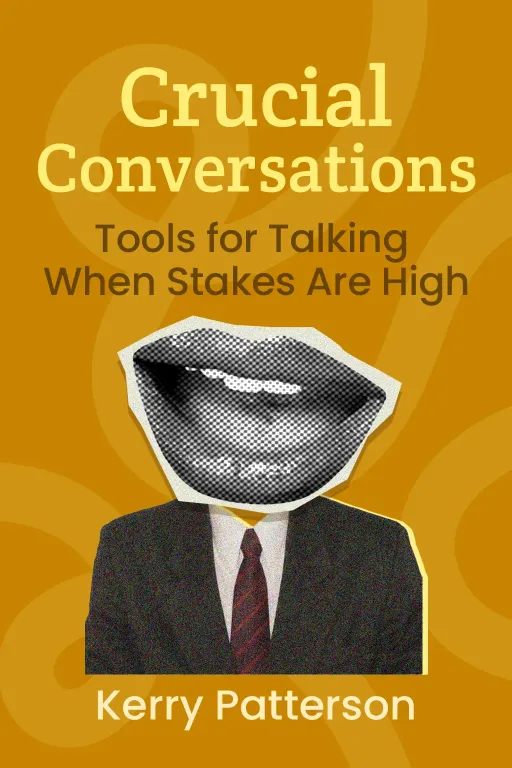
Nova: Not wrong, Atlas, but incomplete. Especially when we're talking about impactful communication, where great ideas often die in translation. Today, we're diving into how to truly connect, not just talk, drawing insights from two phenomenal books. First, "Crucial Conversations" by Kerry Patterson, Joseph Grenny, Ron McMillan, and Al Switzler. What's fascinating about that book is that it wasn't just one person's theory; it was a collaborative effort by four social scientists who spent decades studying what the most effective communicators when things get tough.
Atlas: That's compelling. And then Brené Brown, with her rigorous qualitative research, hundreds of interviews, she brings a whole different, yet complementary, lens to how we connect, right?
Nova: Exactly. And her work on "Dare to Lead" is a masterclass in how vulnerability and courage aren't weaknesses, but the very bedrock of authentic connection.
Atlas: Okay, so we're talking about serious communication strategies here. I can see how that would appeal to anyone trying to build something significant, or lead a team. But it sounds like it might be easier said than done. Let's dig into these tools.
The Art of Crucial Conversations: From Conflict to Connection
SECTION
Nova: Absolutely. Let's start with "Crucial Conversations." The core idea is that there are specific moments in life—crucial conversations—where stakes are high, opinions differ, and emotions run strong. And these are the moments that often define our careers, our relationships, and our impact. The book argues that in these moments, most people either clam up or blow up. They either avoid the conflict entirely, or they engage in a way that creates more damage than good.
Atlas: That sounds rough, but it's so relatable. I imagine a lot of our listeners, especially those in strategic roles, have been in those meetings where you can feel the tension, and people are either biting their tongue or just steamrolling. What's the hidden trap there?
Nova: The hidden trap is what the authors call the "Fool's Choice." It's the belief that you have to choose between either speaking your mind and getting what you want, or preserving the relationship. But it's a false dilemma. The book teaches you how to do both. How to speak your truth maintain respect and connection.
Atlas: So basically you’re saying it's not about avoiding conflict, it's about creating a safe space for? How do you even begin to do that when emotions are running high? Because that's when our prefrontal cortex often goes offline.
Nova: That's where the framework comes in. One of the first steps is "Start with Heart." Before you even open your mouth, you clarify what you want. Not just what you want the other person, but what you want for yourself, for them, and for the relationship. For instance, imagine a tech team racing against a critical launch deadline, and there's a fundamental disagreement about a key feature. One engineer, Alex, thinks it's buggy and needs more time, but the project lead, Sarah, is pushing to ship. Alex is frustrated, feels unheard, and is starting to disengage.
Atlas: Oh, I know that feeling. That’s a classic scenario. Alex either stays silent, risking a flawed product, or blows up, risking their relationship with Sarah and the team.
Nova: Exactly. If Alex "Starts with Heart," they might realize their true goal isn't just to "be right" or "delay the launch," but to ensure a high-quality product maintain a collaborative, trusting relationship with Sarah and the team. With that clarity, Alex can then focus on the next step: "Make it Safe." This involves establishing mutual purpose and mutual respect. Alex could approach Sarah saying, "Sarah, I know we both want this launch to be a massive success, and I have some concerns I want to share about. Can we talk about it?"
Atlas: Okay, so it's about framing the conversation around a shared goal, rather than a personal attack or a demand. That makes sense. But what if Sarah is already defensive? What if she just hears "delay"?
Nova: That's where the crucial skill of "CRIB" comes in: ommit to find a mutual purpose, ecognize the purpose behind the strategy, nvent a mutual purpose, and rainstorm new strategies. Alex might say, "My concern isn't to derail this, it's to ensure we don't have a major bug post-launch that damages our reputation. What's your biggest priority with this deadline?" By focusing on a mutual purpose—a successful, reputable launch—they can then open up a dialogue. The goal isn't necessarily to agree, but to create a "Shared Pool of Meaning," where everyone's ideas, feelings, and experiences are openly discussed.
Atlas: I imagine a lot of our listeners, especially those building businesses or leading initiatives, might feel like they don't have time for this 'soft skills' stuff when there's a fire to put out. How does this translate to measurable impact?
Nova: It translates directly to impact by preventing costly errors, improving team morale, and accelerating decision-making. Think about the alternative: a buggy launch, a demotivated team, or a project that grinds to a halt due to unresolved conflict. The time invested in a crucial conversation saves exponentially more time and resources down the line. It transforms potential conflict into collaborative progress, making your insights truly actionable.
Vulnerability as Strength: Daring to Lead with Authentic Communication
SECTION
Nova: That idea of making it safe and starting with heart flows beautifully into our second big idea, which Brené Brown masterfully explores in "Dare to Lead": the profound power of vulnerability. Brown argues that true courage in leadership isn't about being fearless, but about showing up fully, even when it's uncomfortable.
Atlas: Hold on, vulnerability? In a leadership position? For many, that sounds like a recipe for being taken advantage of, or losing credibility. Especially for someone trying to build for the future, isn't that counterintuitive? It goes against every instinct to project strength and control.
Nova: That's the common misconception! Brown's extensive research, interviewing hundreds of leaders across industries, reveals the opposite. She found that vulnerability, when appropriately applied, actually trust, not diminishes it. It's not about oversharing every personal detail, but about having the courage to show up, to be seen, to ask for help, to admit when you don't have all the answers, or to take a risk.
Atlas: So it's not about crying in front of your team, it's about, what, admitting you don't have all the answers? How does that move the needle on connecting?
Nova: Imagine a leader, Mark, who just inherited a struggling department. The team is demoralized, productivity is low, and there's a lot of finger-pointing. Mark could come in with a rigid new plan, demanding compliance. But instead, he calls a team meeting and says, "Look, I don't have all the answers for how we're going to turn this around. What I do know is that we're all incredibly talented, and I believe in us. But I need your honest input, your ideas, and your commitment to figure this out together. I'm feeling the pressure, and I know you are too, but I'm willing to be vulnerable and say, I need your help."
Atlas: Wow. That's a different kind of strength. It immediately shifts the dynamic from "leader dictates, team obeys" to "we're in this together."
Nova: Exactly. That act of vulnerability—admitting he doesn't have all the answers and asking for help—doesn't make Mark look weak. It makes him look human, authentic, and trustworthy. It creates a space for his team to also be vulnerable, to share their real concerns and ideas without fear. Brown calls the opposite "Vulnerability Armor" – all the ways we protect ourselves from discomfort, from criticism, from failure. But in doing so, we also protect ourselves from connection, innovation, and truly daring leadership.
Atlas: That makes me wonder, how much of our communication failures come from us trying to be 'perfect' rather than simply 'present'? Because if you're constantly trying to project an image of knowing everything, you're not truly connecting.
Nova: Precisely. And that ties back to the "Tiny Step" from our main content: before your next important conversation, identify one specific goal beyond just 'getting your point across.' Focus on mutual understanding. That requires a certain level of vulnerability to truly listen, to be open to influence, and to admit that your perspective might not be the complete picture. It's about being brave enough to connect on a deeper level.
Synthesis & Takeaways
SECTION
Nova: So, bringing these two powerful ideas together, "Crucial Conversations" gives us the tactical framework for navigating those tough, high-stakes discussions with grace and effectiveness. It provides the tools to speak and listen for understanding.
Atlas: And "Dare to Lead" provides the emotional courage, the mindset shift, to actually those conversations authentically, by understanding that vulnerability isn't a weakness, but a superpower for building trust and genuine connection. It's about showing up fully.
Nova: Absolutely. Ultimately, connecting isn't about winning an argument; it's about expanding the 'we.' It's about building a collective understanding that's stronger and wiser than any individual perspective. It's about transforming potential conflict into collaborative progress.
Atlas: So, before your next important conversation, identify one specific goal beyond just 'getting your point across.' Focus on mutual understanding. That requires both the tactical skill and the courage to be open. Imagine the impact we could all make if every conversation started with that intention. What kind of world would that create?
Nova: A far more connected and productive one, I think. This is Aibrary. Congratulations on your growth!