The Architecture of Tomorrows Workplaces
Golden Hook & Introduction
SECTION
Nova: The most expensive piece of office furniture in your building isn't the ergonomic chair or the fancy espresso machine in the breakroom. It is the organizational chart.
Atlas: That is a bold claim. Most people would argue the org chart is the only thing keeping the company from descending into total anarchy by Tuesday morning.
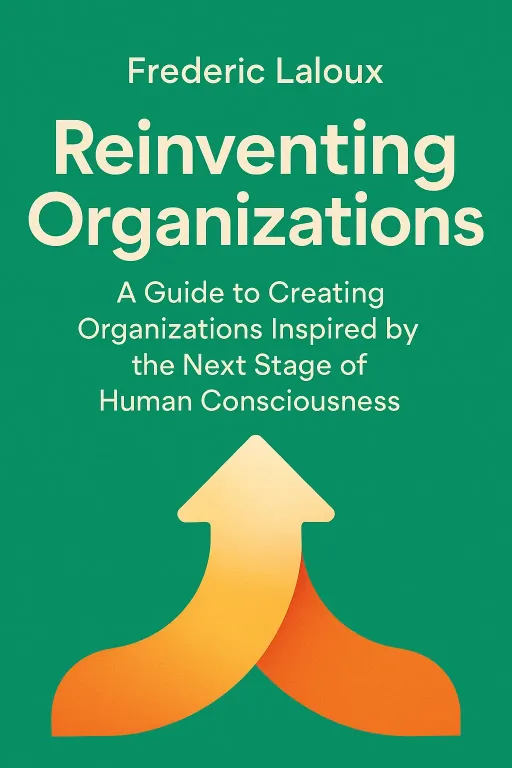
Nova: That is exactly the myth we need to dismantle today. We are looking at the architecture of tomorrow’s workplaces. We are diving into the groundbreaking ideas found in Frederic Laloux’s Reinventing Organizations and the collaborative strategies outlined in Competing in the New World of Work by Keith Ferrazzi, Kian Gohar, and Noel Weyrich.
Atlas: Right. I have seen these terms tossed around in LinkedIn articles. Teal organizations, co-elevation, self-management. It sounds like the kind of management theory that works perfectly on a whiteboard and falls apart the moment a real crisis hits.
Nova: That is the skepticism I was hoping for. Laloux, a former McKinsey consultant, spent years studying organizations that operate differently. He looked at companies that successfully ditched the command-and-control model. And Ferrazzi, who is well-known for his focus on networking and leadership, argues that the old way of working—where you just cooperate to get through the day—is insufficient for the speed of the modern world.
Atlas: So, we are talking about two different but potentially overlapping approaches to fixing the modern workplace. One is about how we structure the company, and the other is about how we actually behave with each other inside that structure.
Nova: Precisely. And for our listeners who are short on time but high on ambition, the goal here is to strip away the jargon and see what actually moves the needle on productivity and burnout. We are not here to talk about utopian dreams. We are here to talk about how to get work done without losing your mind in the process.
The Shift to Self-Management
SECTION
Atlas: Let us start with the big one, then. Self-management. Every time I hear that, I think of a startup where nobody knows who is in charge, and decision-making takes three weeks because everyone has to weigh in. How does Laloux argue that this actually increases efficiency?
Nova: It is a common misunderstanding. People equate self-management with a lack of leadership. But in the Teal model Laloux describes, it is actually about the distribution of authority. Think of it less like a chaotic startup and more like a high-functioning jazz ensemble or a flock of birds. There is no lead bird telling the others how to flap their wings, yet the flock moves with incredible precision.
Atlas: I like the bird analogy, but birds have a genetic instinct for that. Humans have a genetic instinct to hoard power or slack off when no one is watching. How do you replace that oversight without the whole thing collapsing?
Nova: That is the crucial insight. You replace oversight with transparency and clear purpose. In these organizations, information isn't hoarded at the top. It is shared. Everyone knows the company's financial health, its goals, and its challenges. When you have the same information as the CEO, you don't need the CEO to tell you what to do. You can see what needs to be done.
Atlas: Okay, so transparency is the fuel, and purpose is the steering wheel. But what about the friction? In my experience, the biggest bottleneck isn't a lack of transparency. It is the fact that three different departments have three different ideas about what the goal is.
Nova: That is where the second part of the equation comes in. Laloux talks about wholeness and evolutionary purpose. When you bring your whole self to work—meaning you aren't hiding your ideas or your concerns because you are afraid of the hierarchy—you start to see the friction not as a failure, but as data. You fix the process because you are personally invested in the outcome.
Atlas: I can see that working for the top 10 percent of high performers. But what about the rest of the team? Does this model assume that everyone is a self-starter? Because if I am being honest, some people just want to show up, do their tasks, and go home.
Nova: That is a fair critique. And honestly, these models don't work for everyone. They require a shift in mindset. But the data Laloux presents suggests that when you give people autonomy, innovation doesn't just happen; it accelerates. Burnout drops because people aren't feeling trapped by arbitrary rules or micromanagement. They feel a sense of agency.
Atlas: So the trade-off is higher cognitive load for the individual in exchange for higher engagement.
Nova: Exactly. It is a shift from being a cog in a machine to being an owner of a process. And that leads us directly to the second piece of our puzzle. Because autonomy is great, but if you are autonomous and I am autonomous, and we aren't talking to each other, we are just two people working in silos.
The Mechanics of Co-Elevation
SECTION
Atlas: Which brings us to Ferrazzi’s concept of co-elevation. I have heard this term, but it sounds like one of those corporate buzzwords that means "work harder together." How is it different from just being a good teammate?
Nova: It is the difference between cooperation and co-elevation. Cooperation is, "I will do my part, and you do yours, and we will meet at the finish line." It is transactional. Co-elevation, as Ferrazzi defines it, is a commitment to mission success that transcends individual tasks. It means I am as responsible for your success as I am for my own.
Atlas: That sounds exhausting. I have enough trouble managing my own to-do list. Now you are telling me I need to manage my teammate's success, too?
Nova: It is not about doing their work. It is about accountability. In a traditional team, if you see a teammate struggling or cutting corners, you might stay quiet to avoid conflict. In a co-elevation model, you have a duty to push them. And they have a duty to push you. It is a mutual commitment to excellence that makes it safe to challenge each other.
Atlas: That feels like a massive cultural hurdle. Most offices are built on a foundation of "don't rock the boat." If I start pushing my colleagues to be better, they might perceive it as me overstepping or being critical. How do you make that safe?
Nova: You have to establish that it is not personal; it is mission-driven. Ferrazzi talks about having these candid conversations where you frame the feedback around the goal. Instead of saying, "You are doing this wrong," you say, "How can we refine this process so we hit our target faster?" It is about being on the same side of the table, looking at the problem, rather than looking at each other.
Atlas: That makes sense. It is the difference between "You are failing" and "We are struggling." But let's get practical for a second. My listeners are busy. They are dealing with back-to-back meetings. They have inbox zero goals. How does this apply to someone who is just trying to survive the week?
Nova: That is the beauty of the "Tiny Step" approach. You don't need to overhaul your company culture overnight. You can start with something as small as an administrative bottleneck.
Atlas: I like the sound of that. What does that look like in practice?
Nova: In your next team meeting, instead of just running through the status updates, pose a question. Ask your teammates: "What is one administrative bottleneck we can collectively decide to eliminate to work more autonomously?"
Atlas: Just one?
Nova: Just one. It could be a recurring report that nobody reads, a redundant approval process, or a meeting that could be an email chain. When you collectively decide to kill a bottleneck, you are doing two things. First, you are engaging in self-management by taking control of your own process. Second, you are practicing co-elevation by agreeing to solve a systemic problem together.
Atlas: I am actually thinking about a process in my own workflow right now. Every Friday, we spend an hour filling out a spreadsheet that gets emailed to a manager who I know for a fact never opens it. It is the definition of a bottleneck.
Nova: And there is your starting point. Imagine if you and your team agreed to stop doing that. You save an hour. You gain back energy. And more importantly, you have just exercised the muscle of autonomy. You decided that your time was more valuable than the bureaucratic tradition.
Atlas: That is a great example. It feels actionable, and it is low risk. If we stop doing it and the manager asks, we can explain why. But wait, what if the manager gets annoyed? Is that where the co-elevation comes in? Do we need to show them the value we created with that saved hour?
Nova: Exactly. You don't just stop doing it and go silent. You replace the low-value work with high-value output. You tell your manager, "We stopped that report because it wasn't providing value, and instead, we used that hour to focus on this project, which resulted in X." That is how you prove that the new way of working is superior.
Synthesis & Takeaways
SECTION
Atlas: So, if I am synthesizing this, the shift to a better workplace isn't about waiting for leadership to change the org chart. It is about two things. First, identifying where you can exert autonomy to remove friction. And second, finding a partner or a team to co-elevate with, so you aren't just improving your own workflow, but the collective output of the group.
Nova: That is the core of it. We often talk about work as something that happens to us. We are victims of bad meetings, slow processes, and outdated hierarchies. But Laloux and Ferrazzi are telling us that we have more power than we think.
Atlas: It is empowering, but it also puts the responsibility back on us. You can't blame the system if you are not willing to try and change the small parts of it that you control.
Nova: And that is the growth mindset. It is not about making the whole company Teal overnight. It is about finding the 15 minutes in your day, the one process in your week, or the one colleague you can push to be better. Those small changes compound.
Atlas: I think that is the most pragmatic takeaway we have had in a while. Don't try to reinvent the organization. Reinvent the way you operate within it, one bottleneck at a time.
Nova: And remember, these models are not just theories found in books. They are observations of what happens when humans decide to treat work as a collaborative, evolutionary process rather than a static, top-down instruction manual.
Atlas: I am definitely going to try that question in my next meeting. "What is one administrative bottleneck we can eliminate?" It sounds like a great way to test the temperature of the room.
Nova: Let us know how it goes. The beauty of this approach is that it is self-correcting. If the team isn't ready for it, you will know immediately. If they are, you will see the energy in the room shift instantly.
Atlas: This has been really illuminating. It takes the abstract concept of "workplace culture" and makes it something you can actually touch and change.
Nova: That is exactly what we aim for. Intellectual inspiration is great, but intellectual inspiration that you can apply on a Tuesday morning? That is how you actually build a better tomorrow, one small decision at a time.
Atlas: And that is a wrap on today's deep dive. Thank you for walking us through those frameworks, Nova.
Nova: My pleasure, Atlas. And to our listeners, don't just read about these ideas. Test them. The architecture of your workplace is built by your actions, not just your job description.
Atlas: This is Aibrary. Congratulations on your growth!