Agile Leadership & Evolving Work
Golden Hook & Introduction
SECTION
Nova: What if the very idea of a "stable job" or a "stable company structure" is not just outdated, but actively harmful in today's rapidly evolving world?
Atlas: Whoa, harmful? That's a bold claim, Nova. For anyone who's spent their career building stability, that sounds almost… heretical. How can stability, which we've always been told to strive for, be a bad thing?
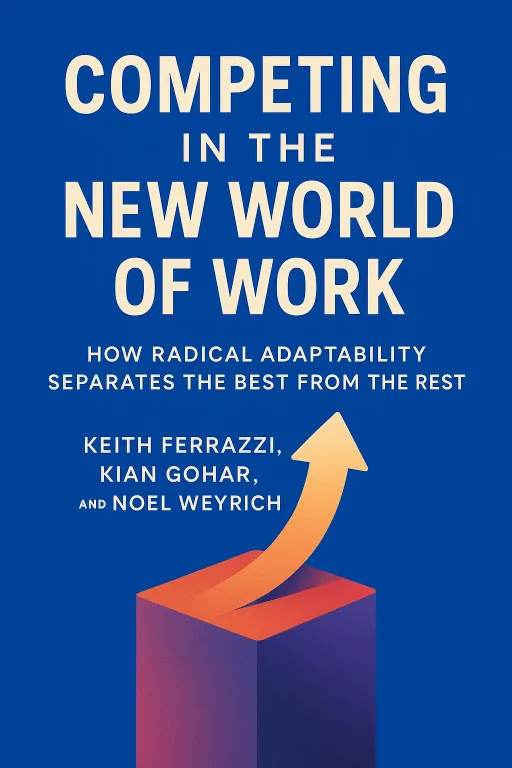
Nova: Because the world isn't stable anymore, Atlas. And clinging to old models of work means you're not just falling behind, you're actively resisting the very forces that could propel you forward. Today, we're diving into how some brilliant minds are helping us navigate this. We're talking about the blueprints laid out in books like by Keith Ferrazzi, Kian Gohar, and Noel Weyrich, by Sebastian Klein and Ben Hughes, and Aaron Dignan's.
Atlas: Ferrazzi, now there's a name that resonates. I remember his earlier work on networking,, which really shifted how many people thought about professional relationships. It sounds like he's taken that collaborative spirit and scaled it up to entire organizations.
Nova: Exactly! He, Gohar, and Weyrich build on that foundation, pushing for something called 'co-elevation' in a world fundamentally reshaped by recent global events. And Aaron Dignan, a consultant who’s spent years redesigning organizations, really dissects why our old bureaucratic structures are failing us. These authors aren't just critiquing; they're offering practical, actionable frameworks.
Atlas: Practical is good. For a strategic leader trying to empower their teams and anticipate future market dynamics, the idea of completely overhauling how work gets done can feel daunting, almost impossible. It's like being asked to rebuild the ship while sailing it through a storm. So, where do we even begin to untangle this?
From Bureaucracy to Radical Adaptability: The New Operating System for Work
SECTION
Nova: We begin by acknowledging that our current operating systems for work are often relics, designed for an industrial age, not the digital one. Aaron Dignan, in, makes a compelling case that most organizations are running on an outdated 'OS' – a set of default beliefs, structures, and practices that actively inhibit creativity and productivity. Imagine trying to run a cutting-edge AI program on a computer from the 1980s. It just won't work.
Atlas: That's a great analogy. It’s not just about upgrading the software, it’s about replacing the entire machine. But for many leaders, especially in established companies, that sounds like a massive, risky undertaking. Isn't 'agility' just another buzzword that ends up in an endless series of workshops but never fundamentally changes anything?
Nova: It can be, if approached superficially. But Klein and Hughes, with, offer a rigorous framework for established companies to truly embrace agility and continuous learning. They don't just say "be agile"; they provide a step-by-step method for integrating continuous feedback loops, rapid experimentation, and adaptation into the very DNA of an organization. Think of it like a self-tuning engine. Instead of a mechanic coming in once a year, the engine is constantly monitoring its performance and making micro-adjustments.
Atlas: So it's about building a system that learns and corrects itself, rather than waiting for a crisis to force a huge, painful overhaul. That’s appealing for someone who values strategic foresight. But what does that look like in practice? Can you give an example of a company that actually pulled this off?
Nova: Absolutely. Consider a large, traditional financial institution that was struggling with slow product development and customer feedback cycles. They adopted a 'loop' mindset, starting with small, cross-functional teams that owned specific customer journeys. Instead of six-month development cycles, they moved to two-week sprints. They instituted daily stand-ups, weekly retrospectives, and monthly "learning loops" where they'd analyze what worked and what didn't, not just for the product, but for their of working.
Atlas: So they were iterating on their work, and iterating on they work, simultaneously.
Nova: Exactly. The key was empowering these small teams with autonomy and giving them direct access to customer feedback, cutting out layers of bureaucracy. The result wasn't just faster product launches, but a dramatic increase in employee engagement and a significant reduction in project failure rates. They literally redesigned their operating system to be more responsive, more intelligent.
Atlas: That’s a powerful illustration. It sounds like the biggest roadblock isn't necessarily the technical implementation, but the mindset shift required from leadership to trust these smaller, autonomous units. It's moving from command-and-control to trust-and-empower.
The Power of Co-elevation & Belonging: Unlocking Human Potential
SECTION
Nova: And that naturally leads us to the second key idea: the profound human element that underpins all this adaptability. It’s not just about processes; it's about people. Ferrazzi, Gohar, and Weyrich introduce the concept of "co-elevation" – a radical form of collaboration where individuals are deeply committed to each other's success, not just their own. It's about nurturing a culture of true belonging.
Atlas: Co-elevation. I like that. It immediately brings to mind climbing a mountain together, where everyone's success is intertwined. But for a visionary leader focused on tangible results and technological integration, how do you prevent this from becoming just "fluffy" HR talk? How do you quantify belonging?
Nova: That’s a fair challenge. The authors would argue that you don't necessarily quantify "belonging" directly, but you measure its. When people feel a deep sense of belonging and psychological safety, they are more willing to take risks, share nascent ideas, challenge assumptions, and admit mistakes – all crucial for rapid learning and adaptation. Dignan’s also champions this, advocating for human-centered design to unlock creativity and productivity. He shows that when people feel truly valued and heard, their output skyrockets.
Atlas: So it's not just about being "nice"; it's a strategic imperative. It's about designing an environment where people feel safe enough to be innovative, to fail fast, and to learn together.
Nova: Precisely. Imagine a team facing a complex technical challenge. In a traditional, fear-based environment, people might hoard information, avoid admitting they don't know something, or shy away from proposing unconventional solutions for fear of being wrong. In a co-elevating culture, that same team would openly share incomplete ideas, ask for help, critique each other’s work constructively, and collectively iterate towards a solution. The speed and quality of their problem-solving would be dramatically higher.
Atlas: That gives me chills. I can imagine how that would empower teams for future challenges. It’s like the collective intelligence is amplified exponentially. But what if your team is already siloed, or there’s a history of distrust? How do you even begin to build that bridge towards co-elevation?
Nova: It starts with leadership modeling radical candor and vulnerability, fostering what Ferrazzi calls "radical transparency." It’s about creating rituals and structures that encourage open dialogue, peer coaching, and shared accountability. It’s not a one-time initiative; it’s a continuous practice of building trust, one interaction at a time. It’s about intentionally designing for connection, not just efficiency.
Synthesis & Takeaways
SECTION
Nova: So, what we're really seeing across these insightful books is a powerful synthesis: true organizational agility and adaptability aren't just about tweaking processes; they are fundamentally powered by human connection and psychological safety. Redesigning your team's operating system means moving from a machine metaphor to a living organism metaphor.
Atlas: That’s a profound shift in perspective. It means that the strategic leader who wants to anticipate future market dynamics and integrate technology seamlessly into their business needs to become an architect of human connection first. They need to build systems that allow people to thrive, adapt, and co-elevate.
Nova: Exactly. It's about recognizing that the most powerful engine for innovation and resilience isn't a new piece of software, but a deeply connected, continuously learning, and radically adaptable human team. The future of work isn't just about what we do, but how we are with each other as we do it.
Atlas: For leaders who feel time-scarce, who are driven by impact, and who want to start building this future, what's one concrete thing they can do to begin redesigning their "operating system" for the future?
Nova: Start small, build momentum. Begin with a "radical candor" exercise within your immediate team. Encourage everyone, including yourself, to share one thing they appreciate about a colleague's work, and one suggestion for improvement, all delivered with genuine care. This creates a tiny, safe loop of feedback and co-elevation, beginning to chip away at old habits and build new muscle memory for open, honest interaction. It’s a small block, but it can build an empire of trust.
Atlas: That’s a tangible step towards shaping the future, not just reacting to it. It’s about building a better world of work, one honest conversation at a time.
Nova: It truly is. This is Aibrary. Congratulations on your growth!