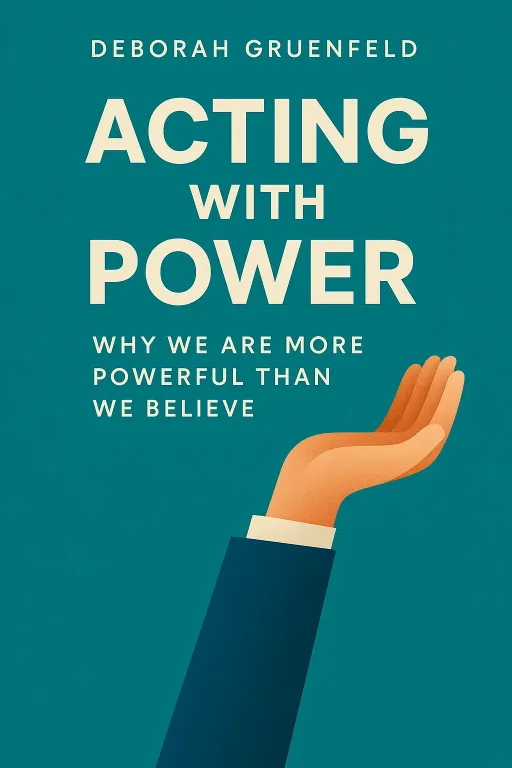
The Power Playbook: How to Act with Confidence on Life's Stage
Golden Hook & Introduction
SECTION
Shakespeare: Ash, have you ever walked into a room—a classroom, a job interview, maybe even a party—and felt like a complete imposter? Like you're just the part and at any moment someone will find you out?
Ash!: All the time. It's that classic feeling, right? Especially as a student, you're constantly stepping into new situations where you feel like you're in over your head. You just hope no one notices.
Shakespeare: What if I told you that's not a weakness, but your greatest strength? That the secret to real power isn't about powerful, but about with power.
Ash!: That's a really interesting flip. So, you're saying the 'faking it' part is actually the key?
Shakespeare: Precisely. Today, we're diving into Deborah Gruenfeld's 'Acting with Power' to turn this idea on its head. We'll explore this from two perspectives. First, we'll uncover the two hidden faces of power—playing it up and playing it down. Then, we'll challenge the myth of 'just being yourself' and discover the power of getting into character to truly own the spotlight. The book's core argument is that power isn't some magical quality you're born with. It's a role you play in someone else's story. And like any great actor, you can learn to play that role brilliantly.
Ash!: I love that. It makes power feel less like this intimidating, fixed thing and more like a skill you can develop. As someone going into tech, a field that's all about building and creating, the idea of building your own presence is really appealing.
Deep Dive into Core Topic 1: The Two Faces of Power
SECTION
Shakespeare: Let's start with this idea of 'playing power.' We often think of power as dominance, as 'playing high.' Think of a boss who interrupts, pulls rank, or takes up a lot of space. That's one face of power. But Gruenfeld shows us a second, often more potent, face of power: 'playing low.' And the perfect story for this comes, fittingly for you, from the heart of Silicon Valley.
Ash!: Okay, I'm intrigued. Silicon Valley is usually the capital of 'playing high.'
Shakespeare: Indeed. The stage is set in 2013. Sequoia Capital, one of the most powerful venture capital firms in the world—the money behind Apple, Google, you name it—had a problem. Their partners were almost all men, and they knew they needed to diversify to stay relevant. A partner named Roelof Botha sees Jess Lee, the CEO of a fashion tech company called Polyvore, give a presentation. He's blown away. She's brilliant. He knows Sequoia needs her.
Ash!: So he makes her a huge, powerful offer she can't refuse?
Shakespeare: That's what you'd expect. They tried. They approached her, but she turned them down. A couple years later, her company is sold to Yahoo, and Sequoia tries again. They visit her at her new office. But Jess Lee is loyal. She says no. She's also, as they discover, a bit of a nerd. She loves cosplay, dressing up as characters from comics and movies. She's not your typical power-broker.
Ash!: Okay, so the standard 'playing high' approach of flashing money and prestige isn't working. They have to change their strategy.
Shakespeare: Exactly. So Botha and his partners do something extraordinary. They learn that Jess Lee is a huge fan of the movie. So, for their final pitch, they don't invite her to a boardroom. They ask to meet her at a simple Peet's Coffee shop. When she arrives, two of the most powerful men in venture capital, Roelof Botha and Jim Goetz, are standing there dressed as Woody and Buzz Lightyear.
Ash!: No way. That's amazing!
Shakespeare: They hand her a 'Wanted' poster, but instead of a criminal, it features the character Jessie from, and the poster is an offer for her to join Sequoia as their first junior female investing partner in the U. S.
Ash!: Wow. That completely subverts the stereotype of a venture capital pitch. Instead of a power-suit negotiation, they used cosplay. It shows they valued her as a person, her 'weird hobbies' and all, not just as a potential asset.
Shakespeare: They played their power. As Botha said, "We wanted her to get that we were willing to adapt and relate to her as she is." By showing vulnerability, humor, and a willingness to meet her on her terms, they built trust. She said yes on the spot, because she realized she could have real relationships with these people.
Ash!: It makes me think about team dynamics in tech. The best leaders I've seen aren't always the ones who are the most commanding. They're often the ones who create psychological safety, who 'play low' by asking for help or admitting they don't have all the answers. That's what empowers everyone else to contribute their best ideas. It's like the difference between a rigid, top-down software architecture and a flexible, collaborative open-source project.
Shakespeare: A perfect analogy. And of course, there are times to play high. Gruenfeld tells the story of a professor who, when a student's phone rings in class, walks over, picks it up, and answers it on speakerphone. It's a clear assertion of authority—'I'm in charge here'—but it serves the group's goal of a focused learning environment. The art is knowing which role to play and when.
Ash!: So it's about having range. You need to be able to be both the authoritative director and the collaborative cast member, depending on what the scene requires.
Deep Dive into Core Topic 2: The Myth of 'Just Be Yourself'
SECTION
Shakespeare: And that idea of choosing your role brings us to a really tricky piece of advice we always get: 'Just be yourself.' Gruenfeld argues this can be a trap, especially when you step into a leadership role. Sometimes, you have to consciously the part.
Ash!: This is one I've struggled with. 'Be authentic' is everywhere. But what if your 'authentic' self in that moment is nervous, or unsure, or even annoyed? That's not always helpful.
Shakespeare: Exactly. Gruenfeld shares a powerful personal story about this. When she first became a boss, she had a smart, hardworking assistant. The author's natural inclination was to be friendly and hands-off. She wanted to be liked. She thought, 'I'll just be myself, the cool, easygoing boss.'
Ash!: Sounds like a dream boss. What went wrong?
Shakespeare: Well, the assistant didn't thrive. Without clear structure and direction, she grew frustrated. Her work became sloppy. She started sending passive-aggressive emails. The author's 'authentic' desire to be liked was actually making her an manager. The relationship was deteriorating.
Ash!: Ouch. I can see that. The assistant probably needed a boss, not another friend.
Shakespeare: Precisely. The breaking point came when the assistant sent a particularly disrespectful email. The author realized her 'be myself' approach had failed. So, she decided to 'get in character.' She channeled a former boss of hers, a retired Marine named Mike who ran a very tight ship. He was direct, no-nonsense, but fair.
Ash!: So she put on a performance.
Shakespeare: She did. She called the assistant into her office, pointed to the disrespectful sentence in the email, and, in a calm but firm voice she borrowed from Mike, she said, "Tell me what you meant by this." She didn't yell, she didn't get emotional. She just played the role of a boss holding an employee accountable.
Ash!: And what happened?
Shakespeare: It changed everything. The assistant was taken aback, apologized, and their working relationship improved dramatically from that day forward. The author wasn't being 'inauthentic' by being firm; she was stepping into the of a manager, which has responsibilities—like setting clear expectations and maintaining respect.
Ash!: That's a tough story, but so real. It's not about being fake. It's about choosing the part of you that is most useful for the situation. The author had that 'firm leader' character inside her; she just had to give herself permission to play it.
Shakespeare: That is the heart of it. Gruenfeld calls it acting with, not authenticity. It's about aligning your actions with the needs of the situation and the people you're responsible for. It's choosing the right mask from your collection for the right scene.
Ash!: This is huge for someone about to enter the workforce. You're not just 'Ash, the student' anymore. You're 'Ash, the software engineer,' or 'Ash, the project lead.' Each role has a script, a set of expectations. This isn't about losing yourself, it's about expanding your range as an actor on the professional stage. It's like learning a new programming language—you're still you, but you now have a new tool to build things and communicate in a new context.
Synthesis & Takeaways
SECTION
Shakespeare: So we are left with these two powerful, poetic ideas. First, that power has two faces, and true masters learn to play both high and low, to command and to connect. And second, that the path to confidence lies not in 'being yourself,' but in courageously and consciously acting the part your role demands.
Ash!: It's so empowering because it takes power out of the realm of mystery and puts it into our hands. It's a craft. It's something you can practice. The book talks about using 'The Magic If,' a concept from acting. You ask yourself, 'What would I do I were the confident leader of this project?' or 'What would I do I were the calm, respected expert in this meeting?'
Shakespeare: A spell to cast upon oneself. You live truthfully under those imaginary circumstances.
Ash!: Exactly. It's not about pretending to be someone you're not. It's about using your imagination to unlock a version of yourself that is absolutely capable, a version that's already there, waiting for its cue. So I think the question for everyone listening is: In that one situation where you feel stuck or powerless, who do you need to as to change the story?
Shakespeare: A perfect curtain call. Find your character, and take the stage.