The 18-Minute Reset: Finding Your Focus, Building Your Confidence
Golden Hook & Introduction
SECTION
Nova: Kat, have you ever had one of those days, or maybe even one of those years, where you were incredibly busy, constantly running, but at the end of it all, you look back and think, 'What did I actually accomplish? Where did the time go?'
Kat: Oh, absolutely. It's that feeling of being a human 'doing' instead of a human 'being.' You check all the boxes, but you don't feel like you've moved forward on the things that really matter to your heart.
Nova: Exactly. And what if I told you that the secret to reclaiming your life, to building real, lasting self-confidence, isn't about finding more hours in the day, but about finding more intention in just 18 minutes?
Kat: I'd be skeptical, but very intrigued. That sounds almost too good to be true.
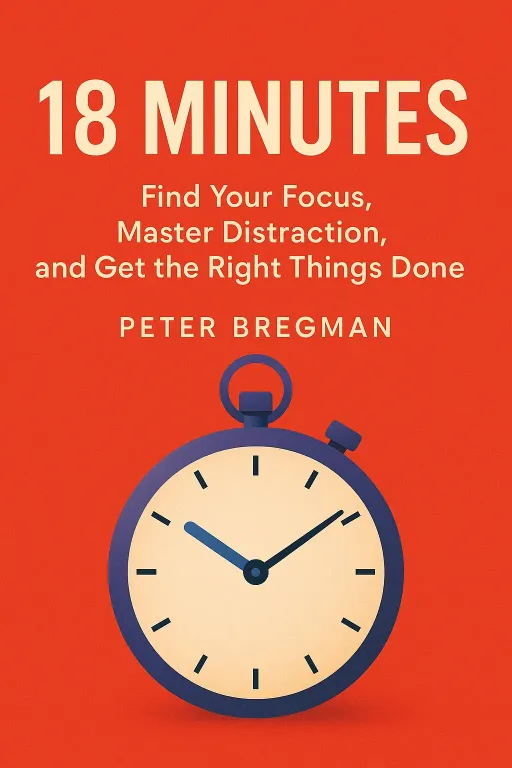
Nova: Well, that's the powerful promise of Peter Bregman's book, '18 Minutes.' And today, we're going to explore how to make that promise a reality from three angles. First, we'll explore the counterintuitive power of pausing to find your true focus. Then, we'll discuss how to design your entire year around just five key priorities. And finally, we'll break down the simple 18-minute daily ritual that brings it all together.
Kat: I'm ready. Let's dive in.
Deep Dive into Core Topic 1: Finding Your True North: The Power of the Pause
SECTION
Nova: So let's start with that first, and maybe most difficult, step: the pause. Bregman argues we're all like objects in motion, just continuing on whatever path we're on, productive or not. He uses this simple analogy of being on a stationary bike at the gym. You're pedaling fast, and when you try to just stop, the momentum keeps the pedals turning. You have to consciously slow down before you can change direction.
Kat: That's so true. We get caught in the momentum of our own lives. We're always told to 'lean in' and 'hustle.' This feels like the opposite. It's about leaning for a moment to make sure you're even on the right mountain.
Nova: You've hit it exactly. It's about getting off the bike. And Bregman shares this incredibly vulnerable story from his own life. In 1998, he started his dream company, a consulting firm. It exploded with success. He was making millions, flying around the world, living the life he thought he wanted. But he realized he was miserable. He felt disconnected from himself.
Kat: He had成功, but not fulfillment.
Nova: Precisely. And then, the dot-com bubble burst, and his business crashed. He lost almost everything. And in that forced pause, that moment of total loss, he started to re-evaluate. He took acting classes, he thought about medical school, he even considered becoming a rabbi. He was trying to figure out what parts of these different lives actually appealed to him.
Kat: That's fascinating. It's like he had to lose the identity he'd built to find out who he really was. It connects to that idea of self-confidence not being about external success, but about authenticity.
Nova: It is. And he realized he loved the performance of acting, the diagnostic problem-solving of medicine, the deep connection of being a rabbi. And he discovered he could bring all of that into his work. This is where he introduces the four elements for finding your focus: leveraging your strengths, embracing your weaknesses, asserting your differences, and pursuing your passions.
Kat: So it's not a business strategy, it's a recipe for self-acceptance. It’s about looking at all the parts of you, even the 'weaknesses' you're told to fix, and asking, 'How can this serve me? How can this be part of my unique power?'
Nova: Yes! It’s a total mindset shift. It's not about becoming a different person, but about becoming more of who you already are, and then building a life around that.
Deep Dive into Core Topic 2: Designing Your Year: The 'Rule of Five'
SECTION
Nova: Exactly! It's about accepting your whole self. And that leads perfectly to our second point. Once you've paused and gotten clear on who you are, how do you stop from getting overwhelmed by all the possibilities? Bregman has this fantastic analogy.
Kat: I'm listening. I get overwhelmed by possibilities all the time.
Nova: He talks about going to a Sunday brunch buffet. He loves buffets, the endless options. So he goes down the line, taking a little bit of everything—the eggs, the bacon, the waffles, the salad, the pastries. And by the end, he's completely stuffed, exhausted, and feels sick. He didn't even truly enjoy any one thing.
Kat: I have been that person at the buffet. And I've been that person in life. Trying to do a little bit of everything, and ending up feeling depleted and like I haven't really savored anything.
Nova: Right? And Bregman's big insight is that the secret to thriving in life is the same as the secret to surviving a buffet: do fewer things. He proposes we choose just five things to focus on for the entire year. Maybe three related to work or career, and two that are personal.
Kat: Only five? That sounds... impossible. But also amazing.
Nova: It's a discipline. And it means saying no not just to bad things, but to good things. He tells a story about getting invited to give a prestigious TEDx talk in Mexico. It fit one of his five focus areas perfectly. But the date conflicted with his wife's 40th birthday party. He had to say no to a great opportunity to honor a personal priority that was also one of his five.
Kat: Wow. That's powerful. It gives you permission to not do it all. So for someone like me, interested in improving my relationships and my self-care, those could be two of my five things. And you're saying I should aim to spend 95% of my time and energy there?
Nova: That's the rule. 95% of your time is dedicated to your five focus areas. The other 5% is for all the miscellaneous stuff that life throws at you.
Kat: That feels radical, but also incredibly freeing. It's like you're building a fence around what matters. You're not just hoping you'll get to it; you're designing your life to make sure you do.
Nova: A fence is the perfect word! It's about protecting your focus. It’s a declaration to yourself and the world about what is truly important to you.
Deep Dive into Core Topic 3: The 18-Minute Daily Blueprint
SECTION
Nova: It freeing! But a yearly plan can still feel huge and abstract. So how do we bring this down to the day-to-day? This is where the book's title comes in: the 18-minute plan. It’s a daily ritual to make sure your yearly focus actually happens.
Kat: Okay, this is the practical magic. Break it down for me.
Nova: It's so simple. It's three steps. Step one is your "Morning Minutes," and it takes five minutes. Before you even open your email, you look at your to-do list—which is organized by your five yearly goals—and you decide what you'll accomplish today. Then, and this is key, you drag those tasks into specific time slots on your calendar. You're not just listing what to do, you're deciding you'll do it.
Kat: So you're making an appointment with your priorities. I like that. It makes them feel real and non-negotiable.
Nova: Exactly. Step two is the "Refocus," and this happens for one minute, every hour. You set an alarm on your phone or computer to go off at the top of every hour. When it beeps, you just take one deep breath and ask yourself two questions: "Was I productive for the last hour?" and "How am I going to make the next hour productive?" It’s a quick reset.
Kat: The hourly beep is genius. It's a micro-pause, bringing you back to your intention. It's not about being perfect, but about constant, gentle course correction. It feels like a form of mindfulness, a way to practice being the person you want to be, hour by hour.
Nova: It's exactly that. And the final step, Step Three, is the "Evening Minutes." Just one minute before you shut down for the day. You quickly review how the day went. What worked? What didn't? Are there any quick follow-ups, like a thank-you email you need to send? It closes the loop on the day.
Kat: So, five minutes in the morning to plan, eight one-minute check-ins during the day, and one minute at night to review. That's 14 minutes. Where do the other four come from?
Nova: Bregman is a realist! He knows we're not robots. The other four minutes are the buffer. It's the time you spend hitting snooze on the hourly alarm, or the extra minute you take to wrap up your thoughts. It’s a plan with built-in humanity.
Synthesis & Takeaways
SECTION
Nova: So in the end, we've gone from this big, scary idea of pausing your whole life, to designing a focused year, all the way down to this simple, 18-minute daily habit.
Kat: It's a complete system for building a life, not just managing a schedule. It connects your highest aspirations, your 'why,' directly to your daily actions, your 'how.' It feels like a roadmap for building self-confidence from the inside out, through integrity and keeping promises to yourself.
Nova: That's it perfectly. It's about intentionality. The confidence comes from knowing you are spending your one, precious life on the things that you have decided truly matter.
Kat: It makes me think of my inspirations, like Oprah or Serena Williams. Their success isn't accidental. You can see the intense focus and the deliberate choices they make in how they spend their time and energy. This system feels like a way for anyone to access that same level of intention.
Nova: It's so powerful. So for everyone listening, and for you, Kat, maybe the question to end on is this: Based on what truly matters to you, what is the you can schedule into your calendar for tomorrow that will feel like a true step towards the life you want to build?
Kat: I love that question. It's not overwhelming. It's just one thing. One step. That feels possible.
Nova: That's the whole point. It's always possible. You just need a plan. And maybe, 18 minutes.