The Performance Optimization Protocol
Golden Hook & Introduction
SECTION
Nova: What if working harder, and even thinking "smarter," isn't enough to truly optimize your performance? What if the real secret to unlocking exponential growth isn't just you do, but you think about doing it, and the invisible safety net you're standing on?
Atlas: Whoa, that's a bold claim, Nova. "Invisible safety net"? It sounds intriguing, but also a little abstract. Are we talking about some kind of secret productivity hack, or something deeper? For anyone trying to build efficient systems and drive growth, the idea that their current efforts might be missing a fundamental piece is… well, it's a bit unsettling.
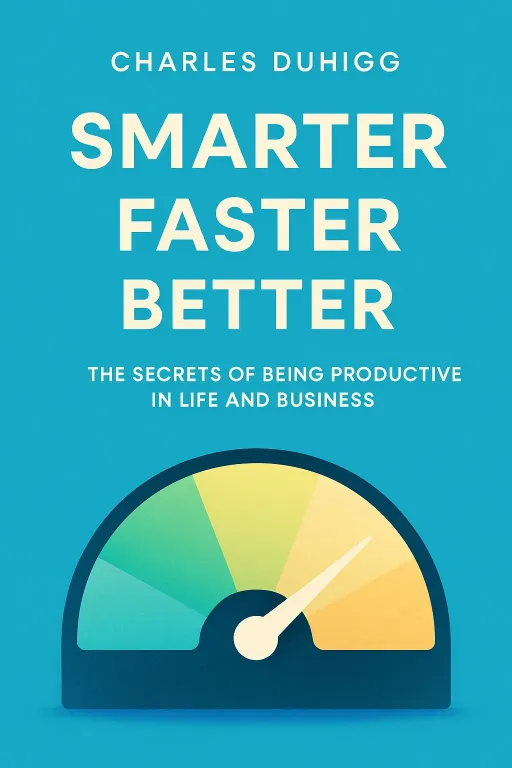
Nova: Absolutely, Atlas. It's deeper than a hack, and it's precisely why we're diving into what we're calling "The Performance Optimization Protocol" today. We're drawing powerful insights from two incredible minds: Charles Duhigg, the Pulitzer Prize-winning journalist behind "Smarter Faster Better," known for making complex cognitive science remarkably accessible, and Jason W. Womack, an executive coach whose "Your Best Just Got Better" offers incredibly practical, actionable advice.
Atlas: So, we're looking at both the underlying psychology and the tangible actions? That makes sense. The core takeaway from the content we're exploring is that to scale a business, you must first scale yourself. And for someone focused on sustainable growth and building resilient organizations, that personal scaling feels like the absolute foundation.
Nova: Precisely. We're going to unpack how understanding these two perspectives—the mental and the methodical—can completely transform how you approach productivity, leadership, and ultimately, your growth trajectory.
The Science of Productivity: Psychological Safety & Mental Models
SECTION
Nova: Let's start with Duhigg, because his work really drills down into the 'how we think' part. In "Smarter Faster Better," he makes a compelling argument that how people think is actually more important than what they think, especially when you're managing teams or driving innovation. He really highlights two crucial elements: psychological safety and mental models.
Atlas: Psychological safety is a term I hear often in discussions about team dynamics. But for someone building systems, is it just about creating a "nice" environment, or is there a strategic, almost quantifiable way to cultivate it, especially in a high-stakes environment where innovation is key?
Nova: It’s far more strategic than just being "nice." Duhigg points to Google's massive "Project Aristotle," where they spent years researching what made their most effective teams tick. They hypothesized it was about the right mix of experts, or personalities.
Atlas: And the outcome? Did they find the magic formula for team composition?
Nova: Quite the opposite! After years of data collection and analysis, they found that was on the team mattered less than the team interacted. The number one factor for team effectiveness was psychological safety: the belief that you won’t be punished or humiliated for speaking up with ideas, questions, concerns, or mistakes.
Atlas: Wow, that's actually really inspiring. So, it's about creating an environment where people feel safe enough to take intellectual risks, to admit when they're wrong, and to truly collaborate without fear of repercussion. That would certainly fuel business model innovation, wouldn't it?
Nova: Absolutely. Think about it: if you're building a new business model, you people to challenge assumptions, to point out potential flaws early, to experiment without fear of catastrophic failure. Psychological safety is the bedrock for that kind of iterative learning and bold experimentation. Leaders foster it by admitting their own mistakes, actively soliciting feedback, and ensuring that every voice is heard and valued, even—especially—the dissenting ones.
Atlas: That makes sense. It's about designing a system where vulnerability is a strength, not a weakness. But then there's the other piece you mentioned: mental models. Are we talking about subconscious biases, or something more actionable? How does auditing one's mental model work for a strategist or someone trying to build resilient systems?
Nova: Mental models are essentially the frameworks we use to understand the world and make decisions. They're our internal maps. Auditing them means consciously examining we approach problems a certain way, or why we hold certain beliefs. For example, a common mental model might be "more hours equals more productivity." If that's your default, you might push for longer workdays. But if you audit that model, you might realize it often leads to burnout and diminishing returns.
Atlas: So, a strategist, for instance, might audit their mental model about market entry. Instead of assuming a 'first-mover advantage' is always best, they might explore models like 'fast follower' or 'niche innovator.' It's about questioning the fundamental assumptions governing your strategic choices.
Nova: Exactly! It's challenging the operating system of your own mind. Duhigg argues that high-performers aren't just intelligent; they're constantly refining their mental models, making them more accurate, flexible, and efficient. This continuous refinement is a key to scaling yourself.
Individual Accountability & Workflow Optimization
SECTION
Nova: That idea of auditing our mental models perfectly bridges us to Jason W. Womack's "Your Best Just Got Better," which takes that individual introspection and turns it into actionable workflow optimization. Where Duhigg focuses on the team and the mental frameworks, Womack zeroes in on the individual and the 'workflow' of high achievers.
Atlas: So, this is where the rubber meets the road, so to speak. Small, consistent adjustments leading to massive career gains. That really resonates with the 'iterative learning' mindset. But for someone driving business model innovation, how do you balance these micro-optimizations with the need for big, strategic leaps? Is there a risk of getting lost in the weeds?
Nova: That's a great question, and it's a common misconception. Womack isn't advocating for micro-optimizations. He's saying that by making small, consistent adjustments to your workflow, you free up mental bandwidth and time focus on those big strategic leaps. It’s about creating a frictionless environment for your own work.
Atlas: Can you give an example of one of these "small, consistent adjustments"? I’m curious how that translates into something tangible.
Nova: A classic Womack technique is the "two-minute rule." If a task takes less than two minutes to complete—like replying to a quick email, filing a document, or making a short call—do it immediately. Don't defer it. The mental load of to do that two-minute task later often takes more energy than just doing it now.
Atlas: Oh, I know that feeling! The mental overhead of a growing to-do list can be crushing. So, it's about eliminating those tiny friction points that accumulate throughout the day.
Nova: Exactly. Another one is his emphasis on reviewing how you spend your time, not just planning it. Womack encourages a consistent, almost daily, audit of your workflow. Where are the bottlenecks in personal process? Are you spending too much time switching contexts? Are you getting distracted by notifications?
Atlas: That makes me wonder, how does this link to the user profile's recommendation of scheduling 30 minutes weekly for deep work on a strategic challenge? It feels like Womack's principles could directly support that.
Nova: Absolutely. By implementing Womack’s approach, you're essentially tuning your personal engine. If you consistently clear out the small distractions and optimize your immediate tasks, you create the dedicated, uninterrupted space needed for those 30-minute deep work sessions. You're not just deep work; you're it by removing internal resistance and external clutter. It’s like having a perfectly tuned engine before you try to win a race, as you said earlier.
Synthesis & Takeaways
SECTION
Nova: So, bringing these two powerful perspectives together: Duhigg gives us the 'why' and the 'how we think,' illuminating the invisible structures of psychological safety and our mental models. Womack gives us the 'what we do' and 'how we refine it,' focusing on individual accountability and workflow optimization. The synergy is profound.
Atlas: It is. The core takeaway from the content was "to scale a business, you must first scale yourself." That hits home for anyone focused on sustainable growth and building resilient organizations. It’s not just about managing people or projects, but about mastering your own cognitive and operational processes. So, beyond just acknowledging these ideas, what's the step someone should take this week to start this personal scaling?
Nova: The most impactful first step, directly from our content, is to identify one mental model you use daily and audit its efficiency. For example, if your mental model for tackling a "strategic challenge" is "it needs hours of uninterrupted focus to even begin," perhaps audit that. You might discover that breaking it into smaller, focused 30-minute deep work blocks—as recommended for our strategist listeners—could be more effective and less daunting, leading to greater progress.
Atlas: That's a powerful and actionable challenge. It's not just about working harder, but working smarter by truly understanding and continuously refining your own internal operating system. It's about making conscious choices about how you think and how you work, which then ripples out to everything you build.
Nova: Exactly. It's about continuously refining that system, because the world around us is always changing. Your performance optimization is an ongoing journey, not a destination.
Atlas: And that journey starts with looking inward, then building outward.
Nova: This is Aibrary. Congratulations on your growth!