The Empty Mirror: Forging Your Identity Beyond "Good Enough"
Golden Hook & Introduction
SECTION
Nova: Dora, have you ever had that feeling? You hit a major goal, you get the promotion, you finish the project... and instead of pure joy, there's this quiet, nagging voice in the back of your head that whispers, 'Is that it? It's still not good enough.' It’s a feeling so many of us, especially high-achieving women, know intimately. What if that voice isn't yours? What if it's an echo from a relationship so fundamental, we rarely think to question it?
Dora Pan: That feeling is incredibly familiar. It's the 'what's next' treadmill of achievement. You're always looking for the next thing to prove your worth, but the goalposts keep moving. The idea that it might be an 'echo' from somewhere else is a powerful and, honestly, a slightly unsettling thought. I'm curious to see the framework.
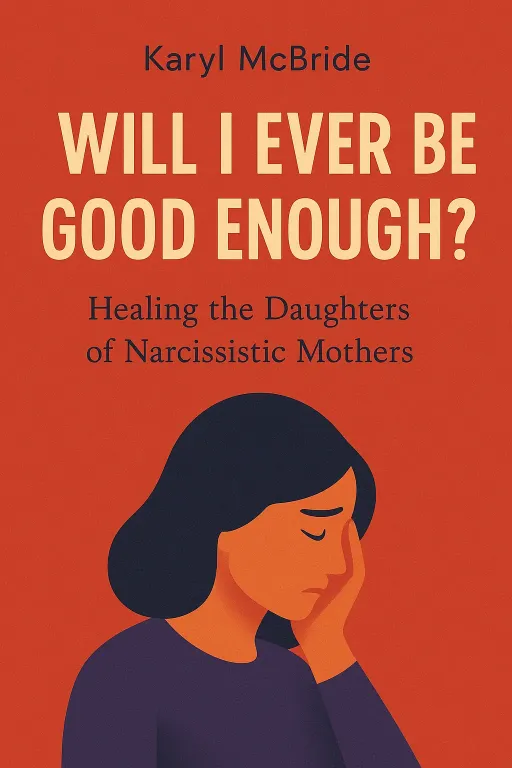
Nova: It is unsettling, but it can also be incredibly freeing. That's the powerful question at the heart of Dr. Karyl McBride's book, 'Will I Ever Be Good Enough?: Healing the Daughters of Narcissistic Mothers'. And today, we're going to tackle this from two critical angles. First, we'll explore the root of that 'never good enough' feeling by unpacking the concept of the 'Empty Mirror' and the two faces of maternal narcissism.
Dora Pan: Okay, a diagnostic phase. I like that.
Nova: Exactly. Then, we'll discuss the adult echo of this dynamic, looking at its powerful impact on our romantic relationships and life choices. The goal here isn't to assign blame, but to gain understanding. It's about finally getting the blueprint to rewrite our own internal script.
Deep Dive into Core Topic 1: The Empty Mirror & The Two Faces of Maternal Narcissism
SECTION
Nova: So, let's start with that blueprint. The book calls the core problem the 'Empty Mirror' effect. It's this idea that our first and most important mirror for who we are is our mother. We look to her to see ourselves reflected with love, with empathy, with validation. But if that mirror is cracked, or worse, only reflects herself back, we grow up with a distorted or completely empty view of our own identity. We feel 'unmothered.'
Dora Pan: That’s a very potent metaphor. An empty mirror. It implies you’re not seeing a negative reflection, you’re seeing at all. And in the absence of data, you just assume the worst. You assume you're the problem.
Nova: Precisely. And Dr. McBride argues this 'empty mirror' is created by a narcissistic mother, and it tends to show up in one of two primary ways. The first is the 'ignoring' mother. This is the parent who is physically present but emotionally absent. The book gives the heartbreaking example of a client named Marie. When Marie was thirteen, she started her period. It's a confusing, scary time for any young girl. But she couldn't go to her mother. Her mother just refused to discuss anything related to puberty or sexuality. Marie had to rely on her sister and a teacher for basic information and support.
Dora Pan: Wow. So the mother is a black hole of information and emotion. The message Marie receives isn't 'I'm angry with you,' it's 'Your needs, your fears, your very development... they are irrelevant. You are invisible to me.'
Nova: Exactly. It's a profound sense of invisibility. And on the complete opposite end of the spectrum, you have the 'engulfing' mother. This is the parent who is hyper-involved, but not with the child. The book tells the story of Sandy, whose mother would proudly tell friends and relatives that she was trying to 'clone' herself through her daughter. Sandy wasn't allowed to have her own opinions, her own style, her own life. She was being groomed to be a younger version of her mom.
Dora Pan: That's a brilliant framework. It's two paths to the same destination: the erasure of the daughter's authentic self. One by neglect, the other by colonization. As an educator, I see how crucial that early mirroring is for developing a stable identity and a sense of autonomy. Without it, a child is left to build a sense of self on... what? On sand.
Nova: Exactly. On sand. And you can spend the rest of your life desperately trying to find solid ground, which is a perfect transition to our next point.
Deep Dive into Core Topic 2: The Adult Echo - Romantic Fallout & Coping Paths
SECTION
Nova: So, that search for solid ground leads directly to our second point: the adult echo. How does this 'empty mirror' from childhood show up in our love lives, our friendships, and our careers?
Dora Pan: This is the part I'm really interested in. The connection between that developmental experience and the habits and mindsets we form as adults. How does the pattern perpetuate itself?
Nova: Well, one of the most common ways is in our romantic relationships. The book suggests that we unconsciously try to 'win at love where we failed with Mom.' We pick partners who, in some way, recreate that original dynamic, hoping that this time, we can finally get it right.
Dora Pan: So you're trying to solve an old problem with a new person.
Nova: You've got it. There's a story about a woman named Betsy who, after her second divorce, realized she was codependent. She looked back at her marriage and saw she was the breadwinner, the social planner, the one who wrote her husband's resumes and got him jobs. She was giving 80% to his 20%. She said she finally understood she had a 'high tolerance for deviant behavior' because, at a deep, unconscious level, this one-sided, exhausting giving felt normal. It was the role she'd always played with her mother.
Dora Pan: It's almost like she's running a script. The role of 'over-giver' is familiar and, in a strange way, feels safer than demanding reciprocity, which was never modeled for her. It's a habit rooted in a survival strategy. You do everything for the other person in the desperate hope that you'll finally be seen and valued.
Nova: And you're almost always disappointed. This dynamic also shows up in our broader life choices. Dr. McBride observes that sisters in these families often split into two extreme, opposing roles. One sister becomes the 'high-achieving daughter.' She's the one who gets perfect grades, has a stellar career, and does everything right. She is relentlessly trying to the love and validation that was never given freely.
Dora Pan: She's trying to present an invoice for love. 'Look at all I've done. Surely I'm worthy now?'
Nova: What a perfect way to put it. And then you have the other sister, the 'self-sabotaging daughter.' She's the one who internalizes the 'not good enough' message so deeply that she essentially gives up. She might struggle with addiction, unstable relationships, or an inability to hold a job. She believes she's unworthy, so her life becomes a reflection of that belief.
Dora Pan: And it's so important to see that they are both responses to the exact same wound. It's two different strategies for coping with the same core belief: 'My worth is conditional.' One tries to meet the impossible conditions, and the other surrenders to them. This speaks directly to the formation of our core 'mindset' and 'habits' that we can carry for a lifetime.
Nova: Precisely. You're trying to fill that empty mirror with reflections from your partner, or your achievements, or even your failures. But the book's central argument is that it can never work. The validation has to come from somewhere else.
Synthesis & Takeaways
SECTION
Nova: So, to bring it all together, we've seen how the 'empty mirror' of maternal narcissism can create this deep void of self-worth, and how we unconsciously, and often painfully, try to fill that void in our adult relationships and life choices.
Dora Pan: And I think the most empowering part of this framework is that it depersonalizes the feeling of being 'not good enough.' It's not a character flaw. It's a predictable, understandable outcome of a specific developmental dynamic. Just having the framework, the language for it, is a huge step toward taking its power away.
Nova: It really is. And that leads to the book's first, and maybe most important, actionable takeaway for healing. It's not about confrontation. It's not about demanding an apology. It's about.
Dora Pan: Which is so hard. It feels like giving up.
Nova: It does, but the book reframes it. It's about accepting the data. Accepting the reality of the mother you had, not the one you wished you had. And then, allowing yourself to grieve that loss. It's a process of finally, truly, letting go of the hope that the empty mirror will ever change.
Dora Pan: Because as long as you're holding onto that hope, you're still tethered to it. You're still waiting for something you'll never get. Acceptance is what cuts the cord.
Nova: That's it. And once that cord is cut, the real work begins. And this is the part I love. It's about becoming your own mirror.
Dora Pan: Building your own.
Nova: Yes! The book talks about developing an 'internal mother'—that consistent, loving, internal voice of unconditional love, support, and validation that we all need. The one that says, 'You did your best, and that is enough.' The one that says, 'It's okay to feel sad or angry.' The one that celebrates your true self, not the image.
Dora Pan: So the ultimate question for our listeners isn't 'How do I fix my past?' or 'How do I get my mother to see me?' It's 'How can I start, today, to become the source of my own validation?' That's where real, unshakable self-confidence is born. Not from external achievements, but from an internal foundation you build yourself.
Nova: That is the perfect place to end. It's not about finding a better mirror, it's about becoming one. Dora, thank you. This was such an insightful conversation.
Dora Pan: Thank you, Nova. It's a lot to think about, but in a very constructive way.