The Hidden Cost of Health: Beyond Diet and Exercise
Golden Hook & Introduction
SECTION
Nova: Reality check: What if I told you that all your green smoothies, all your gym sessions, might be missing the single biggest threat to your health? It’s not what you eat or how much you move, it’s what’s happening inside your head.
Atlas: Whoa, Nova. That's a bold claim, especially for our listeners who are meticulously optimizing every aspect of their lives, from their morning routine to their quarterly sprints. Are you really saying we're all missing something that fundamental?
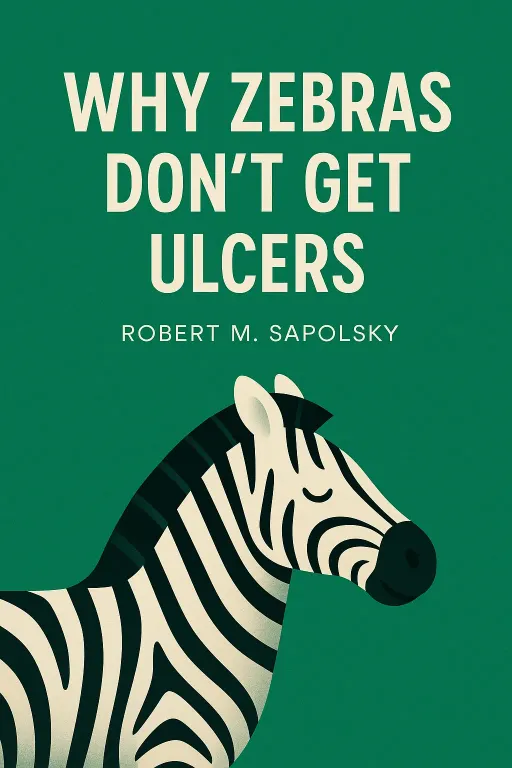
Nova: Absolutely, Atlas. Today, we're unpacking that very idea, drawing incredible insights from two seminal works: Robert Sapolsky's, a book that revolutionized our understanding of stress, and Bessel van der Kolk's, which fundamentally shifted how we view trauma's physical impact.
Atlas: Both authors are giants in their fields, with Sapolsky being a neuroendocrinologist who masterfully translates complex biology for the everyday person, making science genuinely accessible. And van der Kolk, a leading psychiatrist, pioneered the understanding of how trauma is literally embodied. He really changed the conversation.
Nova: Exactly. And what they both reveal is a hidden cost of health we rarely talk about. It's the silent, relentless pressure cooker of our own minds.
Deep Dive into Core Topic 1: The Modern Stress Paradox: Why Our Minds Make Us Sick
SECTION
Nova: So, let's start with Robert Sapolsky and those poor zebras. When a zebra sees a lion, its stress response kicks in with incredible efficiency. Adrenaline surges, heart rate skyrockets, muscles tense—it's all about immediate survival. It either outruns the lion, or it doesn't. The stress is acute, intense, and then it's.
Atlas: Right, like a burst of pure, focused energy for a very specific, short-term problem. That makes perfect evolutionary sense.
Nova: Precisely. But for us humans, our 'lions' aren't always tangible, four-legged predators. They're deadlines, financial worries, social anxieties, the constant pressure to innovate, to lead, to perform. Our brilliant, complex brains can threats, failures, and on past mistakes, keeping that stress response switch flipped to 'on' indefinitely.
Atlas: I can definitely relate to that. The feeling of constantly being 'on,' even when you're technically relaxing. So, our bodies are reacting to an email notification the same way a zebra reacts to a lion? That sounds rough.
Nova: In a very real physiological sense, yes. Your body doesn't distinguish between a physical threat and a perceived psychological threat. When you're stressed, your adrenal glands pump out cortisol and adrenaline. These hormones are great for a quick escape, but in chronic doses, they become incredibly damaging. Imagine a car engine constantly redlining, day in and day out. Eventually, something's going to seize up.
Atlas: Okay, but isn't some stress actually good for performance? The kind that pushes us to meet challenges, to innovate under pressure? What's the actual mechanism that turns this into sickness, beyond just 'feeling stressed'?
Nova: That's a crucial distinction. Acute, manageable stress can be a motivator. But stress is different. That constant flood of cortisol suppresses your immune system, making you more susceptible to illness. It elevates blood pressure, increasing the risk of heart disease. It can disrupt digestion, leading to gut issues. It even shrinks parts of your brain involved in memory and emotional regulation.
Atlas: Wow. So it's not just about 'managing' stress, it's about fundamentally re-evaluating our relationship with it, seeing it not just as a mental state but as a biological process actively eroding our physical well-being. That's a powerful reframing. Can you give a more vivid illustration of this 'hidden cost'?
Nova: Think about cellular aging. Chronic psychological stress has been linked to the shortening of telomeres, the protective caps on the ends of your chromosomes. Shorter telomeres are associated with premature aging and increased risk of age-related diseases. So, that endless worry about that next big project, that constant internal pressure to achieve, it's literally accelerating your cellular clock. It's a silent, cumulative form of damage that traditional health metrics might not even register until it's too late.
Atlas: That gives me chills. The idea that our internal narrative is quite literally impacting our fundamental biology. It makes you wonder how many 'unexplained' health issues are actually rooted in this modern stress paradox.
Deep Dive into Core Topic 2: The Body's Silent Language: Trauma and Embodied Memory
SECTION
Nova: And if chronic stress is the slow burn, then trauma often acts as a deep, structural shift, literally reshaping us. This brings us to Bessel van der Kolk's revelatory work in. Van der Kolk argues that trauma isn't just a bad memory or a psychological scar; it's an event stored in the body's sensations, images, and physiological responses, often outside conscious recall. The body literally 'keeps the score.'
Atlas: Oh, I like that. The body 'keeps the score.' That’s a great way to put it. So, it's not just our brains remembering, but our entire physical being?
Nova: Exactly. When a traumatic event occurs, especially if we feel helpless or overwhelmed, our brain's alarm system, the amygdala, goes into overdrive. The rational prefrontal cortex, which helps us make sense of things, often goes offline. The experience isn't processed as a coherent narrative; instead, it's fragmented and stored as raw sensory data: a smell, a sound, a physical sensation, a feeling of terror or paralysis.
Atlas: That makes me wonder, for someone who's always pushing for innovation, always looking forward, how do you even begin to 'read' these physical messages, especially if they're not obvious memories? Like, if you've consciously 'moved on,' but your body hasn't?
Nova: That's the insidious part. Someone might have experienced childhood neglect, and consciously believe they've 'moved on.' But as an adult, they might struggle with chronic, unexplained pain, or autoimmune issues, or an inability to form secure attachments, or even just a constant, low-level anxiety they can't pinpoint. Their body remains in a state of hypervigilance or shutdown, a physiological echo of that past experience. It manifests as a constant state of internal alarm, or a feeling of numbness, impacting their ability to be present, to connect, to even regulate their own emotions.
Atlas: So this isn't just about emotional well-being affecting physical health; it's about physical health the emotional well-being. That sounds incredibly isolating for people who might be experiencing this without knowing the root cause. What's the fundamental difference between 'stress' and 'trauma' in this context? Is it a matter of degree or kind?
Nova: That's a critical distinction. Stress is a response to a perceived threat, and while chronic stress is damaging, the system is still fundamentally. Trauma, as van der Kolk explains, is when that stress response system is and becomes dysregulated. It's not just a response; it's a lasting imprint on the nervous system and body. It often involves a profound loss of control, a feeling of utter helplessness, and a shattering of one's sense of safety. The body then learns to respond as if that threat is perpetually present, even when it's not.
Atlas: I can see how that would be a huge barrier to leading effectively or thinking strategically. If your body is constantly bracing for a threat, how can you truly innovate or connect with others? It's like your internal operating system is running on a faulty program.
Synthesis & Takeaways
SECTION
Nova: Exactly. So, whether it's the constant drip of modern psychological stress, keeping our bodies in a perpetual fight-or-flight state, or the deep, unprocessed imprint of past trauma, our physical health is far more intertwined with our inner world than we ever imagined. It's a profound connection we tend to overlook in our pursuit of health through external metrics.
Atlas: And for our listeners, who are often driven, aiming to make a difference, who want to master complex subjects and lead with integrity, this means truly understanding holistic health isn't a soft skill, it's a strategic imperative. Ignoring this internal landscape is like trying to build an innovation empire on a shaky foundation. You might achieve short-term wins, but the long-term cost is immense.
Nova: Absolutely. The good news is, once we acknowledge this, we can start to heal and build resilience. It's not about just 'powering through' or 'thinking positive.' It's about listening to our bodies, understanding their silent language, and creating environments—both internal and external—that foster true safety and regulation. It's about recognizing that our greatest innovations often come from a place of inner calm, not constant chaos.
Atlas: That's actually really inspiring. So, as you go about your day, pushing boundaries and striving for impact, how might your daily thoughts and hidden anxieties be quietly shaping your physical health, and what small step will you take to truly listen to your body today?
Nova: A powerful question to sit with.
Nova: This is Aibrary. Congratulations on your growth!