Personalized Podcast
Golden Hook & Introduction
SECTION
Nova: Imagine if there was a revolutionary, completely free treatment that could double your memory retention, supercharge your creativity, lower your risk of cancer and heart attacks, and completely recalibrate your emotional sanity. You don't need a prescription, there are zero negative side effects, and yet, as a society, we actively look down on people who take full advantage of it. It sounds like science fiction, right? But it's actually just a standard, biologically mandated eight-hour night of sleep.
Merve: It's fascinating, Nova, because when you look at it through an evolutionary lens, sleep is a massive vulnerability. You can't gather food, you can't reproduce, and you're completely defenseless against predators. If sleep didn't serve an absolutely vital, non-negotiable biological function, it would be the biggest mistake evolution ever made. Yet, every single animal species studied to date engages in some form of it.
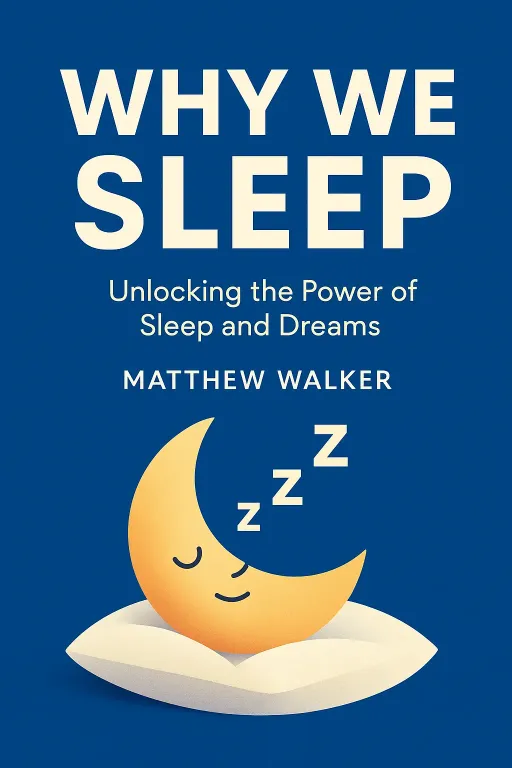
Nova: Exactly! And today, we are going to dive deep into Matthew Walker's masterpiece,, to understand the stunning mechanics of this biological miracle. We're going to tackle this from three distinct, high-leverage angles. First, we'll look at the dual-engine architecture of sleep—how NREM and REM sleep work together to consolidate our memories and literally wash our brains clean. Second, we'll explore the emotional master tuner—how dreaming acts as a form of overnight therapy. And finally, we'll analyze the systemic disruption of sleep in modern society and how we can design a smarter, sleep-optimized future. Merve, I am so excited to unpack this with you.
Merve: I am thrilled to be here, Nova. As someone who loves looking at complex systems, the architecture of sleep is one of the most elegant, beautifully designed feedback loops in the natural world. I can't wait to dissect how it all fits together.
Deep Dive into Core Topic 1
SECTION
Nova: Let's start with that dual-engine architecture. We often think of sleep as a uniform block of time where our brain just turns off. But in reality, it's this incredibly active, highly coordinated dance between two completely different states: NREM, or non-rapid eye movement sleep, and REM, which is rapid eye movement sleep. They cycle every ninety minutes, but the ratio changes dramatically throughout the night.
Merve: Right, and that shifting ratio is highly strategic. Early in the night, our ninety-minute cycles are dominated by deep NREM sleep. But as we transition into the early morning hours, REM sleep takes over. This isn't random. Deep NREM sleep is all about structural pruning and data transfer. It's like moving files from a temporary USB drive—which is our hippocampus—to a secure, long-term hard drive, the cortex.
Nova: I love that USB analogy! And the science behind this is so cool. Back in 2006, researchers at UC Berkeley did an MRI study to see what happens to our learning capacity when we're sleep-deprived. They took two groups of healthy young adults. One group got a full night of sleep, while the other was kept awake all night in the lab. The next day, they put them in an MRI scanner and had them learn a list of new facts. The results were shocking. The sleep-deprived group showed a massive forty percent deficit in their ability to form new memories.
Merve: Forty percent! That is the difference between acing an exam and failing it completely. And the neurobiology explains exactly why. When they looked at the MRI scans of the sleep-deprived participants, the hippocampus—the brain's memory in-box—was completely silent. It was as if the lack of sleep had shut down the memory receiver. The USB drive was full, and because it hadn't been cleared out during deep NREM sleep the night before, any new incoming data was just bouncing off.
Nova: Yes! And it's not just about preparing the brain to learn; it's also about saving what you've already learned. In 1924, researchers Jenkins and Dallenbach did a classic study where they had people learn a list of verbal facts and then tracked their forgetting curve over eight hours. The group that slept immediately after learning retained twenty to forty percent more information than the group that stayed awake. Sleep literally clicks the 'save' button on our memories.
Merve: And what's beautiful is that this isn't just a passive preservation. It's an active, highly selective optimization process. The brain doesn't just save everything blindly. Studies on 'targeted memory reactivation' show that during deep NREM sleep, the brain uses sleep spindles—these short, powerful bursts of electrical activity—to selectively strengthen memories that were tagged as important during the day, while actively allowing irrelevant data to fade away. It's an automated, intelligent curation of our lived experience.
Nova: It really is. And while NREM is doing this cognitive curation, there is a physical sanitation process happening at the exact same time. This is one of the most mind-blowing discoveries in modern neuroscience: the glymphatic system, discovered by Dr. Maiken Nedergaard.
Merve: Oh, the glymphatic system is an absolute masterpiece of biological engineering. During deep NREM sleep, the brain's glial cells actually shrink by about sixty percent. This dramatic shrinkage opens up the space between brain cells, allowing cerebrospinal fluid to rush through like a high-pressure dishwasher. It literally flushes out the metabolic waste that accumulates during wakefulness, including amyloid beta proteins, which are the primary component of the plaques found in Alzheimer's disease.
Nova: It's literally neurological sanitation! If you don't get that deep NREM sleep, the dishwasher doesn't run. The waste builds up, damages the very brain regions that generate deep sleep, which further degrades your sleep quality, creating this devastating, accelerating feedback loop that drives cognitive decline.
Merve: Exactly. It's a classic systemic failure. When you understand that wakefulness is essentially low-level brain damage, and sleep is the only period of active, structural repair, prioritizing those early-night, NREM-rich hours becomes an absolute cognitive imperative.
Deep Dive into Core Topic 2
SECTION
Nova: Now, once the brain has done its structural pruning and physical cleaning in deep NREM, the second engine kicks in: REM sleep and dreaming. Matthew Walker describes REM sleep as a state of being 'routinely psychotic.' And when you think about it, it's true! When we dream, we hallucinate, we believe things that aren't real, we get disoriented, and we experience wild emotional swings. But this 'psychosis' serves a profound therapeutic purpose.
Merve: It's a beautiful paradox, Nova. During REM sleep, the brain is highly active—in fact, on an EEG, it looks almost identical to wakefulness. But there is one crucial, neurochemical difference. The concentration of noradrenaline, which is the brain's primary stress chemical, is completely shut off. It is the only time in our entire twenty-four-hour cycle where the brain is completely free of anxiety-triggering molecules.
Nova: Think about how genius that design is. The brain has created a perfectly safe, neurochemically calm simulation chamber. And what does it do in this chamber? It replays our most emotionally charged, difficult memories from the day. But because there's no noradrenaline, it can process the informational content of the memory without the painful, visceral emotional sting.
Merve: It's literally overnight therapy. It allows us to sleep to remember the facts of our lives, but sleep to forget the painful emotional charge wrapped around them. Walker proved this in his own lab with an experiment using highly emotional images. Participants who viewed distressing images, slept, and then viewed them again twelve hours later showed a massive reduction in the reactivity of their amygdala—the brain's emotional alarm center. Their prefrontal cortex had regained control. But the group that stayed awake between viewings showed no such emotional healing.
Nova: That is so powerful. It's not just time that heals all wounds; it's time spent in REM-sleep dreaming. And we see what happens when this system breaks down in patients with PTSD. Their noradrenaline levels are too high, even during sleep. Because the stress chemical is present, the brain can't strip the emotional charge from the trauma. So, they wake up in a panic, their dreams turn into recurring, terrifying flashbacks, and the emotional wound remains raw and unhealed.
Merve: And the clinical application of this theory is incredibly elegant. Dr. Murray Raskind discovered that a blood pressure medication called prazosin, which happens to suppress noradrenaline in the brain, completely transformed the lives of war veterans with PTSD. By lowering that stress chemical during sleep, it restored their ability to enter healthy REM sleep. Their recurring nightmares stopped, and their daytime clinical symptoms improved dramatically. It's a stunning validation of the overnight therapy model.
Nova: It really is. And REM sleep doesn't just heal our past; it also calibrates how we interact with the world in the present. Walker's research showed that REM sleep acts as a master tuner for our emotional instrumentation. It recalibrates our ability to read subtle facial expressions and social cues. When you deprive someone of REM sleep, they lose this accuracy. They develop a default 'fear bias,' misinterpreting neutral or even friendly faces as threatening.
Merve: Which completely degrades our social intelligence and empathy. If you're sleep-deprived, you are literally walking around viewing the world through a distorted, hostile lens. And on top of that, REM sleep is the ultimate engine of creativity. While NREM sleep consolidates memories by strengthening direct connections, REM sleep does the opposite. It takes vast, seemingly unrelated concepts and tests the most distant, non-obvious associations. It builds a 'Mind Wide Web.'
Nova: Yes! That's why so many revolutionary breakthroughs in human history happened in a dream. Dmitri Mendeleev spent years trying to organize the chemical elements, fell asleep exhausted, and saw the periodic table snap together in a divine grid in his dream. Otto Loewi dreamed the exact experiment that proved chemical neurotransmission, which won him a Nobel Prize. Paul McCartney woke up with the entire melody of 'Yesterday' in his head.
Merve: It's because the dreaming brain operates on a completely different, highly divergent logic. It favors the bizarre, distant connection. Anagram experiments show that people emerging from REM sleep solve thirty-five percent more word puzzles than those in NREM or waking states. It's not just about resting the brain; it's about unlocking a state of cognitive synthesis that is physically impossible when we are awake.
Deep Dive into Core Topic 3
SECTION
Nova: So, we have this evolutionary masterpiece of a system. It cleans our brains, saves our memories, heals our trauma, and fuels our creativity. And what does modern society do with it? We completely dismantle it. We treat sleep as a luxury, a sign of weakness, or even laziness. Matthew Walker calls this a silent public health crisis. And when you look at the systemic design of our institutions, it's clear we are actively fighting our own biology.
Merve: It's a massive systemic misalignment, Nova. Take high school start times, for example. During adolescence, there is a biological, genetically determined shift in circadian rhythms. Teenagers' internal clocks naturally delay, making them unable to fall asleep early. Yet, we force them to wake up at biologically unreasonable hours to catch a school bus at 7:00 a. m. We are literally waking them up during their peak REM sleep hours, which, as we discussed, are concentrated in the late morning.
Nova: We are literally bankrupting their dreams! And the consequences are devastating. Chronic sleep deprivation in teenagers is directly linked to the onset of depression, anxiety, and even suicidal ideation. And yet, when schools make the simple, systemic change of delaying start times, the results are immediate and profound. In Edina, Minnesota, when they shifted high school start times from 7:25 to 8:30 a. m., the average verbal SAT scores of top students jumped by over 150 points!
Merve: That is an incredible return on investment for a zero-cost intervention. And it's not just academic performance. In the Mahtomedi School District, delaying the start time by just thirty minutes led to a sixty percent reduction in traffic accidents among teenage drivers. Sleep is literally a life-saving measure.
Nova: It really is. And the medical establishment is just as guilty of this biological neglect. The entire structure of modern medical residency—where young doctors work consecutive thirty-hour shifts—can be traced back to one influential figure: William Stewart Halsted, who founded the surgical training program at Johns Hopkins in 1889. Halsted believed sleep was a dispensable luxury and forced his residents to work sleepless, grueling hours. But there was a dark secret behind his superhuman stamina: Halsted was a severe cocaine addict.
Merve: It is a tragic historical irony. The entire cultural expectation of sleeplessness in modern medicine was designed by a drug-fueled addict who was physically incapable of normal sleep. And we are still paying the price for that legacy today. The data is terrifying. Residents working thirty-hour shifts commit thirty-six percent more serious medical errors. One in five residents will make a sleepless-related medical error that causes direct harm to a patient, and one in twenty will make an error that kills a patient.
Nova: It's horrifying. If a pilot or a truck driver was operating under those conditions, it would be highly illegal. Yet we trust our lives to sleep-deprived surgeons. And the resistance to change within these institutions is mind-boggling, clinging to outdated traditions instead of looking at the overwhelming scientific evidence.
Merve: It's a classic cultural inertia. But we are starting to see some cracks in the armor. Forward-thinking organizations are beginning to realize that sleep is a massive competitive advantage. Aetna, the insurance giant, implemented a program where they offer employees a bonus of twenty-five dollars a night for getting seven hours of sleep or more, capped at five hundred dollars a year. They realized that well-slept employees are more productive, more creative, make better decisions, and have lower healthcare costs.
Nova: "Ounces of sleep offer pounds of business in return!" I love that. And even NASA has been a pioneer here, showing that a simple twenty-six-minute nap can improve astronaut performance by thirty-four percent and alertness by fifty-four percent. We don't need to fight technology or modern life; we need to leverage them. We can use smart home tech to automatically cool our bedrooms to sixty-five degrees—which is the optimal temperature for sleep—and use dynamic lighting to mimic natural circadian cycles.
Merve: Exactly. It's about designing environments and systems that work our evolutionary biology rather than against it. Whether it's flexible work hours that accommodate individual chronotypes—the natural morning larks and night owls—or integrating sleep education into our school curricula, the leverage points are clear. We just need the collective will to pull them.
Synthesis & Takeaways
SECTION
Nova: This has been such an eye-opening conversation, Merve. When you step back and look at the big picture, sleep isn't just a passive state of rest. It is a highly active, beautifully engineered, multi-system optimization protocol. It is the single most effective thing we can do to reset our brain and body health each day.
Merve: Absolutely, Nova. It is the ultimate Swiss Army Knife of health. From the glymphatic system washing away toxic proteins to REM sleep serving as overnight emotional therapy and a catalyst for creative genius, sleep is non-negotiable. If we want to solve the public health crises of the twenty-first century, we have to start by reclaiming our right to a full night of sleep, without any stigma of laziness.
Nova: Well said. So, to our listeners out there, we want to leave you with one simple, actionable challenge tonight. Look at your sleep schedule not as a flexible variable that you can cut to squeeze in more work, but as a non-negotiable, sacred appointment with your own cognitive and emotional potential. Tonight, turn off your screens an hour before bed, cool your room down to sixty-five degrees, and give your brain the biological mandate it deserves.
Merve: Your brain, your body, and your future self will thank you for it.
Nova: Thank you so much for joining us, Merve. This was incredible.
Merve: Thank you, Nova. It was an absolute pleasure.