The Science of Deep Engagement
Golden Hook & Introduction
SECTION
Nova: What if the secret to truly mastering something isn't careful study, but a little bit of productive failure? And what if your memory only remembers what you've actually about deeply?
Atlas: Whoa, okay, that's a bold opening. Productive failure? That sounds like an oxymoron. And the memory part… so just passively soaking up information doesn't actually work? My brain is already protesting.
Nova: Precisely! And that's exactly what we're diving into today on Aibrary. We're dissecting the core principles behind genuine, lasting learning. We're looking at the science of deep engagement, drawing from some incredible insights.
Atlas: Deep engagement. Sounds… intense. So, we're talking about how to actually make knowledge, not just pass a quick quiz. What’s the source material for this intellectual deep dive?
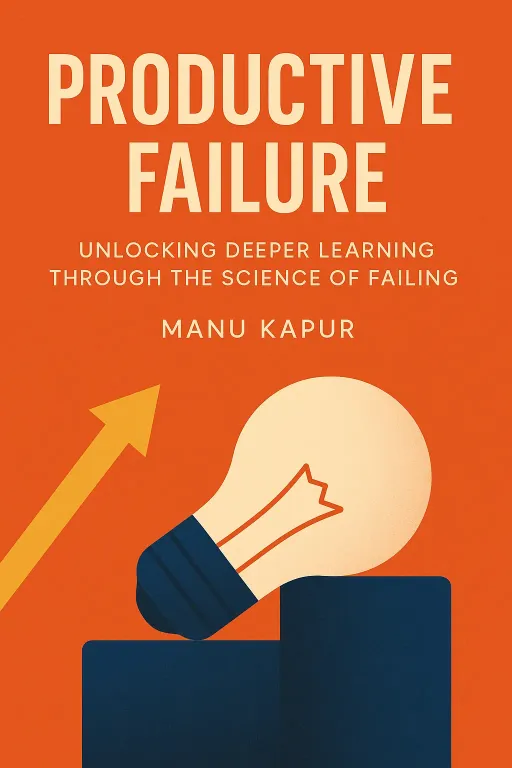
Nova: We're pulling wisdom from two key thinkers. First, Manu Kapur, who wrote "Productive Failure," and then Daniel T. Willingham, author of "Why Don’t Students Like School?" Both offer profound, yet surprisingly simple, shifts in how we approach learning.
Atlas: Manu Kapur and Daniel T. Willingham. Kapur, the one who argues for letting students struggle a bit? And Willingham, the memory guru. Interesting pairing. So, Nova, paint us a picture. What's the fundamental premise here that challenges how we usually think about learning?
Nova: The fundamental premise, Atlas, is a radical departure from the common "teach first, then practice" model. It’s about embracing the as the primary engine for learning, and understanding that true memory isn't about accumulation, but about deep, active cognition.
Atlas: Embracing struggle. That’s a tough sell for many of us, right? Especially in a world that often rewards quick answers and apparent effortlessness. So, let's break this down. Where does this idea of "productive failure" come from?
The Power of Productive Struggle
SECTION
Nova: Manu Kapur's work on "Productive Failure" is fascinating because it directly challenges our intuition. His research, and that of many others, demonstrates that students who are given complex problems to to solve they are explicitly taught the method or the solution actually perform on long-term assessments.
Atlas: Better? So, they try, they fail, and makes them learn more effectively in the long run? I mean, my instinct is to say, "If you don't know how to do it, you're just going to get frustrated and reinforce bad habits, aren't you?" How do we ensure it's failure and not just… failure?
Nova: That’s the brilliant nuance. It’s not about aimless floundering. It's about. Think of it like this: imagine you're learning to cook a brand-new, incredibly complex dish. The traditional approach might be to read the entire recipe meticulously, then gather ingredients, then start. Kapur's idea suggests you might get better results by first looking at the finished dish, or the ingredients, and trying to how it might come together, perhaps even attempting a few steps without the full instructions.
Atlas: So you’re saying you’d try to assemble something, maybe get it wrong, but in that process, your brain starts to identify the missing pieces of information. You begin to form questions you even know the right questions to ask.
Nova: Exactly! When you attempt a problem without knowing the solution, your brain is forced to engage in what we might call "retrieval practice" and "hypothesis generation." You're not just passively receiving information; you're actively trying to map the terrain. This initial exploration highlights your knowledge gaps in a very real, very tangible way. It creates a cognitive need for the information that will follow.
Atlas: Ah, so you’re creating a for the knowledge. It’s like your brain is saying, "Okay, I to know how to do X because I just tried and couldn't, and that feels… inefficient." It makes the subsequent learning much more meaningful.
Nova: Precisely. It transforms learning from an act of absorption into an act of construction. When you’ve wrestled with a problem, the explanation that follows isn't just abstract information; it’s a solution to a puzzle you’ve already encountered. This makes the information more relevant, more memorable, and more deeply integrated into your existing mental framework. It’s about building conceptual bridges by first identifying the chasms.
Atlas: That makes a lot of sense, especially for someone like me who’s always trying to optimize how they learn. For anyone striving for true mastery, admitting you something can feel like a step backward, a sign of inadequacy. But this reframes that initial confusion not as a deficit, but as a necessary precursor to genuine understanding. It’s the fertile ground where real learning can grow.
Nova: And it’s not just about academic subjects. Think about learning a new skill, like playing a musical instrument or mastering a complex software. If you try to jump straight to the advanced techniques without understanding the foundational movements or commands, you’ll likely struggle. But if you first try to improvise a simple melody, or attempt a basic function on the software, you’ll immediately discover what you know, creating a much more focused and effective learning path when you then seek instruction.
Atlas: It’s like giving your brain a puzzle to chew on the instruction manual arrives. It primes it for the information, making it more receptive and, I imagine, more engaged. But this still feels like it requires a certain mindset, doesn't it? How do you encourage that initial engagement with the struggle?
Nova: That’s where the of problem matters, and where the guidance comes in. It’s not about throwing impossible tasks at learners. It's about problems that are challenging enough to require thought and perhaps initial error, but not so overwhelmingly difficult that they lead to complete demotivation. It’s finding that sweet spot of cognitive challenge. The key is that the attempt itself, the engagement with the problem, is the valuable part, regardless of whether the initial attempt is "successful" in finding the right answer.
Atlas: So, the intention behind the struggle is crucial. It’s not about proving you’re incapable, but about actively probing the boundaries of your current knowledge. It’s a proactive exploration rather than a reactive memorization.
Nova: Exactly. And this brings us beautifully to the second pillar of deep engagement, which is the very nature of how we retain this information once we finally learn it. This is where Daniel T. Willingham’s insights become paramount.
Memory as the Residue of Deep Thought
SECTION
Nova: Willingham makes a profound observation: memory is the "residue of thought." What does that really mean? It means you only remember what you have actually spent time thinking about deeply. It’s not about how many times you’ve seen or heard something, but how much cognitive effort you’ve invested in processing it.
Atlas: "Residue of thought." That’s a powerful image. So, if I'm just passively reading a textbook chapter, my brain isn't really much with that information, is it? It’s like watching a movie without really paying attention; you might remember a few scenes, but the plot is a blur.
Nova: Precisely. Willingham argues that the common experience of material isn't necessarily because the material is too difficult, or because our memory is faulty. It's often because we didn't actually about it deeply enough in the first place. If you read a sentence and your mind wanders, or if you just skim over the words without questioning them, connecting them, or visualizing them, then there's very little "residue" left behind.
Atlas: So, staring blankly at a page, or listening to a lecture while mentally planning dinner, isn't thinking; it's just… waiting for the words to magically stick? And they won't. This feels like a direct challenge to how many of us approach studying or even just consuming information. If I'm in a meeting and my mind drifts, am I essentially erasing any potential learning?
Nova: You're certainly diminishing it. Think about it from a neurological perspective. When you engage in deep thought, you're creating and strengthening neural pathways. You're making connections between new information and what you already know. You're asking "why," "how," and "what if." This active processing is what makes information salient and memorable. Passive exposure, on the other hand, is like dropping a pebble into a vast ocean – it creates a ripple, but it doesn't fundamentally alter the ocean's structure.
Atlas: That’s a great analogy. So, if I'm trying to learn a new skill or grasp a complex concept, and I find myself zoning out, it's not a sign that I'm lazy, but that I'm not deeply enough about it. But how do we cultivate that "deep thought," especially when the material feels dry or complex, and we're already pressed for time? This is where the "focused strategist" in me gets a bit anxious about time management.
Nova: That’s where the two ideas we're discussing converge beautifully. Remember Kapur's "productive failure"? That initial struggle is precisely what deep thought. When you attempt a problem and realize you don't have the answer, you're compelled to think harder about the underlying principles. You start questioning assumptions. You're more motivated to analyze the information that finally comes to you because it directly addresses the gap you just experienced.
Atlas: Ah, I see the synergy! So, the productive struggle acts as a catalyst, igniting the deep thinking process that Willingham says is essential for memory. It’s not just about to solve it, but the you do in that attempt that makes the subsequent explanation stick. It’s about making your brain work the information, not just passively receive it.
Nova: Exactly. And Willingham also points out that content becomes more memorable when it's presented in a way that encourages inference and elaboration. When you're asked to explain something in your own words, to compare it to something else, or to predict what might happen next, you're engaging in deeper cognitive processing. This is why active recall, summarizing, or teaching the material to someone else are such powerful learning techniques. They you to think deeply.
Atlas: It’s like your brain is an artist, and the "residue of thought" is the paint that sticks to the canvas. If you just hold the paintbrush near the canvas, nothing happens. You have to actively apply it, mix colors, create strokes. That active application is the deep thinking. So, for our listeners who are aspiring masters, this means that the moments of confusion or difficulty aren't roadblocks; they're actually the very moments where the most valuable learning is happening.
Nova: They are the moments where the neural pathways are being forged. It’s about shifting our perspective from seeing learning as an accumulation of facts to seeing it as a process of building understanding through active cognitive engagement. It’s about valuing the of thinking, even when it’s difficult, because that’s where the real learning and memory formation occur.
Atlas: This has been incredibly illuminating. So, if we're not just absorbing information, but actively constructing knowledge through struggle and deep thought, what’s the actionable takeaway here? How do we translate this into our daily lives, especially when we only have a limited amount of time for focused learning?
Synthesis & Takeaways
SECTION
Nova: This is where the brilliant "Tiny Step" comes in, which is the actionable takeaway from these powerful ideas. It’s incredibly simple, yet profoundly effective. Tomorrow, for just five minutes, try to solve a practice problem you read the chapter that explains how to do it.
Atlas: Just five minutes? That’s it? It sounds almost too simple to be effective, given how much we’ve just discussed about the importance of deep cognitive effort. But I see it now. That five minutes of initial struggle is precisely the "productive failure" Kapur talks about. It’s the spark that ignites the "residue of thought" Willingham describes.
Nova: Exactly! That brief period of attempting the problem, even if you get it wrong, forces your brain to engage. It creates that cognitive need, that question mark, that makes the subsequent information you read much more meaningful and memorable. You’re not just passively reading; you’re actively seeking answers to questions your own attempt has raised.
Atlas: It's a micro-dose of genuine engagement. It leverages the discomfort of not knowing to create a powerful learning opportunity. For anyone aiming for mastery, this is a game-changer. It’s about shifting from being a passive recipient of information to becoming an active architect of your own knowledge. It’s about making your learning count, not just by putting in time, but by putting in.
Nova: And it directly addresses the user profile we often see – the curious learner, the focused strategist, the aspiring master. This tiny step supports the desire for growth by embracing the journey, even the challenging parts. It’s a practical application of scheduling focused learning, making every minute count by making it.
Atlas: It reframes difficulty not as a barrier, but as an essential part of the learning architecture. It’s not about avoiding struggle, but about using it strategically to build a stronger, more resilient understanding. This is the kind of insight that can truly transform how we approach any new skill or subject.
Nova: The science is clear: genuine understanding and lasting memory are built not through passive reception, but through active engagement, fueled by productive struggle. By wrestling with problems first, we prime our brains for deeper thought, and that deep thought is what engraves knowledge into our minds.
Atlas: It’s a powerful reminder that learning isn't always meant to be easy. In fact, the moments that feel the hardest are often the moments where the most profound learning is happening. It’s about embracing that discomfort as a signpost, a signal that your brain is actively growing and making those crucial connections.
Nova: So, the challenge is set: tomorrow, just five minutes. Try to solve a practice problem you dive into the explanation. See what happens. See what questions arise, and how much more meaningful the learning becomes.
Atlas: And remember, it’s not about getting the answer right away. It’s about the of trying, the that struggle provokes. That's where the real growth lies.
Nova: This has been Aibrary. We encourage you to take that tiny step tomorrow and experience the science of deep engagement for yourself.
Atlas: Absolutely. It’s about making your learning truly stick.
Nova: This is Aibrary. Congratulations on your growth!