Navigating High-Stakes Family Conversations
Golden Hook & Introduction
SECTION
Nova: Atlas, if I asked you to describe "difficult conversations" in exactly five words, what would you say? No pressure, just off the cuff.
Atlas: Oh, that's a challenge. Five words, huh? Hmm. I’d go with: "Awkward, essential, often misunderstood, painful."
Nova: Painful! That's a strong one, and I can absolutely relate. Mine would be: "Avoided, dreaded, but deeply necessary." And that, my friend, is exactly what we’re diving into today: the art, or perhaps the science, of navigating those high-stakes family conversations.
Atlas: Honestly, that sounds like a superpower I desperately need. Because most of us just muddle through, right? We either blow up or shut down, and neither feels particularly productive.
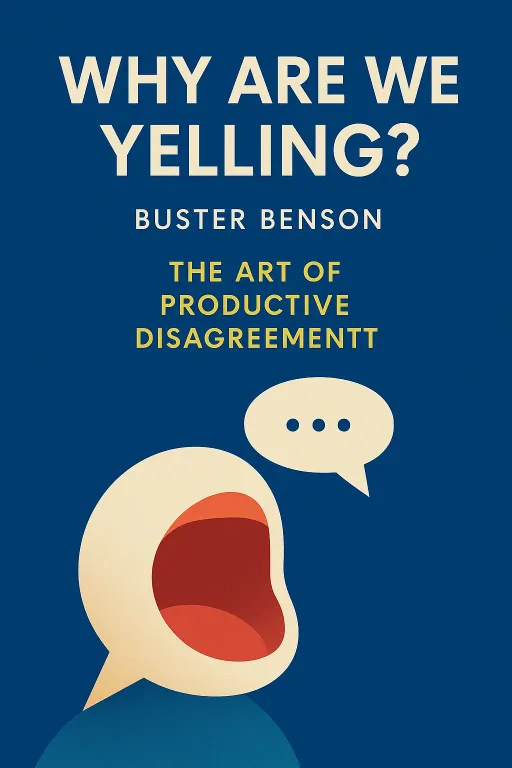
Nova: Exactly. And today, we’re drawing wisdom from two exceptional works that offer a clear roadmap out of that muddling. First up is Buster Benson’s "Why Are We Yelling?", which reframes arguments as opportunities for profound discovery. Benson, a fascinating figure with a background in tech and product management, brings a really unique, systems-thinking approach to human interaction, showing us how our brains often trip us up in these moments.
Atlas: Oh, I like that. A tech mind tackling human messiness. That’s promising. It makes it feel grounded and less abstract.
Nova: Absolutely. And then we have the classic, "Difficult Conversations" by Douglas Stone, Bruce Patton, and Sheila Heen. These authors aren't just academics; they're from the renowned Harvard Negotiation Project. This gives their work incredible real-world weight and a practical, research-backed foundation. They literally teach people how to negotiate peace treaties and complex business deals, and they apply that same rigorous thinking to our everyday challenging interactions.
Atlas: So, we’ve got brain science meets negotiation mastery. That sounds like a powerful combination for anyone who's ever felt trapped in a family argument that just goes nowhere. Because for many of our listeners, improving family communication isn't just a nice-to-have, it's about strengthening those core bonds, fostering connection.
Nova: Precisely. And what both works emphasize, despite their different origins, is this crucial insight: we need to move beyond the surface-level content of what’s being said to explore the deeper feelings, assumptions, and intentions that are truly fueling our conflicts. It's about shifting from blame to genuine understanding.
Atlas: Okay, I’m in. Because I imagine a lot of our listeners, especially those who value clarity and connection, are tired of circular arguments. They want to know, how do we actually this? What are the pragmatic steps?
The Stories We Tell Ourselves: Reframing Intentions
SECTION
Nova: Let’s start with Benson’s core idea in "Why Are We Yelling?" He argues that arguments are actually opportunities for discovery. But the reason we don't see them that way, the reason they often devolve, is because our brains are constantly misinterpreting intentions. We're telling ourselves stories about what others mean.
Atlas: Oh, I know that feeling! Someone does something, and instantly, my brain fills in the blanks with a narrative about they did it, and it's usually not a flattering one. It's like my brain has a default setting for 'worst-case scenario.'
Nova: Exactly! It’s a cognitive shortcut. Our brains are incredibly efficient, but sometimes that efficiency leads to assumptions that are completely off base. Think about a common family scenario: you've planned a family dinner, you've cooked, set the table, and your sibling shows up 45 minutes late, again.
Atlas: Ugh. Classic. My internal monologue immediately starts with, "They don't respect my time. They think their schedule is more important. They just don't care about my effort."
Nova: And that's your brain immediately crafting a story about their intention: disrespect, selfishness, thoughtlessness. And once that story is firmly in place, how do you feel? What's the emotional impact on you?
Atlas: Annoyed, frustrated, maybe a little hurt, actually. And then I'm probably going to greet them with a passive-aggressive comment about traffic, or a very pointed sigh, or just a cold silence.
Nova: And how do you think that sets the stage for the rest of the evening? For the quality of the connection you might have?
Atlas: It pretty much guarantees a tense atmosphere. It's a self-fulfilling prophecy, isn't it? I’ve already decided they’re the villain in my internal narrative, and I’m subtly ready for a fight, or at least a standoff.
Nova: That's the trap. Benson helps us see that this isn't necessarily malicious on our part; it's how our brains are wired to quickly make sense of the world. We fill in the gaps with the most readily available, often negative, story to protect ourselves. The "tiny step" he recommends, and our actionable takeaway today, is to consciously challenge that first story.
Atlas: So, when my sibling walks in late, and my brain starts screaming "they don't care," what do I do? How do I actively intervene in that thought process?
Nova: You pause. And you consciously consider. Maybe their previous appointment ran over unexpectedly, and they couldn't get a message to you. Maybe they had a genuine, urgent call they didn't want to worry you with. Maybe they got caught in unexpected traffic or took a wrong turn trying a new route.
Atlas: That sounds incredibly difficult in the moment, especially when I’m already stewing. How does that feel like an when my emotions are already high? It feels like just… thinking differently, which can be hard to force.
Nova: It thinking differently, but it's a deliberate, cognitive action. It’s a mental muscle you build with practice. The goal isn't necessarily to believe the alternative interpretations are true, but to to the possibility that your first, negative story might not be the whole truth. It shifts you from a mindset of judgment to one of curiosity. It’s about building momentum, even with small steps.
Atlas: Okay, I can see how that could be incredibly powerful. It’s like, instead of walking into a conversation with a preconceived verdict, you’re walking in with genuine questions. It’s about creating space for understanding, which is what I, and I think many of our listeners who are driven by connection, genuinely want in family interactions. It's not about letting people off the hook for their actions, but about getting to the hook of what's going on.
Nova: Exactly! And that shift in your internal monologue changes everything: your body language, your tone, your initial greeting. Instead of "You're late, again, how inconsiderate," it might be "Hey, everything alright? We were starting to wonder, glad you made it safely." The exact same situation, but a completely different energetic start, which can then lead to a completely different outcome.
Atlas: That’s fascinating. It’s like we have this default setting for conflict, and Benson is saying, "Hey, you can actively reprogram that default." For someone who's a focused achiever and values clarity, that idea of a mental hack to improve communication is really appealing. It’s a strategic approach to emotional situations.
Deconstructing Difficulties: The Three Conversations
SECTION
Nova: Once we’ve managed to shift our internal narrative and approach with curiosity, the next challenge is actually navigating the conversation itself effectively. And this is where the work of Stone, Patton, and Heen in "Difficult Conversations" becomes absolutely invaluable. They give us a framework to understand what’s going on beneath the surface.
Atlas: Because it’s never just about the dirty dishes, or the late sibling, is it? It always feels like there are layers upon layers, unspoken things, that make these conversations so heavy.
Nova: Oh, those layers are absolutely real! They deconstruct every challenging interaction into three distinct conversations happening simultaneously, whether we realize it or not. There’s "the what happened" conversation, "the feelings" conversation, and "the identity" conversation.
Atlas: Whoa. Three conversations at once? No wonder it’s so draining and confusing. It’s like trying to juggle three different balls while blindfolded.
Nova: Right? Let's take another common family example, perhaps a more complex one: a disagreement over holiday plans. One sibling wants to host the big family gathering, the other wants to travel with their immediate family, and the parents are caught in the middle, feeling the pressure.
Atlas: Okay, so "the what happened" would be the surface-level facts: who proposed what, who said no to what, the specific dates, the preferred locations, the logistics of travel or hosting.
Nova: Precisely. That’s the easiest one to focus on, and often, it’s the only one we we’re having. We argue about logistics, about fairness, about who's making more of an effort. But underneath that, bubbling just below the surface, is "the feelings" conversation.
Atlas: The feelings. So that's the unexpressed stuff. Like, one sibling might feel hurt that their offer to host was immediately shot down, feeling unappreciated for their effort. Or the other might feel overwhelmed by the thought of traveling with young kids, but they don't want to admit that vulnerability.
Nova: Exactly! Disappointment, frustration, feeling unappreciated, resentment, fear of inadequacy, a sense of obligation, or even just pure exhaustion. These emotions are powerful, and if they’re not acknowledged and addressed, they leak out as passive aggression, sarcasm, stubbornness, or just a general unwillingness to compromise on the "what happened" details. And then, the deepest, most subtle layer, is "the identity" conversation.
Atlas: The identity conversation? What does that even mean in the context of holiday plans? That feels incredibly profound for something as simple as Christmas dinner.
Nova: It’s about how we see ourselves, and crucially, how we want others to see us. For the sibling who desperately wants to host, maybe their identity is tied to being the "family glue," the generous one who keeps traditions alive, the competent manager of family gatherings. If their hosting offer is rejected, it’s not just about the plans; it’s a direct threat to that self-perception, that role they cherish.
Atlas: Oh, I see! Or for the sibling who wants to travel, maybe they see themselves as independent, adventurous, breaking free from old patterns. Or perhaps they feel like a failure if they can’t provide a magical, stress-free holiday for their kids, separate from the larger family pressures. This is about our deepest insecurities, our sense of worth, our fears of being perceived as selfish or incompetent.
Nova: You've got it. It’s profound. When we argue about holiday plans, we're rarely just arguing about where to eat turkey. We're arguing about respect, love, belonging, competence, autonomy, and our very place within the family system. And if we don't understand these three layers, if we don't peel them back, we'll keep arguing about the "what happened" and never get to the real, core issues.
Atlas: That’s going to resonate deeply with anyone who struggles with feeling misunderstood, or who tries to resolve a factual disagreement only to find it spirals into something much bigger. So, how do you even to untangle these layers in a live conversation, especially when everyone is already defensive and emotions are high? For someone who wants to integrate this into their busy life, this sounds like a lot of emotional heavy lifting.
Nova: The authors give us strategies for each layer. For "the what happened," it’s about moving from certainty to curiosity, just like Benson suggests. Acknowledge that everyone has their own story, their own valid perspective. For "the feelings" conversation, it’s about expressing your own feelings without judgment, and actively listening for others'. It's okay to say, "When you said X, I felt Y" rather than "You made me feel Y." It takes ownership.
Atlas: But wait, how do you approach the identity conversation? That feels so vulnerable. It's like exposing your deepest fears.
Nova: It absolutely is. And it’s often the hardest, but most crucial. It involves acknowledging your own vulnerabilities, and gently exploring theirs. It might sound like, "I know you work so hard, and I worry sometimes that I'm not pulling my weight in the family, and that makes me sensitive about how we divide things." Or "I know how important it is for you to feel like a good parent and create special memories, and I want to understand what's making this decision so hard for you." It’s about seeing the humanity in the struggle.
Atlas: So it's less about winning the argument and more about understanding the whole iceberg underneath. It's about seeing the human being behind the position they're taking. That’s a fundamentally different approach to conflict, moving it from a competitive arena to a collaborative exploration.
Synthesis & Takeaways
SECTION
Nova: So, bringing these two powerful ideas together: Buster Benson helps us manage our internal stories and reframe intentions, moving from judgment to curiosity. And Stone, Patton, and Heen give us the external framework to deconstruct the actual conversation into its factual, emotional, and identity layers.
Atlas: This really speaks to that core desire for connection and self-growth that so many of our listeners have. It’s not just about 'solving' a problem in the moment, but about building stronger, more resilient relationships over time. It's about achieving that clarity in communication that can feel so elusive, especially with family.
Nova: Exactly. It's about moving from a place where family disagreements feel like destructive forces, draining energy and creating distance, to seeing them as rich opportunities for deeper understanding and connection. Imagine how different your family dynamics could be if every difficult conversation became a chance to learn something new about each other, rather than just a rehash of old wounds.
Atlas: That’s a powerful vision. For anyone who's ever felt frustrated, unheard, or just plain exhausted by family friction, this offers a tangible, thoughtful path forward. So, as a tiny step, before your next potentially difficult family conversation, just take a moment to pause.
Nova: And ask yourself: what story am I telling myself about the other person's intentions? And can I consciously consider two alternative, more generous interpretations that might be equally plausible?
Atlas: And then, as you step into that conversation, remember those three layers: what happened, feelings, and identity. Try to listen not just for the facts, but for what’s truly being felt and what deeper parts of their identity might be at stake.
Nova: How might reframing family disagreements as opportunities for mutual learning completely change your approach to conflict at home? It's a profound question, and the answer could genuinely transform your most important relationships.
Atlas: That gives me chills. The idea that a seemingly small shift in perspective and a bit of framework can have such a ripple effect on our deepest connections.
Nova: It’s truly transformative.
Atlas: This is Aibrary. Congratulations on your growth!