Bridging Dental Science with Systemic Wellness
Golden Hook & Introduction
SECTION
Nova: Atlas, five words to describe the profound, almost secret, connection between your teeth and your entire body. Go!
Atlas: Hidden. Gateway. Ecosystem. Shocking. Essential. Your turn!
Nova: Mirror. Map. Foundation. Future..
Atlas: Ooh, "Whole." I like that. It’s concise and yet it hints at so much more than just a dental check-up.
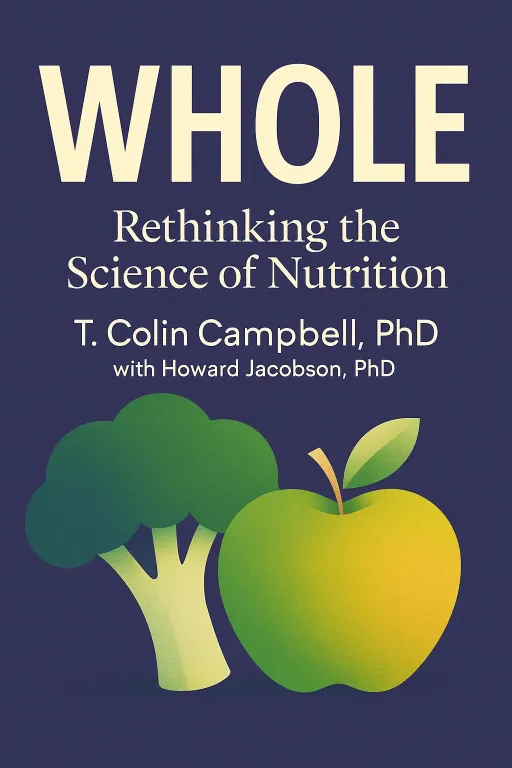
Nova: Exactly! Today, we're diving deep into that "whole" idea, challenging the way we've traditionally viewed health, starting right in the mouth. We're going to explore two groundbreaking books: T. Colin Campbell’s "Whole: Rethinking the Science of Nutrition" and Weston A. Price’s seminal work, "Nutrition and Physical Degeneration."
Atlas: Campbell, if I’m not mistaken, is a nutritional biochemist, right? The name rings a bell from a lot of discussions around plant-based diets.
Nova: That’s right! Campbell is a giant in the field, renowned for his extensive population studies, particularly his work in rural China, which really challenged the conventional wisdom on diet and disease. His scientific rigor, though sometimes debated for its interpretations, pushed the entire conversation towards a more holistic understanding of nutrition. And then we have Weston A. Price, a pioneer in a different sense. He was a dentist in the early 20th century who, before modern medicine truly grasped the systemic impact of nutrition, traveled the globe documenting traditional diets and their profound effects on dental and overall health.
Atlas: So, one is a biochemist looking at large data sets, and the other is a dentist observing ancient practices. It sounds like a fascinating combination, but how do books primarily focused on nutrition and indigenous diets connect so directly to, say, my last dental cleaning?
Nova: That's the beautiful bridge we're building today, Atlas. These books, through different lenses, reveal that the mouth isn't just a collection of teeth and gums; it’s a crucial gateway, a dynamic mirror reflecting the health of our entire ecosystem. What we see in the mouth is often a profound indicator of what’s happening deeper within the body. And that's where we start our journey.
Unveiling the Oral-Systemic Connection – Beyond Reductionism
SECTION
Nova: Most of us, and frankly, much of modern medicine, have been trained to see the body in silos. You go to the dentist for your teeth, the cardiologist for your heart, the gastroenterologist for your gut. That’s reductionist science at work. Campbell's "Whole" critiques this approach, arguing that by breaking everything down into isolated parts, we often miss the interconnectedness, the synergy of biological systems.
Atlas: That makes sense. It’s like trying to understand how a car works by only ever looking at the tires. You’d miss the engine, the transmission, the electrical system—all working together. So, how does this reductionist view specifically impact how we think about oral health?
Nova: It’s profound. We treat cavities with fillings, gum disease with deep cleanings, maybe antibiotics. All very localized. But what if that cavity isn't just about sugar on a tooth, but a symptom of a larger metabolic imbalance? What if that persistent gum inflammation is a sign of chronic systemic inflammation, perhaps stemming from gut health issues or unmanaged stress? Price’s work, decades before Campbell, gave us visual proof of this interconnectedness, long before we had the molecular science to explain it.
Atlas: Oh, I love that – "visual proof." Can you give us an example from Price’s travels that really hammers this home? Something that jumped out at you?
Nova: Absolutely. Price traveled to remote parts of the world, places where modern processed foods hadn't yet reached. He documented populations like the Swiss villagers in the Loetschental Valley or the Native American tribes in the Canadian Rockies. He’d show us photographs. On one page, you’d see a group of individuals, perhaps an older generation, with perfectly straight, broad dental arches, virtually no cavities, wide, open airways, and radiant health. Then, on the very next page, he’d show their children, or the generation after, who had begun adopting Western diets – white flour, sugar, canned goods.
Atlas: And what did he see in the second group? I’m imagining a stark contrast.
Nova: It was often shocking. The children would exhibit rampant dental decay, crowded and crooked teeth, narrower faces, and often, signs of chronic illness that were absent in their parents. These weren’t genetic changes; they were generational shifts occurring within a single lifetime, purely due to dietary changes. Price meticulously measured and photographed these changes, showing the rapid deterioration of facial structure and dental health, hand-in-hand with a decline in overall systemic well-being.
Atlas: Wow. So you’re saying diet could quickly impact facial structure and lead to crooked teeth, not just cavities? That’s wild. We’re often told orthodontics is just a genetic lottery.
Nova: It challenges that notion entirely, doesn't it? Price's observations suggest that proper nutrition, especially during crucial developmental stages, is fundamental for optimal facial and dental development. It provides the building blocks and the epigenetic signals for our bodies to express their full genetic potential. When that nutrition is compromised, the blueprint falters, and we see the consequences in crowded teeth, reduced airways, and compromised systemic health. It’s a powerful illustration of how the mouth truly is a window to the body's entire ecosystem, not just a separate entity.
Atlas: That’s a fundamentally different way to look at it. It makes me wonder, if diet can have such a profound and rapid impact, what does that mean for how we approach health in general? It feels like we’re missing a huge piece of the puzzle if we’re only ever focusing on the symptoms.
Bridging Ancient Wisdom and Modern Practice – The Integrative Blueprint
SECTION
Nova: That’s the exact question these books compel us to ask, Atlas. And it naturally leads us to the second key idea: how do we bridge this ancient wisdom, these profound observations, with our modern scientific understanding to create an integrative blueprint for health? For practitioners, and for all of us seeking wellness, it's about moving from theory to application.
Atlas: That’s what I was thinking. It’s one thing to say "eat traditional diets," but in a world of drive-thrus and processed everything, it feels like a massive leap from observing indigenous tribes to my daily life. And for a dentist, how do you even begin to ethically integrate this broader understanding without overstepping professional boundaries?
Nova: That’s a really crucial point, and it speaks directly to the "Deep Question" in our integrative practice blueprint: how to empower patients with holistic insights without becoming a nutritionist or a general physician overnight. The "tiny step" approach is key here: begin by observing and documenting specific cases where you suspect a systemic issue, like gut health or chronic stress, might be influencing a patient's oral health.
Atlas: Okay, so it’s about being a detective, looking for clues beyond just the obvious dental issues. Can you give an example? What would that look like in a dental chair?
Nova: Imagine a patient who comes in with persistent, recurring gum inflammation, despite excellent oral hygiene habits. A traditional approach might just prescribe stronger mouthwash or more frequent deep cleanings. But an integrative dentist, inspired by Price and Campbell, might start asking different questions: "How's your sleep? Have you been under unusual stress lately? How's your digestion? Any unexplained fatigue?" They might observe dry mouth, tongue coating, or even certain patterns of tooth wear that hint at systemic issues like chronic stress, nutrient deficiencies, or gut dysbiosis.
Atlas: So you're connecting the dots for them, showing them that their chronic gum issues aren't just an isolated problem, but a potential signal from their body.
Nova: Exactly. We’re not diagnosing a gut issue; we're simply empowering the patient with insights. We can say, "While we're treating your gums here, I've noticed a few things that often correlate with systemic inflammation. Have you ever considered exploring your gut health or stress management with a functional medicine doctor or a nutritionist?" It's about being a "bridge-builder," as our user profile describes, connecting patients to the right resources and helping them see their body as a coherent whole.
Atlas: That’s actually really inspiring. It’s not about abandoning modern dentistry, but enriching it with this deeper understanding. It makes me think about Campbell’s emphasis on whole foods. If we know diet is so foundational, then a plant-rich, whole-foods approach, which often mirrors traditional diets, becomes a foundational intervention for both oral and systemic health.
Nova: Precisely. It’s a foundational systemic intervention. When we recommend reducing processed foods and increasing nutrient-dense, whole plant foods, we’re not just thinking about a healthy heart or stable blood sugar. We’re simultaneously supporting healthy gums, strong teeth, and even optimal facial development for future generations, as Price so vividly illustrated. It’s about understanding that the mouth is not just a receptor of food, but a critical player in the entire digestive and immune system.
Atlas: So this isn’t just about treating symptoms anymore. It's about looking at the root cause, which often circles back to our diet and lifestyle, and how that impacts every single part of our being, starting with the very first gateway.
Nova: It truly is. It's about moving from fragmented care to truly compassionate, holistic care.
Synthesis & Takeaways
SECTION
Nova: Ultimately, Atlas, these books challenge us to fundamentally reconsider not just we eat, but we view health itself. They pull us away from the narrow, reductionist lens and invite us to see the human body as an intricately connected, self-regulating masterpiece.
Atlas: And realizing that perhaps the most revolutionary dental care starts not with a drill or a filling, but with a deeper understanding of our plates and our lifestyles. It makes you wonder, what else are we missing or compartmentalizing right under our noses? What other "separate" body parts are actually shouting warnings for the whole system?
Nova: Exactly! The journey to whole health truly begins at the mouth. It’s a powerful reminder that every choice we make, from the food we eat to how we manage stress, echoes throughout our entire system. And for practitioners, it’s an invitation to trust their innate wisdom, to look beyond the immediate symptom, and to empower their patients with a truly holistic perspective.
Atlas: It’s a call to observe, to connect, and to heal deeply. It's about seeing the mouth not as an isolated problem, but as a crucial indicator and an entry point for profound systemic wellness. Truly transformative insights today.
Nova: Indeed. This is Aibrary. Congratulations on your growth!