The Stress Paradox: Why Resilience Isn't Just for Crisis.
Golden Hook & Introduction
SECTION
Nova: Atlas, quick game. If you had to describe 'stress' in just five words, what would they be? Go!
Atlas: Ugh. Inescapable. Draining. Annoying. Necessary. And… frankly, a bit misunderstood.
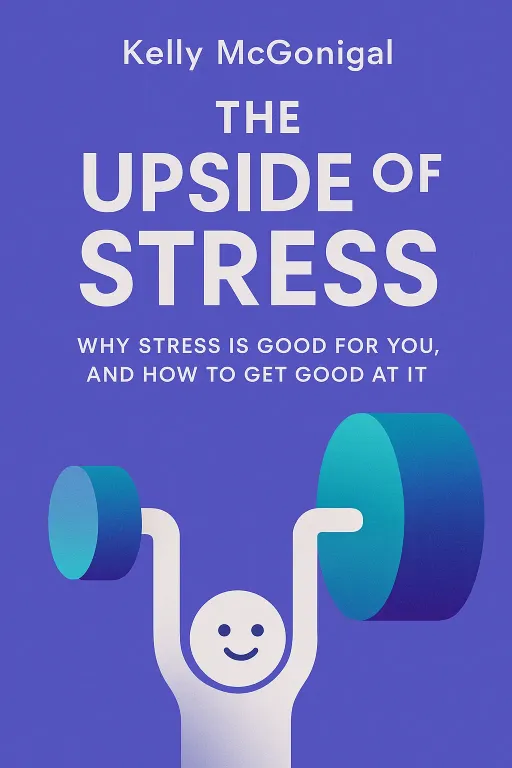
Nova: "A bit misunderstood." That's a perfect segue, because today we're diving into a fascinating paradox that completely flips our conventional understanding of stress. We're drawing insights from two incredible minds: Kelly McGonigal, a health psychologist whose book "The Upside of Stress" literally changed her own professional trajectory, and physician Gabor Maté, whose clinical observations in "When the Body Says No" offer a profound, often unsettling, look at the body's silent narrative of stress.
Atlas: So, we’re not just talking about ‘stress management’ here, are we? It sounds like we’re peeling back layers on something much deeper than just breathing exercises.
Nova: Exactly! McGonigal, for instance, started her career as a staunch advocate for stress reduction. She even taught Stanford’s "Science of Stress" course, promoting all the classic stress-busting techniques. But then, her research started pointing in a completely different direction, showing that simply trying to eliminate stress might be missing the point entirely. She pivoted, asking: what if our relationship with stress is the variable that truly matters?
The 'Stress Paradox': Why Our Perception of Stress Matters More Than Stress Itself
SECTION
Nova: Think about it: we're constantly told stress is bad for us. It kills brain cells, it ages us, it causes heart disease. And, yes, chronic, unmanaged stress absolutely does that. But McGonigal's work highlights a critical distinction: it’s not the stressor itself, but our body’s response to it, that dictates its impact.
Atlas: Hold on. So you’re saying that the pounding heart, the sweaty palms, the surge of adrenaline – those things I usually associate with a mini-panic attack before a big presentation or a complex system deployment – aren’t inherently destructive? For someone in a high-stakes engineering environment, that physical reaction often feels like a warning sign, a system going into red alert.
Nova: That's the crux of her argument. She points to a groundbreaking Harvard study, often called the 'social stress test.' Participants were subjected to a mock job interview, designed to be highly stressful. One group was taught to view their stress response – the increased heart rate, rapid breathing – not as anxiety, but as their body preparing them for peak performance, energizing them to meet the challenge.
Atlas: So, a reframe. Instead of thinking ‘Oh no, I’m scared,’ it’s ‘My body is getting me ready to perform.’
Nova: Precisely. And the results were fascinating. The group who reframed their stress responses not only felt more confident and performed better in the interview, but their cardiovascular profiles were healthier. Their blood vessels remained relaxed, rather than constricting, which is the typical, unhealthy response to chronic stress. It’s almost like their heart was still pumping hard, but it was doing so in a much more efficient, less damaging way.
Atlas: That's actually really inspiring. So, for someone who thrives on data, this isn’t just a feel-good mantra; there’s a physiological mechanism at play. It’s like optimizing a system. If I, as an engineer, see a warning light, my first instinct is to find the fault. But you’re suggesting the warning light itself isn’t the fault; it’s my interpretation of its meaning that can either lead to system failure or system optimization.
Nova: Exactly! It’s a shift from 'threat' to 'challenge.' When we view stress as a challenge, our bodies produce DHEA and oxytocin alongside cortisol. Cortisol is the stress hormone we all know, but DHEA is actually a neurosteroid that helps with growth and repair, and oxytocin is often called the 'cuddle hormone,' but it also plays a crucial role in social bonding and resilience, encouraging us to seek support.
Atlas: So, it’s not just about toughing it out. It’s about leveraging this biological cocktail. It makes me wonder about our default settings then. Why do we so easily default to the negative interpretation of stress? Because it seems like the default for most people, especially in demanding fields, is to see stress as something to be endured, not embraced.
The Somatic Narrative: How Unprocessed Stress Manifests in the Body
SECTION
Atlas: And that naturally leads us to the second key idea we need to talk about, which often acts as a counterpoint to what we just discussed. While McGonigal shows us how to stress in the moment, what happens when stress isn't reframed at all, but instead buried, ignored, or chronically suppressed? That's where Gabor Maté’s work, particularly in "When the Body Says No," becomes incredibly illuminating.
Nova: Oh, Maté. His insights are both profound and, at times, heartbreaking. He spent decades working with patients, from addiction to palliative care, and saw patterns that conventional medicine often overlooks.
Atlas: He did. Maté argues that many chronic illnesses – from autoimmune diseases to certain cancers – are not just random biological misfortunes. Instead, they are often the body’s physical manifestation of unaddressed emotional trauma and chronic stress, particularly the stress of emotional suppression. He calls it the 'somatic narrative.'
Nova: That's a powerful phrase: the 'somatic narrative.' So the body literally tells the story that the mind couldn’t or wouldn’t express?
Atlas: Precisely. He gives numerous case studies, but one that always sticks with me is the pattern he observed in many of his patients with autoimmune diseases. Often, these individuals were deeply compassionate, highly responsible people who consistently put others' needs before their own. They struggled to say no, to express anger, or even to acknowledge their own emotional pain.
Nova: The classic 'nice person' syndrome, but taken to a pathological extreme, where the body ends up paying the price. I imagine a lot of our listeners, especially those driven by impact and community building, might resonate with that. The desire to improve the world, to optimize systems, can sometimes lead to neglecting the self.
Atlas: It’s a profound internal conflict. Maté describes how this constant self-sacrifice, coupled with the suppression of authentic emotions, creates an internal environment of chronic stress. The immune system, designed to protect the body, essentially gets confused and starts attacking itself. It’s not a direct, simple cause-and-effect, but a complex interplay where the emotional environment significantly impacts biological function. It's like a grand, meticulously designed urban infrastructure project: if there's a hidden, fundamental flaw in the design – say, a buried pipe that's constantly leaking – eventually, no matter how beautiful the facade, the whole system starts to show cracks, not necessarily where the leak is, but the consequences manifest in unexpected places.
Nova: That's such a vivid analogy, Atlas. And it ties back to the user profile of someone who seeks to optimize and build. If the 'system' is the human body, and the 'optimization' is self-care and emotional honesty, then ignoring those 'leaks' of unexpressed stress ultimately undermines the entire structure.
Atlas: Absolutely. Maté’s work isn't about blaming the victim; it's about empowerment through self-awareness. It's about understanding that our bodies are constantly communicating with us, and often, our deepest wounds manifest as physical symptoms because we haven’t given ourselves permission to process the emotional load.
Synthesis & Takeaways
SECTION
Nova: So, bringing these two powerful perspectives together, it's clear stress isn't a monolithic enemy. On one hand, McGonigal shows us the incredible power of reframing our immediate physiological responses to stress, transforming it from a threat into an enabler of performance and resilience. On the other hand, Maté reminds us that there's a deeper, often unacknowledged layer of stress – the chronic emotional patterns and suppressed feelings that can silently erode our health over years, manifesting as illness.
Atlas: It’s about both the and relationship with stress. It’s not just about thinking positively about a deadline, but also about asking: what deep, unaddressed emotional patterns might be contributing to my overall stress load? For those of us who are analytical, who thrive on optimizing and building, it's a call to apply that same systematic approach to our internal landscape. To recognize that the human element isn't just about data; it's about the lived experience, the stories our bodies tell.
Nova: What a profound thought, Atlas. It's an invitation to view our next challenge not just as an opportunity for growth in the external world, but also as an opportunity for profound internal growth – to both harness the power of acute stress and to listen deeply to the quiet, persistent narratives of our bodies. What a powerful way to redefine resilience.
Atlas: Absolutely. For our listeners who are constantly optimizing systems and shaping communities, how might viewing your own physical and mental energy as a complex, interconnected system – one that requires both conscious reframing and deep emotional listening – fundamentally change your approach to well-being?
Nova: This is Aibrary. Congratulations on your growth!