Beyond Diet and Exercise: The Mind-Body Connection to Wellness
Golden Hook & Introduction
SECTION
Nova: What if everything you've been meticulously taught about health, about what keeps you well, is missing a crucial, monumental piece of the puzzle? What if the very foundation of how we approach sickness and wellness is built on a blind spot?
Atlas: Oh, I like that, Nova. That's a bold claim right out of the gate. For someone who values clear logic and understanding foundational principles, that immediately piques my interest. Are we talking about some revolutionary new diet, or is this something far more… internal?
Nova: Far more internal, Atlas. Today, we’re peeling back the layers on a truth that's both ancient and radically modern, brought to vivid life by two brilliant minds: Gabor Maté with his groundbreaking work,, and Robert M. Sapolsky's essential read,. These authors didn't just write books; they shifted paradigms in how we understand our health. They argue that our emotional experiences, our stress, our hidden traumas, are not just "mental states," but profoundly physical realities that shape our biology.
Atlas: That sounds like a powerful re-framing. We often compartmentalize, right? Our doctor handles the body, our therapist handles the mind. But you're suggesting these works force us to confront the seamless connection between the two.
Nova: Exactly. And the implications are staggering. Today we'll dive deep into this from two perspectives. First, we'll explore how our bodies silently carry the weight of our emotional lives, then we'll discuss the evolutionary paradox of human stress and why it makes us uniquely vulnerable.
The Body's Silent Language: Repressed Emotions and Physical Illness
SECTION
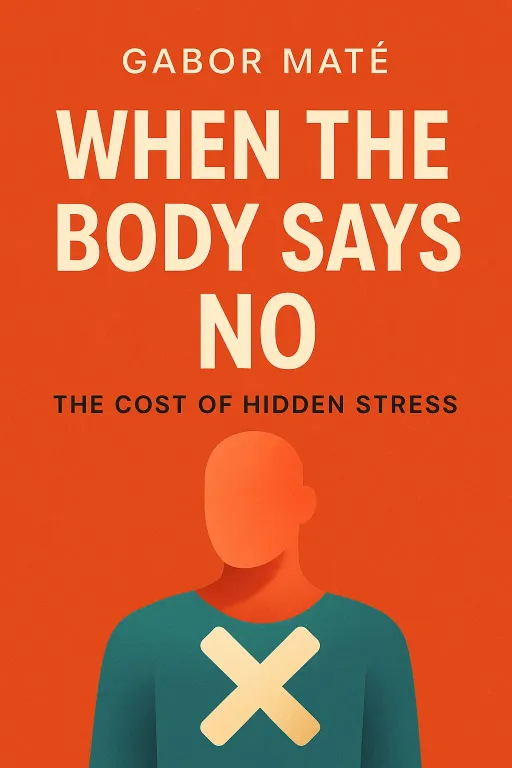
Atlas: So, let's start with Maté and. The title itself is incredibly evocative. What exactly is he getting at when he talks about the body saying no?
Nova: He's getting at something truly profound and often deeply uncomfortable for us to acknowledge. Maté, a physician with decades of clinical experience across diverse populations, argues that chronic illness—everything from autoimmune diseases like MS and Crohn's, to cancer, to fibromyalgia—isn't just a random biological malfunction. He posits that these conditions are often the body's ultimate, desperate "no" to a lifetime of unexpressed emotions, suppressed needs, chronic stress, and unresolved trauma.
Atlas: Wait, so we're talking about more than just "stress headaches" or feeling run down? This is profound physical illness, potentially life-threatening, stemming from our emotional lives? That's a massive leap for many people to make.
Nova: It absolutely is, and it challenges the very bedrock of conventional medicine, which tends to view the body as a machine separate from the mind. Maté doesn't claim that psychological factors these diseases in isolation, but that they create the physiological terrain, the vulnerability, within which disease can take root and flourish. He shows how chronic stress, the inability to say "no," the constant need to please others, or the repression of anger and grief, can profoundly dysregulate our immune system, our hormonal balance, and our nervous system.
Atlas: Can you give an example? Because for an analyst, I need to see the pattern, the cause-and-effect chain. How does a repressed emotion translate into, say, an autoimmune condition?
Nova: Maté shares countless case studies, but one that always strikes me is the story of "Susan." Susan was a woman who, from childhood, learned that her value came from being agreeable, from always putting others' needs before her own. She was the quintessential "good girl," the caregiver, the one who never complained. Internally, she carried immense resentment and stress, but she never expressed it, believing it was her duty to remain cheerful and accommodating. Her body, however, was speaking a different language. She developed a severe autoimmune disease where her immune system began attacking her own tissues.
Atlas: Oh man. So, her body was literally turning against itself, mirroring her internal conflict of self-sacrifice?
Nova: Precisely. Maté meticulously charts how her lifelong pattern of emotional repression and chronic self-denial led to a state of constant physiological stress. Her nervous system was perpetually in "fight-or-flight," her immune system became confused and overactive due to the constant internal alarm bells, and eventually, it manifested as a physical attack on her own body. The body, in essence, had to create a crisis to force her to stop, to say "no," something she could never do verbally. It’s a powerful illustration of the body keeping the score of every unacknowledged emotion, every unfulfilled need.
Atlas: That's incredibly vivid, and almost heartbreaking. It really hammers home that our biographies become our biology. For someone who seeks understanding, this reveals a sharp mind at work, connecting eras of personal experience to present-day physical symptoms. But it also raises a deep question: if our emotions are so powerfully linked to our physical state, what's the underlying mechanism? And why are humans so uniquely vulnerable to this internal warfare?
The Paradox of Stress: Why Our Brains Make Us Sick
SECTION
Nova: That's a perfect pivot, Atlas, because it brings us directly to Robert Sapolsky and. Sapolsky, a neuroendocrinologist and primatologist, offers the scientific explanation for humans, unlike zebras, are so prone to chronic stress and its devastating health consequences.
Atlas: Right. Zebras face life-or-death situations regularly—a lion chase, for instance. But once the threat is gone, they're back to grazing. No lingering anxiety about future lion attacks or replaying the near-death experience.
Nova: Exactly! That's the fundamental insight. Zebras experience acute stress. Their physiological stress response—adrenaline surging, heart pounding, blood rushing to muscles—is perfectly adapted for immediate physical threats. It's a short-term, life-saving burst. Once the lion is gone, their system returns to baseline. They don't lie awake at night worrying about their herd's quarterly earnings report or the existential dread of climate change.
Atlas: That makes perfect sense. So, our advanced brains, which give us so much, are also our Achilles' heel when it comes to stress? What's the evolutionary "trade-off" there?
Nova: It's the ultimate paradox. Our prefrontal cortex, the seat of complex thought, planning, memory, and imagination—the very thing that makes us human, that allows us to build civilizations and ponder the cosmos—also allows us to threats that aren't physically present. We can worry about a job interview next week, ruminate on a past argument, or obsess over a potential future crisis.
Atlas: And our bodies can't tell the difference between a real lion and an imagined one, can they?
Nova: Precisely! When we worry, when we feel anxious, when we suppress emotions like Susan did, our bodies launch the same physiological response as if a lion were chasing us. But instead of a quick burst and recovery, it becomes a chronic state. This constant activation of the stress response—elevated cortisol, prolonged adrenaline—begins to wreak havoc. It suppresses our immune system, damages our cardiovascular system, impairs digestion, disrupts sleep, and even shrinks parts of our brain.
Atlas: So, for someone who looks for historical patterns, is this a relatively modern problem, or have humans always struggled with chronic psychological stress? Because it feels like the pace of modern life has certainly amplified it.
Nova: That's a brilliant question. While our modern world, with its constant digital stimulation and societal pressures, certainly amplifies chronic stress, the for it has always been part of the human condition due to our cognitive abilities. However, the and of psychological stressors that aren't immediately resolved with physical action, that's undeniably a hallmark of modern life. We've created a world where our minds are constantly engaged in non-physical "threats," and our bodies are paying the price. The human stress response, designed for survival over millennia, is now often working against us.
Synthesis & Takeaways
SECTION
Nova: So, bringing Maté and Sapolsky together, we see a powerful, undeniable truth: our health is an integrated narrative. It's not just about what we eat or how much we exercise, but profoundly about how we live, how we feel, and how we process the world emotionally.
Atlas: That really shifts my perspective. If our bodies are truly keeping score, what does that mean for how we approach self-care not just physically, but emotionally and mentally? It feels like it adds an immense layer of responsibility, but also immense potential for healing.
Nova: It means recognizing that your body isn't just a machine to be fixed when it breaks, but a highly intelligent messenger. It's constantly communicating the state of your inner world. Maté would argue that true healing often begins when we listen to those silent signals, when we start to address the underlying emotional burdens and unexpressed needs. Sapolsky gives us the scientific framework for understanding that listening is so critical to our physical well-being.
Atlas: That's an incredibly powerful synthesis. It's about cultivating self-awareness, isn't it? Not just about what we consume, but what we. It makes me wonder, where in our current health journey might we be overlooking the silent signals our body is sending about our emotional state? What small, unacknowledged stress or repressed feeling might be subtly shaping our physical reality?
Nova: An essential question, Atlas. It's a call to profound self-reflection, and perhaps, a deeper compassion for ourselves. The body speaks; are we listening?
Atlas: Food for thought indeed. This is Aibrary. Congratulations on your growth!