The Art of the Unseen Fight: Decoding Covert Aggression
Golden Hook & Introduction
SECTION
Nova: Naa, have you ever walked away from a conversation not feeling angry, but just… confused? Like you've somehow lost ground, but you can't pinpoint a single mean word that was said? You feel a little guilty, a little off-balance, and you're left wondering, 'Wait, am I the problem here?'
Naa: Absolutely. It's such a disorienting feeling. It's like psychological vertigo. You know something is wrong, your gut is screaming it, but your logical brain can't find the evidence. It's incredibly isolating.
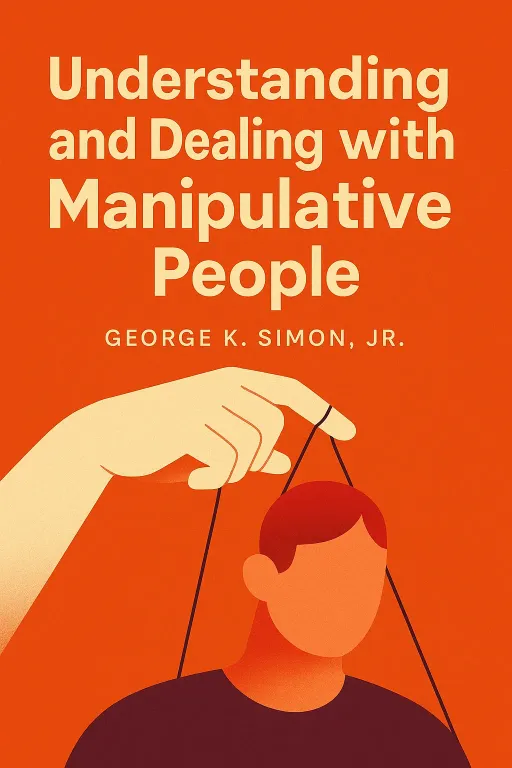
Nova: That unsettling feeling is the first sign you’ve been in a fight you didn't even know was happening. And that's the core of what we're exploring today, using the incredible insights from Dr. George K. Simon's book, 'Understanding and Dealing with Manipulative People.' For anyone like you, Naa, who is so interested in empathy and emotions, this book is a crucial read. It’s about understanding how the beautiful human quality of empathy can be weaponized against us.
Naa: That’s a fascinating and slightly terrifying frame. I love it.
Nova: Right? So today we'll dive deep into this from two perspectives. First, we'll define this 'unseen fight' of covert aggression and what it feels like to be a target. Then, we'll open the manipulator's playbook, breaking down the most common tactics they use to control us, and finally, we'll land on one powerful tool to start taking our power back.
Deep Dive into Core Topic 1: The Unseen Fight: Defining Covert Aggression
SECTION
Nova: So let's start with that core idea, Naa. Dr. Simon calls it 'covert aggression.' It's not overt, like shouting, and it's not passive-aggressive, like the silent treatment. He says it's an active, but hidden, fight for advantage. The book gives this perfect, subtle example. Imagine a family: a mother, Mary, a father, Joe, and their daughter, Lisa. Lisa's grades are slipping, and she's becoming withdrawn. Mary, the mother, is worried about the pressure Joe is putting on Lisa to get straight A's.
Naa: A classic family stressor. I can already feel the tension.
Nova: Exactly. So Mary gently approaches Joe. She suggests that maybe his demands are a bit unreasonable. And Joe, calmly and without raising his voice, replies, "Shouldn't any good parent want their child to do well and succeed in life?"
Naa: Oof. There it is. That's the trap.
Nova: What do you see happening there?
Naa: He's not answering her concern, which is about the. He's completely sidestepped it and reframed the entire conversation into a test of her quality as a parent. It's a question you can't say 'no' to without feeling like a monster. He's not arguing the point; he's attacking her character, but in a way that sounds perfectly reasonable. It's brilliant, and it's terrifying.
Nova: It is. And it works. Mary feels insensitive and backs down. A little later, she tries a different approach. She suggests maybe they could all go to family counseling. And Joe's response? He says, "Are you saying I'm psychiatrically disturbed?"
Naa: Wow. Another masterclass in deflection. He's taking her suggestion for collaborative help and twisting it into a personal accusation. Now she's not just insensitive, she's accusatory. He's making it impossible for her to raise a concern without being painted as the villain.
Nova: And that's the essence of covert aggression. The book says, "When you're being manipulated, chances are someone is fighting with you for position, advantage, or gain, but in a way that's difficult to readily see." Mary walks away from these conversations feeling confused, full of self-doubt, and even resentful, but she feels like she be resentful, which just adds another layer of guilt.
Naa: And it really speaks to why we fall for this. Why does Mary doubt her own gut feeling? Because most of us operate on good faith. We want to believe our partner has good intentions. Our empathy makes us ask, 'Maybe he's right? Maybe I being insensitive?' The manipulator counts on us using our own conscience against ourselves.
Nova: That is the perfect summary of the dynamic. They leverage our own desire to be fair and understanding. And that idea—that they count on our conscience—is the perfect bridge to our second topic.
Deep Dive into Core Topic 2: The Manipulator's Playbook: Tactics of Control
SECTION
Nova: If covert aggression is the war, then what are the weapons? The book details a whole playbook of tactics, and there's this one heartbreaking story of a woman named Janice and her partner, Bill, that shows these tactics in action.
Naa: Okay, I'm ready.
Nova: So, Janice is in a long-term, draining relationship with Bill. He drinks, he complains, and she's a classic caretaker who feels guilty for not doing enough. Finally, she reaches her breaking point and decides she needs space. She tells Bill she's going to visit her sister for a while to sort things out.
Naa: Good for Janice. Setting a boundary.
Nova: You'd think so. At first, Bill is surprisingly supportive on the phone. But then, his calls start to change. His voice gets a little shaky, a little slurred. He talks about how lonely he is, how the kids miss her. This is a tactic Dr. Simon calls. Bill knows Janice is a conscientious person, and he's deliberately poking at her sense of responsibility.
Naa: He's making his well-being her problem to solve, even from a distance. It's a way of pulling her back into the caretaker role she was trying to escape.
Nova: Precisely. Janice feels more and more guilty. But she holds firm. So Bill escalates. One night, Janice gets a call from the local hospital. Bill has been admitted for an overdose.
Naa: Oh no. That's the nuclear option.
Nova: It is. Janice rushes to the hospital, her mind racing, consumed with guilt. She sees Bill lying in the bed, looking weak. But then the doctor pulls her aside and says the overdose wasn't actually that serious. It was a cry for help. But for Janice, it's too late. The guilt has won. She sees him as a victim, and she believes she was selfish for leaving. She goes back to him.
Naa: That is just devastating. He's using the ultimate form of another tactic Simon lists:. It's so effective because it triggers Janice's deepest caretaking instincts and makes her feel responsible for his very life. It completely erases her own needs from the equation.
Nova: It completely erases them. And the book has this brilliant analogy for why she stays, and why so many people stay in these cycles. It's called the 'Slot Machine Syndrome.'
Naa: I'm intrigued.
Nova: Think about it. Why do people play slot machines? They're mostly losing, right? But they keep pulling the lever because every once in a while, they get a small 'win.' A few coins clatter down. That intermittent reward is incredibly addictive. In the relationship, Janice keeps putting in her time, her love, her emotional energy. Most of the time, she's losing. But every once in a while, Bill gives her a small 'win'—a moment of kindness, a flash of the man she fell in love with. She's invested so much, she can't walk away, because maybe the next pull of the lever will be the jackpot.
Naa: That's such a powerful model. It completely changes the narrative. It removes the unhelpful question, 'Why doesn't she just leave?' and replaces it with a clear psychological mechanism. It's not a failure of her character; it's a feature of the manipulative system she's trapped in. That reframing is so important for having empathy for victims of manipulation. You see that they aren't weak; they're hooked.
Nova: Exactly. They're hooked. And recognizing the game, recognizing the tactics, is the first step to unhooking yourself.
Synthesis & Takeaways
SECTION
Nova: So, we've seen that manipulation is this hidden fight, this covert aggression. And we've exposed some of the key tactics from the manipulator's playbook, like Guilt-Tripping and Playing the Victim.
Naa: And crucially, we've seen how our own best qualities—our empathy, our conscience, our willingness to see the good in others—can be the very things they use against us. It’s a sobering thought.
Nova: It really is. The book offers so many tools for fighting back, for redefining the terms of the engagement. But there's one I think is the most powerful and practical place to start. Dr. Simon says:
Naa: Say more about that. That feels really important.
Nova: We can drive ourselves absolutely crazy trying to get inside someone's head. 'Did he to hurt me?' 'Was she to make me feel guilty?' 'Maybe they're just insecure.' That's a trap, especially for empathetic people. But Dr. Simon says to ignore the 'why.' Just look at the action and its effect. The action was a guilt-trip. The effect was you felt bad. The action was a subtle put-down. The effect was you lost confidence. The action itself is all the data you need.
Naa: That's it. That cuts through all the noise and self-doubt. It’s not about diagnosing them or proving their malice. It's about recognizing a harmful pattern and protecting yourself. It shifts the focus from their internal state, which we can never know, to our own experience, which is undeniable.
Nova: Exactly. It gives you permission to trust your own reality.
Naa: So I guess the question for our listeners to take away is this: where in your life have you been focusing on someone's supposed 'good intentions' while ignoring the consistently negative impact of their actions?
Nova: A powerful question to end on. Naa, thank you for helping us decode this.
Naa: This was fascinating. Thank you, Nova.