

Personalized Podcast
Golden Hook & Introduction
SECTION
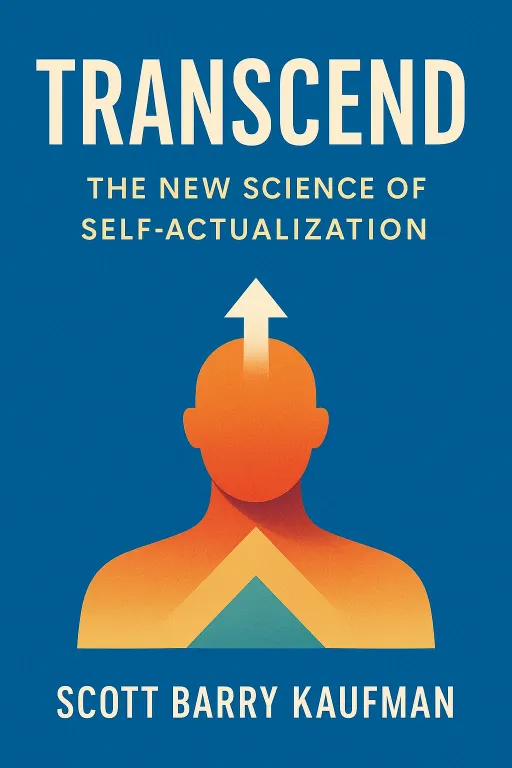
Albert Einstein: Imagine you are tasked with designing a structure to withstand the chaotic, unpredictable forces of nature. If you build a rigid, heavy pyramid, it might stand still, but it cannot move. It cannot explore. Now, what if the human soul is not a monument to be built, but a vessel designed to navigate the open sea? Welcome to our discussion of Scott Barry Kaufman's brilliant book,. Today, we are going to tackle this book from three different angles. First, we will explore why the classic pyramid of needs is a mechanical design flaw and replace it with Kaufman's dynamic sailboat metaphor. Then, we will discuss the neurobiology and mechanics of exploration, looking at how we turn anxiety into stress tolerance. And finally, we will focus on Theory Z and how true transcendence aligns our individual agency with the common good. Joining me today is Eugene, a mechanical engineering student, social innovator, and a wonderfully analytical thinker. Eugene, it is a pleasure to have you here.
Eugene: Thanks, Albert. It is fantastic to be here. You know, as an engineer, when I first looked at Kaufman's critique of the classic Maslow pyramid, it immediately clicked. In engineering, we talk about static versus dynamic systems. The pyramid, which, as Kaufman points out, Maslow himself never actually drew—it was created by a management consultant in the 1960s—is a static structure. It implies that once you complete a level, like a video game, you are done. But human life is a fluid, turbulent environment. We do not live in a vacuum; we live in a sea of constant change.
Albert Einstein: Ah, yes! The fluid dynamics of existence! It is a beautiful way to put it. If you are locked in a rigid pyramid, a sudden wave of adversity—a loss of a job, a health crisis—can shatter the structure. But a sailboat? A sailboat is designed to interact with the waves. It is a self-correcting cybernetic system. Let us look at how Kaufman breaks down this sailboat. He divides it into two main parts: the hull, which represents our security needs, and the sail, which represents our growth needs.
Eugene: Exactly. And from a mechanical perspective, the hull is all about stability. Kaufman identifies three components of the hull: safety, connection, and self-esteem. If your hull has a leak—say, you lack physical safety, or you feel deeply isolated, or your self-esteem is fragile—the boat takes on water. You cannot focus on sailing if you are constantly bailing out water just to stay afloat.
Albert Einstein: Quite so! A leaky hull keeps you trapped in what Maslow called the D-realm, or the Deficiency realm. You are motivated by lack, by fear, by the desperate need to survive. But tell me, Eugene, how do you see the relationship between these security needs and the concept of equilibrium in engineering?
Deep Dive into Core Topic 1
SECTION
Eugene: In engineering, we have the concept of dynamic equilibrium. A system is not static; it is constantly adjusting to external forces to maintain balance. If you look at the hull, safety is your baseline structural integrity. But connection and self-esteem are where the feedback loops get really interesting. Kaufman talks about how our social protection system evolved to keep us safe. When we feel rejected, it actually registers in the brain similarly to physical pain. It is a warning light on the dashboard saying, "Structural integrity compromised!"
Albert Einstein: Yes, the brain is a marvelous instrument of survival. It reminds me of the classic experiments by Harry Harlow on infant rhesus monkeys, which Kaufman discusses. The prevailing view back then was that infants only loved their mothers because they provided food—a very transactional, mechanical view of connection. But Harlow gave the monkeys two surrogate mothers: one made of cold, bare wire that provided milk, and another made of soft terrycloth that provided no food. And what happened? The baby monkeys clung to the cloth mother for comfort, especially when frightened. They needed that secure base, that physical reassurance, to feel safe enough to explore.
Eugene: Right, it shows that connection is not a luxury; it is a fundamental safety requirement. Without that secure base, the monkey's system goes into a state of high entropy—disorder and anxiety. In engineering, entropy is the measure of disorder in a closed system. Without a secure connection, our psychological system becomes highly entropic. We see this in adults with insecure attachment styles. They often make choices that inadvertently bring about the very rejection they fear, creating a destructive feedback loop.
Albert Einstein: It is a tragic paradox, is it not? The spy in enemy territory, as Maslow put it, who views everyone with suspicion and thereby invites hostility. But let us move to the third part of the hull: self-esteem. Kaufman makes a crucial distinction here between healthy self-esteem and narcissism. Healthy self-esteem is built on two pillars: self-worth, the feeling that you are a good person with social value, and mastery, the feeling of agency and competence. Narcissism, on the other hand, is a fragile, inflated balloon. It is grandiose or vulnerable, but always dependent on constant external validation.
Eugene: Yes, and from a systems perspective, narcissism is an unstable equilibrium. It requires an enormous amount of energy to maintain that inflated self-image. If a single pinprick of criticism hits it, the whole system collapses into anger or shame. Healthy self-esteem, however, is a stable equilibrium. It is grounded in genuine competence and warm relationships. It allows you to accept feedback without your entire identity being threatened. It is like having a well-designed ballast in the hull of your sailboat. It keeps you upright even when the wind blows hard.
Albert Einstein: A ballast! What a wonderful analogy. The heavier and more centered the ballast of self-worth and mastery, the more stable the boat, allowing you to carry a much larger sail. And that sail, of course, is what allows us to catch the wind of growth.
Deep Dive into Core Topic 2
SECTION
Albert Einstein: Now, let us unfurl the sail. Kaufman identifies the growth needs as exploration, love, and purpose. Let us start with exploration. It is the drive to seek out and make sense of novel, challenging, and uncertain information. It is the very engine of plasticity, as personality neuroscientist Colin DeYoung describes it. While stability protects our goals, plasticity is the urge to explore and create new ones.
Eugene: This is where the engineering mindset really resonates with the psychological. When we explore, we are deliberately introducing a controlled amount of uncertainty into our system. If we stay entirely in our comfort zone, our system is stable, but it is stagnant. We do not grow. But if we step too far out without a secure hull, we experience chaotic entropy—panic. Growth happens at the boundary, where we push our limits just enough to learn. Kaufman talks about stress tolerance as a key component of exploration. It is the willingness to embrace the anxiety of the unknown.
Albert Einstein: Yes! Think of the extraordinary free solo climber Alex Honnold, whom Kaufman highlights. He climbed the three-thousand-foot granite wall of El Capitan with absolutely no ropes or safety gear. To the casual observer, it looks like madness, a reckless search for an adrenaline rush. But researchers studied Honnold's brain and found something fascinating. When shown highly disturbing images, his amygdala—the brain's threat detector—showed almost no activity. He had not simply been born without fear; he had trained himself through years of meticulous preparation to manage uncertainty. He turned a high-entropy situation into a highly controlled, structured system.
Eugene: Exactly. He mapped out every single handhold and foothold, memorizing the physical choreography of the climb. He reduced the entropy of the unknown through deliberate, systematic preparation. As an oboe player, I see a parallel here. The oboe is a notoriously difficult, unstable instrument. The double reed is highly sensitive to temperature, humidity, and air pressure. If you just blow into it without preparation, it sounds like a dying duck—pure chaos, high entropy! But through thousands of hours of practice, you learn to control the micro-muscles in your embouchure, to anticipate the reed's response, to turn that unstable system into a vehicle for beautiful music. You build stress tolerance through mastery.
Albert Einstein: That is a marvelous connection, Eugene! The oboe as a cybernetic system of breath, wood, and reed. And the driver behind all this seeking, this desire to master the instrument or climb the mountain, is dopamine. We often think of dopamine as the pleasure chemical, but neuroscientists now know it is the chemical of anticipation, of wanting. It is the fuel that drives us to explore the next horizon, to ask the next question. It makes the unknown feel intoxicating rather than terrifying.
Eugene: Right, dopamine is the engine of the sail. It pushes us to expand our boundaries. But exploration is not just about physical adventure or intellectual curiosity; Kaufman also talks about social exploration—being curious about other people, seeking out novel social experiences without the defensive armor of our insecurities. And he also discusses posttraumatic growth, the profound psychological restructuring that can happen after a crisis. When a trauma shatters our old worldview—our old pyramid, if you will—we are forced to rebuild. And often, the new structure we build is much more resilient, open, and integrated than the old one.
Albert Einstein: "Though the physicality of death destroys us, the idea of death may save us," as the existential psychotherapist Irvin Yalom so beautifully wrote. Confronting our limitations, our mortality, can be the ultimate catalyst for opening the sail. It forces us to ask: what truly matters? And that leads us directly to the next growth need: love. Not the deficiency-love, or D-love, which is selfish and needy, but B-love—Being-love. A love that admires the being of the other person without wanting to possess or change them.
Eugene: B-love is like looking at a beautiful flower and letting it grow in the soil, whereas D-love is plucking it to keep for yourself, which ultimately kills it. In relationships, B-love requires a high degree of integration. It is the synergy of individuality and connectedness. You do not lose yourself in the other person; instead, your secure boundaries allow you to connect even more deeply. It is a non-possessive, unconditional positive regard that actively supports the other person's growth.
Albert Einstein: And when we combine exploration and love, we find our sail fully catching the wind, propelling us toward the third growth need: purpose. Purpose is an overarching aspiration that organizes our lives, giving us a central source of meaning. But Kaufman warns us that a purpose driven by deficiency—like a desperate search for fame, power, or money to fill a void in our self-esteem—is not growth-fostering. A true, healthy purpose must be built on a foundation of security and love.
Deep Dive into Core Topic 3
SECTION
Albert Einstein: This brings us to the farther reaches of human nature, what Maslow called Theory Z. In his later years, Maslow realized that self-actualization—realizing your own unique potential—was not the final destination. There is a level beyond that: transcendence. He distinguished between "merely healthy" self-actualizers, who are focused on growth and excellence, and "transcenders," who are motivated by B-values like truth, goodness, beauty, justice, and playfulness. They live in the B-realm, experiencing frequent peak and plateau experiences.
Eugene: This concept of Theory Z is incredibly powerful. As a co-founder of a social venture, "For a Smile's Sake," I often think about the relationship between the individual and the collective. In a low-synergy society, what is good for the individual is bad for the group, and vice versa. It is a zero-sum game. But in a high-synergy system, the interests of the individual and the society are aligned. Advancing yourself naturally helps others, and helping others naturally fulfills you.
Albert Einstein: Yes! Maslow's fieldwork with the Northern Blackfoot Indians in 1938 was a revelation for him in this regard. He observed a culture with incredibly high emotional security and almost no crime or violence. And he noticed their attitude toward wealth was the exact opposite of the European-American society he knew. In the Blackfoot tribe, wealth was not measured by how many possessions you accumulated, but by how much you gave away. The most prestigious members of the tribe were those who had given away the most to support the community. Generosity was the ultimate status symbol.
Eugene: That is a beautiful example of a high-synergy system. The individual's drive for status and esteem is channeled into acts of community support. It is a perfect feedback loop. In engineering, we try to design systems where the waste product of one process becomes the fuel for another. That is industrial synergy. The Blackfoot culture did the same thing socially. They designed a system where the pursuit of personal prestige fueled the welfare of the entire tribe. When I work on social impact projects, that is the goal: to create sustainable, high-synergy structures where doing good is not a sacrifice, but a natural, self-actualizing expression of who you are.
Albert Einstein: It is the integration of agency and communion. The moral exemplars studied by psychologists show this exact balance. Their personal agency is entirely in the service of communion. They do not see a conflict between their own happiness and the well-being of others; the two have merged into a single, elegant motion. This is healthy transcendence. It is not about escaping the world or feeling superior to it; it is about being a harmonious part of the whole of human existence.
Eugene: And it requires us to integrate our entire self, including our dark side, our shadow. Kaufman emphasizes that we cannot achieve true transcendence by suppressing our anger, our fear, or our imperfections. We have to accept them, understand them, and harness their energy. In engineering, we do not try to eliminate friction entirely; friction is what allows us to move, to brake, to hold things together. The key is to manage and integrate it. Our inner conflicts and vulnerabilities are like friction—they can wear us down if unmanaged, but if integrated properly, they give us traction, depth, and resilience.
Albert Einstein: A profound insight, Eugene! Without friction, the wheel just spins in place. We need our struggles to move forward. And as we mature, our experience of transcendence often shifts. In our youth, we might have acute, overwhelming peak experiences—moments of sudden, ecstatic oneness. But as we age, we cultivate what Maslow called the plateau experience. It is a more serene, constant state of unitive consciousness. It is the ability to see the sacred in the ordinary, to look at a simple cup of tea, or a child's smile, or a mathematical equation, and feel a deep, quiet sense of awe and gratitude.
Eugene: The plateau experience is much more stable. It is not a transient spike in the system; it is a permanent shift in the baseline. It is like moving from a chaotic, turbulent flow to a smooth, laminar flow in fluid dynamics. You are still moving, but there is a deep, quiet order to it. And confronting our own mortality, as Maslow did after his heart attack in 1967, can accelerate this shift. He wrote about how the awareness of his own mortality made the "non-me world" look so incredibly precious and beautiful. He forgot to fear death because he was so busy appreciating life.
Albert Einstein: "That’s weird—that I should be enabled to perceive, accept, and enjoy the eternity and preciousness of the non-me world just because I became aware of my own mortality." A deeply moving thought from Maslow's journal. It is the ultimate paradox: by accepting our ultimate limitation, we unlock our ultimate potential.
Synthesis & Takeaways
SECTION
Albert Einstein: As we bring our vessel back to harbor, let us synthesize the core coordinates of our journey today. We have dismantled the rigid, static pyramid of needs and replaced it with the dynamic sailboat. We have seen that a secure hull—built on safety, connection, and healthy self-esteem—is the essential foundation that allows us to unfurl the sail of growth. Through exploration, driven by dopamine and stress tolerance, we venture into the unknown. And by cultivating B-love and a healthy purpose, we propel ourselves toward Theory Z—where our individual agency aligns in perfect synergy with the common good, allowing us to experience the quiet awe of the plateau.
Eugene: And for our listeners, the practical takeaway is to look at your own life not as a ladder to climb, but as a sailboat to balance. Ask yourself: Where are the leaks in my hull? Am I neglecting my need for deep, secure connection because I am too focused on external validation? Or is my sail tightly bound because I am afraid of the friction of uncertainty? Remember, you do not need a perfect hull to raise your sail. You can work on both simultaneously. Step into the unknown, build your stress tolerance, and look for ways to align your personal passions with the needs of your community. Create your own high-synergy feedback loops.
Albert Einstein: Wonderfully said, Eugene. Let us leave our audience with a final thought experiment. Imagine you are standing on the deck of your own sailboat, looking out at the vast, unpredictable ocean of the future. The wind is blowing, the waves are rising. Do not fear the movement of the water, for it is the very thing that carries you. The question is: which way will you turn your rudder today, and what wind will you choose to catch? Thank you, Eugene, for this deeply enriching conversation.
Eugene: Thank you, Albert. It was an absolute pleasure.
Albert Einstein: And to our listeners, keep exploring, keep connecting, and may your sails always catch the wind of healthy transcendence. Until next time!









