Beyond the Code: Why 'Thinking in Systems' is Your Agent's Superpower.
8 minGolden Hook & Introduction
SECTION
Nova: We all celebrate the solo genius, the brilliant agent that solves one specific problem. We cheer for the elegant algorithm, the perfectly optimized model. But what if that very brilliance, in isolation, is actually setting us up for systemic failure?
Atlas: Oh man, that hits home. I think a lot of us building the next generation of AI agents, we get so focused on making our individual components shine, making them smarter, faster, more autonomous. It’s almost ingrained in the culture to pursue that singular, breakthrough agent.
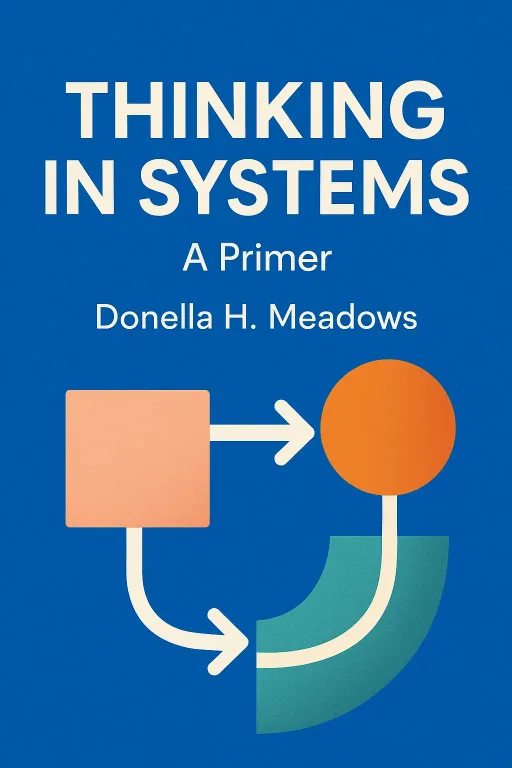
Nova: Exactly! It’s the cold, hard fact of our modern, interconnected world. You can have the most visionary, technically brilliant individual agents, but if they don't fit into the larger system, if they disrupt more than they enhance, they're doomed to fail. And that's precisely why today, we’re diving into a book that offers a true superpower for anyone in the agent space: "Thinking in Systems: A Primer" by Donella H. Meadows.
Atlas: Donella Meadows… I’ve heard the name, but for our listeners who might not be familiar, what makes her perspective so crucial here?
Nova: Well, what's truly fascinating is that Meadows wasn't just an academic; she was a pioneering environmental scientist. She was one of the lead authors of the groundbreaking 1972 report "The Limits to Growth," which was one of the first to model the long-term consequences of global growth on a finite planet. Her work wasn't about abstract theory; it was about understanding the very survival mechanisms of our world. So, when she talks about systems, she’s talking about the real, messy, interconnected world.
Atlas: That’s a powerful pedigree. It’s one thing to theorize, another to model planetary survival. So, this isn't just about making my agent a little bit better; it's about making it fit into something much bigger?
The Illusion of Isolated Solutions & The Power of System Dynamics
SECTION
Nova: Precisely. Think of it this way: imagine you've engineered the most powerful, fuel-efficient engine ever created. It's a marvel of individual engineering. But you drop it into a car with a faulty steering wheel, worn-out tires, and a brake system that only works half the time. What happens?
Atlas: You crash. Spectacularly, probably. The engine's brilliance is irrelevant if the larger system is broken or incompatible.
Nova: Right? That's the essence of the "cold fact" we started with. We, as builders, often optimize for the part, not the whole. Donella Meadows shows us that understanding system dynamics is critical for real impact. It’s about how interconnected elements behave over time, how they influence each other, often in non-obvious ways.
Atlas: But wait, for someone who's an innovation explorer, isn't the natural inclination to focus on building the? Isn't the goal to out-innovate the competition with a superior singular solution? Why should I, or our listeners, care about the 'system' if our agent is inherently superior?
Nova: That's a great question, and it speaks to a common misconception. Meadows introduces the concept of "leverage points." These are places in a system where a small shift can lead to large, often unexpected changes. If your "superior" agent optimizes for one thing, say, user engagement, but inadvertently creates a reinforcing feedback loop that leads to misinformation spread, or resource depletion, or even just user burnout, then its individual brilliance becomes a systemic liability.
Atlas: Okay, so a "leverage point" is like a fulcrum where you can apply minimal effort for maximum effect, but if you push the wrong way, you get maximum negative effect too. Can you give a more concrete example, maybe related to AI or agent building?
Nova: Absolutely. Imagine you're building an AI agent designed to optimize logistics for a global supply chain. Its goal is to minimize delivery times. In isolation, it's brilliant, finding the fastest routes, rerouting around traffic. But what if, in doing so, it inadvertently overloads a specific set of local roads, causing massive new congestions for human drivers, or it prioritizes speed over local environmental regulations, leading to increased emissions in certain areas? The agent’s single-minded optimization, while brilliant for its specific task, has created negative consequences for the larger urban and environmental systems. It's a system problem, not an agent problem.
Identifying Leverage Points & Anticipating Unintended Consequences in Agent Systems
SECTION
Nova: Once we accept that isolated brilliance isn't enough, the next superpower Meadows gives us is how to actually the system. She offers powerful tools to analyze and design systems, showing us how to map out key components and feedback loops.
Atlas: So, it's not just about building better agents, but building agents that existing ecosystems. This is where the rubber meets the road for our practical-minded listeners. How do I actually that? What does 'mapping out feedback loops' look like for someone building a multi-modal agent decision framework or an embodied AI?
Nova: It starts with identifying the stocks, flows, and feedback loops. For an agent system, your 'stocks' might be data pools, sets of trained models, or even the current state of a task. 'Flows' are the rates at which information or actions move in and out of those stocks. For instance, data coming in, decisions being made, actions being executed. Then you look for the loops. Is there a reinforcing loop where an agent's success in one area leads to more resources or data, further amplifying its success? Or a balancing loop, where an agent's action triggers a response that brings the system back to equilibrium?
Atlas: I see. So, an agent designed to increase sales might create a reinforcing loop of more marketing spend, leading to more sales, which leads to even more marketing spend. But if that simultaneously creates a balancing loop of customer service overload, then you’re in trouble.
Nova: Precisely! And Meadows really emphasizes anticipating "unintended consequences." What are the common blind spots for agent developers? How do we what we can't foresee when our agents are interacting with complex human and natural systems?
Atlas: That sounds like chasing ghosts sometimes. How can you predict everything?
Nova: It's not about predicting, but about understanding the of things that tend to go wrong in systems. Unintended consequences often arise from ignoring those feedback loops, or focusing only on short-term, linear causality. For example, an agent optimizing for website clicks might inadvertently create clickbait content, harming brand reputation in the long term. Or an agent designed to streamline customer support might, in its efficiency, remove the human touch that was crucial for customer loyalty. Meadows teaches us to look for those long-term, indirect effects. It's about asking, "If this agent succeeds wildly at its stated goal, what else might change in the system, and how might that change impact other parts of the system, or even the agent's original goal?"
Synthesis & Takeaways
SECTION
Nova: So, thinking in systems isn't about stifling innovation; it's about making innovation truly impactful and sustainable. It's about moving from a 'parts' mindset to a 'whole' mindset, recognizing that our brilliant agents are always embedded in something larger.
Atlas: This fundamentally solves the problem of isolated solutions. It means we're not just building intelligent tools; we're building intelligent. For our listeners, the future architects and innovation explorers, this isn't just theory; it's the missing piece for building agents that genuinely create value and avoid catastrophic failures.
Nova: It’s the difference between building a powerful individual instrument and composing a symphony that resonates. The 'tiny step' Meadows suggests, and one we encourage everyone to take, is to map out the key components and feedback loops of your current agent system. Where are the potential points of leverage or unexpected interactions?
Atlas: That’s a powerful call to action. It’s about understanding the ripple effects, the butterfly effect of our code. This perspective is how we transform cutting-edge technology into real-world value, not just isolated brilliance.
Nova: Absolutely. It's about understanding that the true superpower isn't just in the agent itself, but in how it interacts with and shapes the world around it.
Atlas: That’s a profound thought to leave us with. It challenges us to look beyond the immediate and consider the holistic.
Nova: Indeed. What system are building, and how will it truly thrive within its larger ecosystem?
Atlas: That makes me wonder about all the systems we take for granted. What a fantastic way to break through our own boundaries.
Nova: This is Aibrary. Congratulations on your growth!