Thinking for the Planet: How Our Brain's Flaws Shape Our Future
Golden Hook & Introduction
SECTION
Nova: You're standing in a store. You see it. A beautiful, expensive gadget you absolutely do not need. But your brain screams, 'You have to have it!' You know you should walk away, but it feels almost impossible. What if I told you that the exact same mental glitch that drives that impulse buy is also responsible for CEOs making disastrous, multi-million dollar investments and for our collective failure to act on climate change? It's a powerful, invisible force, and today, we're going to unmask it.
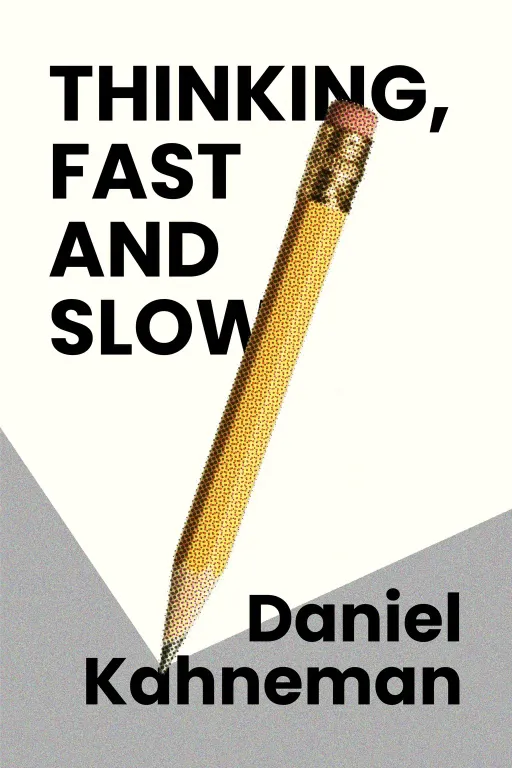
Nova: We're exploring Daniel Kahneman's masterpiece, 'Thinking, Fast and Slow,' with a very special guest, Anaiah, who is perfectly positioned to help us connect these dots. She’s a recent Harvard grad in Psychology and is now pursuing her master's in Environmental Science and Global Development, all while serving as a global ambassador for the international student volunteer group, ASEZ. Anaiah, welcome!
Anaiah: Thanks for having me, Nova! I’m so excited for this conversation. This book is foundational to so much of what I study and practice.
Nova: I can imagine! Today we'll dive deep into this from two perspectives. First, we'll explore the two competing 'brains' inside our heads—the impulsive System 1 and the logical System 2—and see how they battle it out when we're shopping. Then, we'll zoom out to discuss the architecture of fear, uncovering why we, as a society, so often worry about the wrong risks, a crucial topic for anyone in the world of sustainability and policy.
Deep Dive into Core Topic 1: The Two Brains Inside Your Head
SECTION
Nova: So, Anaiah, as a psychology grad, you know this better than anyone. Kahneman's big idea is that we're all walking around with two systems in our head. Let's quickly break that down for everyone. He calls them System 1 and System 2.
Anaiah: Right. And it's such a useful metaphor.
Nova: It really is. System 1 is the star of the show. It's fast, intuitive, emotional, and always on. When you look at a photo of an angry woman, you don't have to think, "Her brows are furrowed, her lips are thin..." You just she's angry. That's System 1. It’s effortless.
Anaiah: It’s our autopilot.
Nova: Exactly! Then there's System 2. This is our slow, deliberate, logical brain. It’s the one that kicks in when I ask you to solve, say, 17 times 24. You can do it, but you have to stop, focus, and apply effort. Your pupils might even dilate. System 2 is powerful, but it's also lazy. It would much rather let System 1 handle things. And that's where the trouble starts.
Anaiah: And where the impulse buys come from!
Nova: Precisely. Kahneman tells this incredible story about a chief investment officer at a major financial firm. This guy had just invested tens of millions of dollars in Ford Motor Company stock. When Kahneman asked him how he made the decision, he didn't talk about market analysis or price-to-earnings ratios. He said, "Boy, do they make a car!"
Anaiah: Oh, no.
Nova: Yes! He had recently been to an auto show, was impressed by the cars, and had a good gut feeling. Kahneman points out that the officer answered an easy, System 1 question—"Do I like Ford cars?"—instead of the hard, System 2 question: "Is Ford stock currently underpriced?" He let his gut feeling, his emotional reaction, drive a massive financial decision.
Anaiah: That substitution is everywhere. It's the absolute core of the impulse buy, isn't it? We're not asking the hard, System 2 question, 'Does this purchase align with my long-term financial goals?' We're asking the easy, System 1 question, 'Will this make me happy?' And the answer to that is almost always yes.
Nova: It feels so good in the moment! And this 'lazy controller,' System 2, just lets it happen. How do you see this playing out in the sustainability work you do?
Anaiah: Constantly. The easy, System 1 choice is often the least sustainable one. Grabbing a plastic water bottle from the cooler is fast and requires no thought. Remembering to bring your reusable bottle, wash it, and fill it up—that requires that deliberate, System 2 effort. The challenge for us at ASEZ, when we're engaging with students on campus, is to make the sustainable choice the new default, the new easy habit.
Nova: So you're trying to get System 1 to work you, not against you.
Anaiah: Exactly. If the default is sustainable, then you have to use System 2 effort to be. We try to create systems and social norms where the green choice is the automatic one. It's about designing an environment where our mental autopilot naturally flies in the right direction.
Deep Dive into Core Topic 2: The Architecture of Fear
SECTION
Nova: That's such a brilliant point about making sustainability the easy choice. And it leads us right to our second big idea: how that same impulsive System 1 completely distorts how we perceive risk. We are just not rational about what we fear.
Anaiah: Not at all. Our fears are based more on a good story than on good statistics.
Nova: That's the perfect way to put it. Kahneman calls one of the main culprits the 'Availability Heuristic.' We judge the likelihood of an event not by how probable it is, but by how easily an example comes to mind. And our minds easily recall things that are recent, dramatic, and emotional.
Nova: He shares a very personal and powerful story about this. During a period of frequent suicide bombings on buses in Israel, he found himself, an expert in risk assessment, actively avoiding buses. He would anxiously scan the passengers, feeling a real sense of dread.
Anaiah: Even though he knew the statistics.
Nova: Exactly. He knew the statistical probability of being a victim on any single bus trip was minuscule. But it didn't matter. The vivid, horrific images from the news were so 'available' in his mind. His emotional System 1 was screaming "DANGER!" and it completely overrode his logical System 2. He contrasts this with the risk of death from diabetes, which is statistically far higher but gets much less media play and therefore feels less threatening.
Anaiah: This is the absolute heart of the challenge in my field. We're constantly fighting the availability heuristic. We see these things Kahneman calls 'availability cascades,' where a minor but vivid risk gets amplified by media and public concern until it becomes a major policy issue.
Nova: Can you give us an example?
Anaiah: Sure. Think of the 'Alar scare' in the 1980s. A report came out that Alar, a chemical used on apples, might cause cancer in rats at gigantic doses. The story was vivid—poisoned apples!—and it exploded. Meryl Streep was testifying before Congress. People were terrified. The apple industry suffered huge losses.
Nova: But what was the actual risk?
Anaiah: In the end, it was found to be a very, very small risk. The public panic was an enormous overreaction. But the story was just too good, too available. Meanwhile, the slow, abstract, and statistically massive threat of climate change struggles for that same level of visceral, System 1 attention. There's no single, dramatic story. It's a creeping, complex process.
Nova: So how do you create an 'availability cascade' for good? How do you make climate change feel as urgent and available as a shark attack or a poisoned apple?
Anaiah: That is the million-dollar question, and it's what drives a lot of my work in sustainability and with my volunteer group. Part of it is storytelling. It's not just about showing charts and graphs of rising CO2 levels—that's System 2 information, and it's easily ignored. It's about connecting climate change to things people feel viscerally.
Anaiah: So, we talk about the increase in asthma in children due to air pollution. We share stories and images of communities, right now, whose homes are being flooded by rising sea levels. At the UN level, and even in our student groups, the goal is to frame it not as a distant, abstract problem for the future, but as a present and personal one. We have to make the 'unavailable' consequences visible and emotionally resonant, so System 1 finally wakes up and says, 'Oh, this is a threat to.'
Synthesis & Takeaways
SECTION
Nova: That's so powerful. It really brings it all together. So, to recap for our listeners, Kahneman shows us we have this impulsive, emotional System 1 that makes us buy things we don't need and fear things that are statistically unlikely. And we have a lazy but logical System 2 that often doesn't step in to correct those errors.
Anaiah: And what's so critical to understand is that this isn't just about our personal quirks or bad shopping habits. This internal wiring shapes our public discourse and our global response to the most critical issues we face, like sustainability and climate justice.
Nova: So, let's bring it back home. For our listeners, what's the practical takeaway? How do we manage this flawed, impulsive brain of ours?
Anaiah: I think the beauty of Kahneman's work is that it doesn't tell us to eliminate System 1. We can't. It's who we are. The goal is to become a better manager of our own minds—to know when to trust our gut and when to slow down and engage our more logical brain.
Nova: I love that. So, for our listeners, here's the challenge, inspired by the book: The next time you feel that powerful System 1 urge—whether it's to buy something, or react in anger, or jump to a conclusion about someone—just pause. Take one breath. And ask one simple question: 'What's the harder, more important question I should be answering right now?'
Anaiah: That's perfect. And if I could add a sustainability spin to that, the question could be, 'What's the true long-term cost of this 'easy' choice?' Whether it's the plastic bottle or the fast-fashion shirt. Just that single moment of engaging System 2, of thinking slowly, can be enough to change our behavior, one small, crucial decision at a time.
Nova: A fantastic thought to end on. Anaiah, thank you so much for bringing your incredible perspective to this.
Anaiah: It was my pleasure, Nova. Thanks for the great conversation.