The View from the 99th Floor: A Financier's Guide to 'Thinking, Fast and Slow'
Golden Hook & Introduction
SECTION
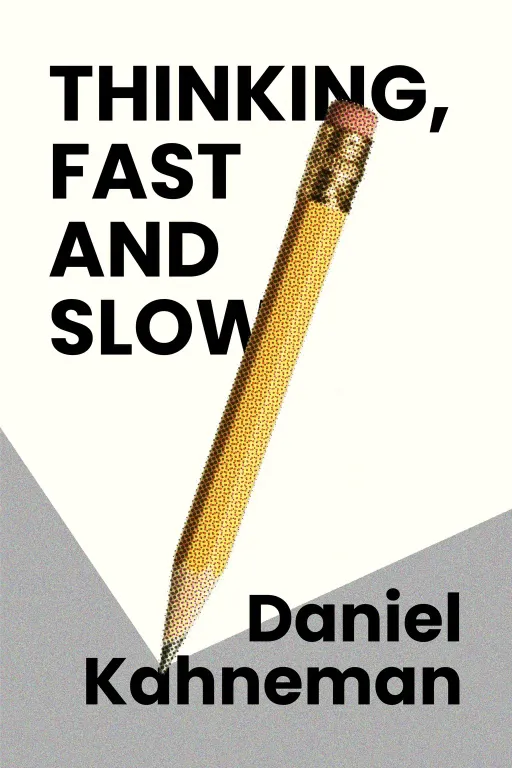
Dr. Warren Reed: Imagine standing in a penthouse, the city sprawling beneath you, the absolute peak of the financial world. Now, imagine that in a matter of weeks, you're in the sub-basement, five levels down, with no elevator in sight. That's not a hypothetical; it's the reality our guest, Cesar Nader, lived through. This experience taught him a profound lesson about decision-making, a lesson that lies at the very heart of Daniel Kahneman's masterpiece, 'Thinking, Fast and Slow.' It’s the difference between taking the fast, intuitive elevator and learning to climb the slow, deliberate stairs. Cesar, welcome.
CESAR NADER: Thank you, Warren. It's a powerful way to frame it, and it's very true. When the elevator is gone, you realize how little you know about staircases.
Dr. Warren Reed: Exactly. And that's what we're here to talk about. Kahneman's book is essentially a blueprint for that mental staircase. Today we'll dive deep into this from two powerful perspectives. First, we'll explore the deep-seated psychological asymmetry of risk—why losses feel so much worse than gains feel good, and how that derails financial decisions. Then, we'll discuss the illusion of understanding—how the simple stories we tell ourselves about market successes and failures create a dangerous trap of overconfidence.
Deep Dive into Core Topic 1: The Asymmetry of Risk: Loss Aversion and the Trader's Mind
SECTION
Dr. Warren Reed: Cesar, let's start there, in that basement. Kahneman would argue that the pain you felt was disproportionately greater than the pleasure of your previous gains. He calls this 'Loss Aversion.' It's a cornerstone of his Prospect Theory.
CESAR NADER: It’s more than disproportionate, Warren. It’s a different species of feeling altogether. The pleasure of the climb to the penthouse was a thrill, but the fall... that was visceral. It felt like a physical threat.
Dr. Warren Reed: That's the perfect description. Kahneman illustrates this with a simple thought experiment. Imagine two people, Jack and Jill. Today, both have a net worth of five million dollars. The difference? Yesterday, Jack had one million and Jill had nine million. A rational economist would say they're equally well-off. But Kahneman says, and you've just confirmed, that's absurd. Jack is ecstatic. Jill is devastated. It’s not about how much you have; it’s about the change from your reference point.
CESAR NADER: That's the emotional reality of a market crash. Your net worth might still be high objectively, but the feeling is one of pure, gut-wrenching loss. The absolute number on the screen doesn't matter; the direction of travel is everything. Your reference point was the penthouse, and now you're in the basement. The gap is what you feel.
Dr. Warren Reed: And this feeling drives decisions. Kahneman points to a specific bias this creates in finance: the 'disposition effect.' He gives an example: an investor needs money for his daughter's wedding. He has two stocks. One, Blueberry Tiles, is up five thousand dollars. The other, Tiffany Motors, is down five thousand. Which one does he sell?
CESAR NADER: He sells Blueberry Tiles. Every time.
Dr. Warren Reed: Exactly. He sells the winner. Why? Because it feels good. It's booking a win. It allows him to close that mental account with a positive feeling. Selling the loser, Tiffany Motors, would mean admitting a mistake, making the loss real. Even if Tiffany is a failing company and selling it would give him a tax advantage, the emotional pull to avoid crystallizing a loss is immense.
CESAR NADER: It's the most common rookie mistake, and even seasoned pros fall for it constantly. Closing a winning position feels like a victory. Closing a losing one is admitting you were wrong. It's an ego-driven decision, not a financial one. Your fast, intuitive System 1 is screaming 'Take the win! Protect your ego!' while your slow, analytical System 2, which should be analyzing the company's fundamentals, is asleep at the wheel.
Dr. Warren Reed: Kahneman talks about this at an organizational level. He describes asking 25 division managers if they'd take a favorable gamble with a chance of a significant loss. Individually, none of them would. They were all too loss-averse. But their CEO, looking at all 25 gambles as a portfolio, said he'd gladly take all of them, because statistically, the company was almost certain to come out ahead. Have you seen that disconnect between the individual's fear and the organization's need for risk?
CESAR NADER: Absolutely. It's the core tension in any large financial institution. Every trader is managing their own book, their own P&L, their own ego. They are Jack and Jill, living the daily gains and losses. The CEO is supposed to be the rational actor, looking at the aggregated whole. The problem is when the CEO is also just a collection of their own biases, or when the culture punishes individual losses so severely that no one is willing to take the smart, aggregated risks the company needs to grow. It creates a system-wide paralysis.
Deep Dive into Core Topic 2: The Illusion of Understanding: Narrative Fallacy and Hindsight's Trap
SECTION
Dr. Warren Reed: This fear of admitting we're wrong, of booking a loss, is deeply tied to the stories we tell ourselves. Which brings us to our second big idea from Kahneman: the Narrative Fallacy. Our minds crave simple, coherent, causal stories. We hate randomness and luck.
CESAR NADER: We want a hero and a villain. A clear cause and effect.
Dr. Warren Reed: Precisely. Kahneman uses the story of Google. Today, we see its success as inevitable. The story is: two brilliant grad students had a genius idea and executed it flawlessly. But Kahneman digs up a crucial detail: a year after founding the company, Larry Page and Sergey Brin were willing to sell it for less than one million dollars. The potential buyer refused, saying the price was too high. Luck is a messy, unpredictable character, so we tend to write it out of the script. We prefer the clean narrative of skill and destiny.
CESAR NADER: That story is terrifying because it's so true. In finance, you see it all the time. A fund manager has one great year, and the narrative becomes 'He's a genius, a visionary.' The next year, he underperforms, and the narrative is 'He lost his touch, he got arrogant.' The possibility that he was skilled but also incredibly lucky in year one, and then just moderately unlucky in year two, is too complex. It doesn't sell magazines.
Dr. Warren Reed: And this leads directly to the trap of Hindsight Bias. After an event happens, we feel it was obvious and predictable all along. 'Of course the housing bubble was going to pop!' we say in 2009. But very few were saying that with any certainty in 2006. After your personal crisis, Cesar, what was the story people told? And more importantly, what was the story you told yourself?
CESAR NADER: The public story was simple, just as Kahneman would predict. It was 'risky bets,' 'a flawed system,' 'greedy bankers.' It's easy to blame individuals or a vague 'system.' The real story was a complex web of interconnected, low-probability events, where a failure in one obscure corner of the market cascaded in a way no one had modeled. But that doesn't make for a good headline.
Dr. Warren Reed: And the story you told yourself?
CESAR NADER: For a while, it was a story of personal failure. 'I should have seen it coming.' That's hindsight bias poisoning your own memory. The most dangerous part of hindsight is that it makes you think you've learned a lesson, when you've often learned the lesson. The lesson isn't 'avoid that specific type of mortgage-backed security.' The lesson is 'the world is far more random than your mind wants to believe.'
Dr. Warren Reed: As a Business Analyst now, how do you fight that?
CESAR NADER: My job is to fight the narrative fallacy every day. The numbers might tell one story, a clean story of growth or decline. But you have to dig for the role of luck, for the external factors, for the story that being told. You have to actively look for the evidence that would disprove the simple, clean narrative. You have to ask, 'What if the opposite happened? How would we explain that?' It's about stress-testing the story itself.
Synthesis & Takeaways
SECTION
Dr. Warren Reed: So we have two powerful illusions at play. First, the illusion of value, driven by loss aversion, where we misjudge risk because of our emotional reaction to where we stand relative to a reference point. Second, the illusion of understanding, driven by the narrative fallacy and hindsight bias, where we misjudge the past and therefore become overconfident about the future.
CESAR NADER: And they feed each other. The pain of a loss makes us seek a simple narrative to explain it, and that simple narrative then makes us overconfident that we can avoid future losses. It's a vicious cycle.
Dr. Warren Reed: So, how do we break it? What's the actionable takeaway for our listeners who want to build that mental staircase?
CESAR NADER: The leader who helped me taught me to take the stairs. That's the antidote. It's about building what Kahneman calls a 'Risk Policy.' Before any big decision, financial or otherwise, you have to force yourself to take the slow, deliberate stairs of System 2. For me, that means asking two questions. One: 'What's the outside view?' Forget the specifics of my 'unique' situation for a moment. What happened to the last ten companies that tried this? What happened to other people in this exact situation? Get the base rate.
Dr. Warren Reed: A dose of statistics to fight the story.
CESAR NADER: Exactly. And the second question is: 'How can I reframe this?' If my gut is screaming that this is a terrifying loss, can I reframe it as a cost of doing business, or the price of an education? If my gut is euphoric about a sure-win, can I force myself to write down all the ways it could still go to zero? That deliberate, effortful process of questioning your own frame and your own story... that is what gets you out of the basement. That's how you start climbing, one step at a time, back to the 99th floor.