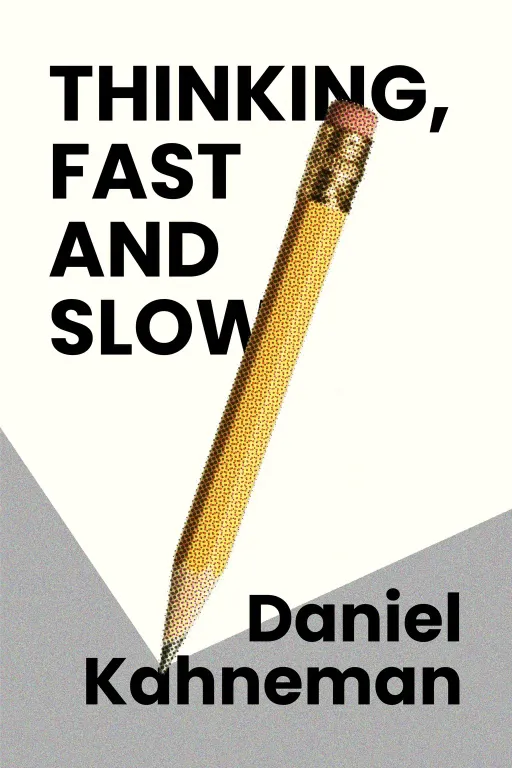
** The Two-System Brain: A UX Designer's Guide to 'Thinking, Fast and Slow'
Golden Hook & Introduction
SECTION
Nova: Have you ever watched a user test where someone says they desperately need a new feature, you build it, and then... crickets? They never use it. Or they swear a button is missing, when it's right there in the middle of the screen? It's one of the most frustrating puzzles in technology and design. Our guest today, J, is a UX designer who lives and breathes this puzzle.
J: It happens more than you'd think, Nova. It's the classic gap between what people and what they. It’s the central challenge of my job, really.
Nova: Exactly! And it turns out, the answer to this puzzle isn't just in design principles, but deep in cognitive science. That's why we're diving into Daniel Kahneman's masterpiece,. For people like you, J, it’s like the missing user manual for the human brain.
J: I couldn't agree more. It provides a language for so many of the invisible forces that shape how a user interacts with a product. It’s essential reading.
Nova: I'm so glad you think so. Today we'll dive deep into this from two perspectives that are incredibly relevant for anyone building things for people. First, we'll explore the two 'operating systems' of the brain—the fast and the slow—and what that means for intuitive design. Then, we'll uncover a powerful bias called the 'focusing illusion' to understand why users, and all of us really, often don't know what we truly want.
Deep Dive into Core Topic 1: The Two Minds of Your User
SECTION
Nova: So, J, let's start with the book's central idea, which feels like it was written specifically for designers. Kahneman says we have two 'systems' in our head. He gives them the simple, memorable names System 1 and System 2.
J: Right, the characters of the story.
Nova: Exactly, they're not real parts of the brain, but characters in a story about how we think. System 1 is the hero who acts on instinct. It's fast, automatic, intuitive, and emotional. Think about looking at a picture of an angry woman. You don't have to analyze her furrowed brow or tight lips; you just she's angry. It's effortless. That's System 1.
J: It’s our autopilot.
Nova: Perfect. Then there's System 2. This is our slow, deliberate, analytical self. It's the one that kicks in when I ask you to solve, say, 17 times 24. You can feel the mental gears grinding, right? You have to focus, hold numbers in your memory... it's work. That's System 2. Now, the fascinating part is how these two interact, and Kahneman tells this incredible story to illustrate it. It's from an experiment called "The Invisible Gorilla."
J: Ah, a classic.
Nova: It is! So, researchers asked people to watch a short video of two teams, one in white shirts and one in black, passing basketballs. The instruction was simple: count the number of passes made by the team in white. It's a task that requires focus, so people lean in, their System 2 is engaged. Halfway through the video, a person in a full gorilla costume walks into the middle of the scene, thumps their chest, and walks off. The gorilla is on screen for nine full seconds.
J: Which is an eternity in a short video.
Nova: You'd think! But the shocking result was that about half of the viewers did not see the gorilla at all. They were so focused on counting the passes that this bizarre, totally unexpected event was rendered invisible. And Kahneman's takeaway is chilling: "We can be blind to the obvious, and we are also blind to our blindness."
J: That experiment is everything in UX. We see it every single day. We call it 'inattentional blindness' or 'task-oriented blindness.' A user is so focused on a task—say, filling out a complex form to book a flight—that they will literally not see a giant banner ad, or even a critical help button right next to the field they're stuck on. Their System 2 is so engaged in the task that it's actively filtering out everything it deems 'irrelevant.'
Nova: So you're saying good design has to anticipate and account for that blindness?
J: It has to. We have to design primarily for System 1. The goal of a great interface, a great user experience, is to feel so intuitive that the user never has to engage their slow, effortful System 2. Every single time a user has to stop and think, "Wait, where do I click next?" or "What does this icon mean?", that's a design failure. We've forced them into System 2, and that creates what we call 'cognitive load.' It's mentally taxing.
Nova: And cognitive load leads to frustration.
J: It leads to frustration, and frustration leads to abandonment. People will just close the app or the website. So, a good app is one that lets the user's intuitive System 1 drive, and a bad app is one that keeps yanking the steering wheel over to the effortful System 2.
Nova: I love that analogy. So in the case of the experiment, the 'gorilla' is the thing you the user to see, even when they're focused.
J: Exactly. The 'gorilla' is the critical error message we designed poorly, the one that says their credit card was declined. If they miss it because they're so focused on hitting the 'Complete Purchase' button, the whole transaction fails, and they blame the app. Our job as designers is to make that gorilla impossible to miss. We have to make it big, red, and maybe even make it roar—metaphorically, of course. It has to be something that System 1 can't help but notice.
Deep Dive into Core Topic 2: The Focusing Illusion
SECTION
Nova: That's such a powerful way to put it. So we're designing for this fast, intuitive, but easily blinded System 1. But this brings us to our second big idea from the book, which explains that gap you mentioned at the start—the gap between what users they want and what they actually. Kahneman calls this the 'focusing illusion.'
J: The source of so much wasted development time.
Nova: I can only imagine! The core idea is a quote from the book: "Nothing in life is as important as you think it is when you are thinking about it." When we focus on any single factor, we exaggerate its importance. Kahneman gives the example of asking people if they think Californians are happier. Most people say yes, because they focus on the sunny climate. They forget about all the other things that actually make up daily life, like traffic, high cost of living, and so on. Their focus on the weather creates an illusion.
J: It's a mental spotlight that blows one thing out of proportion.
Nova: Perfectly said. And Kahneman has this brilliant study that shows how this affects our choices. Let's call it the "Dolphins versus Farmworkers" story. Imagine you're asked, in isolation, how much you'd be willing to contribute to a cause for "saving dolphins." Your System 1 kicks in. You see these beautiful, intelligent, playful creatures in your mind's eye. It's emotionally appealing, and you're likely to name a generous amount.
J: It’s a very charismatic cause.
Nova: Very. Now, a different group is asked a different question: "How much would you contribute to a fund that provides skin cancer check-ups for farmworkers?" Now, this is an incredibly worthy cause, but it's less emotionally vivid. It doesn't have that same System 1 appeal. People might contribute, but maybe a bit less. But here is the magic trick. When you put the two causes side-by-side in what Kahneman calls a 'joint evaluation' and ask people, "Which is more important to support?", the results flip. Almost everyone agrees that human health is more important, and they allocate more money to the farmworkers.
J: The comparison forces System 2 to wake up.
Nova: Exactly! The focusing illusion is broken. In isolation, the emotional, charismatic 'dolphin' wins. But in comparison, the more logical, but less glamorous, 'farmworker' wins.
J: This is the absolute bane of user research, but also its greatest challenge. A user will tell you in an interview, "I would absolutely love and use a feature that lets me customize the color scheme of the app's background." They're focusing on it in that moment, so it seems incredibly important. It's their 'dolphin.'
Nova: It sounds cool, it sounds fun. It's a feature you can easily imagine.
J: Right. But their 'farmworker'—the thing that causes them daily, low-grade pain—is the app's slow loading time, or the confusing checkout process. In their day-to-day use, those are the real problems. But they're not as exciting to talk about in an interview, so they don't come up. If we as designers just listen to the feature requests—if we just build all the 'dolphins'—we end up with a bloated, colorful, but still fundamentally slow and unusable product.
Nova: So as a designer, how do you get past the user's 'dolphins' to find the real 'farmworkers' that need attention?
J: That's where we have to consciously design our research to force that 'joint evaluation' that Kahneman talks about. We try to never just ask, "Do you want this feature?" Instead, we use techniques that force a trade-off. For example, A/B testing is a classic form of joint evaluation. We pit two versions of a design against each other and see which one performs better, regardless of what users say they prefer.
Nova: You're watching their actions, not just listening to their words.
J: Exactly. Another method is called 'card sorting' or 'feature ranking.' We'll give a user a list of ten potential improvements and a limited budget of 'points' to spend on them. We'll say, "You can't have everything. Show us what's most important." This forces them out of that narrow focus on one shiny idea and makes them compare. It makes them weigh the 'dolphin' of a custom color scheme against the 'farmworker' of a 50% faster loading time. And when you force that choice, the farmworker almost always wins.
Synthesis & Takeaways
SECTION
Nova: That is so clear. It seems the big lesson from Kahneman for designers is twofold. First, you have to build for the fast, intuitive, and sometimes blind System 1. But second, you have to use your own slow, analytical System 2 to check your own biases and, crucially, your users' biases, especially that powerful focusing illusion.
J: Precisely. In a way, the designer's job is to be the user's external System 2 for them. You have to create a design that's so clear and effortless that it perfectly guides their System 1. But you have to use your own disciplined System 2 to run the experiments and do the analysis to validate that you're guiding them to the right place—to solve their real problem—not just to the shiniest object in the room.
Nova: That's a huge responsibility. So, for all the other designers, product managers, and innovators listening, what's one practical thing they can do tomorrow, inspired by this?
J: I'd say this: the next time a user, or even a stakeholder, comes to you demanding a specific feature, don't just take the request at face value. Don't just ask, "What do you want?" Ask a question that forces a trade-off. Ask, "If you could only have one thing—this new feature you're describing, or making the entire app twice as fast—which would you choose?" Force the comparison. It's a simple way to break the focusing illusion, and you will be amazed at what you uncover about their true priorities.
Nova: A brilliant, practical tip. It really forces us to question our own focus in our work and in our lives. It leaves me wondering... what 'dolphin' am I chasing right now, while my 'farmworker' is being ignored? J, thank you so much for these incredible insights.
J: My pleasure, Nova. It was great to connect these dots.