The Mind's Blueprint: Outsmarting Your Two Inner Systems
Golden Hook & Introduction
SECTION
Nova: Imagine you're given a brief personality sketch: 'Steve is shy, withdrawn, and has a passion for detail.' Is he more likely to be a librarian or a farmer? Most of us instantly say librarian. But what if I told you that for every male librarian in the US, there are more than 20 male farmers? Suddenly, that gut feeling feels... questionable. This is the kind of mental trap we fall into every single day, and it reveals a hidden battle raging in our minds.
Noragbai P Naimah: That's a fantastic example. It immediately makes you question your own judgment process. My mind went straight to librarian, without a second thought for the statistics.
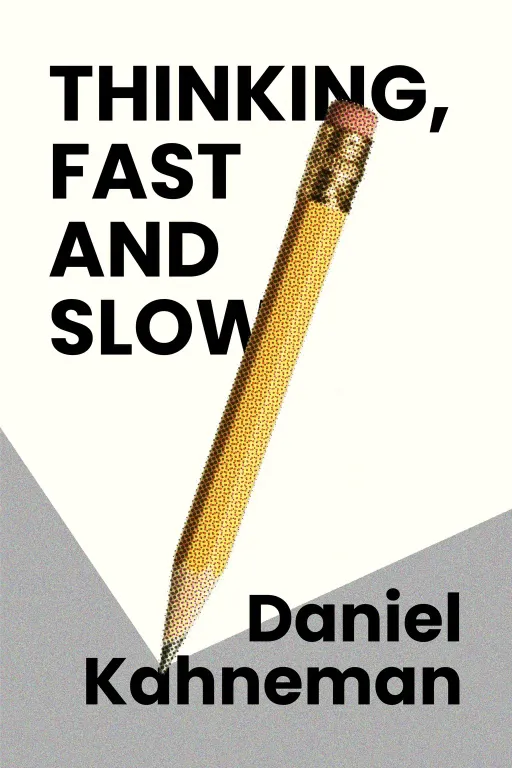
Nova: Exactly! And that's why we're so excited to have you here today, Noragbai. As someone who loves to analyze and connect ideas, you're the perfect person to dive into this with. We're exploring the masterpiece, 'Thinking, Fast and Slow' by Nobel laureate Daniel Kahneman, which is essentially a user manual for the human brain.
Noragbai P Naimah: It really is. It gives you a language for things you've always felt but couldn't name. I'm thrilled to be here.
Nova: In the book, Kahneman gives us the key to understanding that 'Steve' problem and so much more. Today, we're going to unpack this from two main perspectives. First, we'll introduce the two main characters that run our minds: the fast, intuitive System 1 and the slow, deliberate System 2. Then, we'll uncover the predictable mistakes these systems make, exploring the fascinating world of cognitive biases that shape our everyday choices. Ready to meet the voices in your head?
Noragbai P Naimah: Absolutely. Let's do it.
Deep Dive into Core Topic 1: Meet the Two Systems
SECTION
Nova: Alright. So, to understand why we jump to conclusions about Steve the librarian, Kahneman says we first have to meet the two characters in our head. He gives them these wonderfully simple names: System 1 and System 2.
Noragbai P Naimah: It’s such an effective metaphor. Not literal parts of the brain, but two modes of thinking.
Nova: Precisely. System 1 is the star of the show. It’s fast, it's intuitive, it's automatic. It operates with little to no effort and no sense of voluntary control. Think about looking at a picture of an angry woman. You don't have to she's angry. You just. You see her narrowed eyes, her tight lips, and your brain instantly generates a story: she's about to say something unkind. That whole process is effortless. That's System 1.
Noragbai P Naimah: It's our brain's autopilot. It handles the thousands of micro-judgments we need to make just to get through the day, like detecting hostility in a voice or understanding simple sentences. We'd be paralyzed without it.
Nova: We absolutely would. But then there's System 2. Now, I want you to try something. In your head, solve this problem: 17 times 24.
Noragbai P Naimah: Okay... hold on. I'm retrieving the method... carrying the one... it's... 408. But wow, I could feel my brain working. It was not automatic at all.
Nova: You felt it, right? That feeling of mental strain, of concentration? Your pupils literally dilated. That is System 2. It's the slow, deliberate, analytical part of our mind. It's what we use for complex computations, for comparing two washing machines for the best value, or for parking in a tight space. It’s effortful.
Noragbai P Naimah: So System 1 is the gut reaction, and System 2 is the conscious reasoning. It’s such a brilliant and simple way to categorize our own thinking. It's like System 1 is on autopilot, handling the routine flight, while System 2 is the human pilot we have to consciously call upon to take the controls in a storm or during a tricky landing.
Nova: That is the perfect analogy! And here’s the twist in the book that changes everything: we all like to think the pilot, our rational System 2, is in charge. But Kahneman’s research shows the autopilot, System 1, is flying the plane 95% of the time.
Noragbai P Naimah: And that’s because System 2 has a major character flaw, doesn't it?
Nova: It does. System 2 is powerful, but it is fundamentally lazy. It requires energy and attention, which are limited resources. So, whenever it can, it outsources the job to System 1. It often just accepts the story that System 1 provides without checking the facts.
Noragbai P Naimah: Which is a bit terrifying for someone who prides themselves on being analytical. The idea that my conscious, reasoning mind is often just rubber-stamping the suggestions of a fast, impulsive, and sometimes wrong, autopilot... it's humbling.
Nova: It's incredibly humbling! And Kahneman demonstrates this beautifully with a famous experiment. He and his colleague created a short video where two teams, one in white shirts and one in black, are passing basketballs. The instruction is simple: count the number of passes made by the team in white.
Noragbai P Naimah: I think I know this one. It's a classic.
Nova: It is! As people are intently focusing on counting, something else happens. A person in a full gorilla suit walks into the middle of the game, thumps their chest, and walks off. The gorilla is on screen for a full 9 seconds.
Noragbai P Naimah: And the shocking part is...
Nova: About half the people who watch the video don't see the gorilla at all. They are so focused on the System 2 task of counting that they become blind to the completely unexpected. Kahneman’s point is profound: we can be blind to the obvious, and we are also blind to our blindness. We don't even know what we're missing.
Noragbai P Naimah: It shows the real cost of System 2's effort. When it's engaged, it creates tunnel vision. It's not just lazy; it has a limited bandwidth. And that's where the real danger lies, because it leaves System 1 in charge of everything outside that narrow tunnel.
Deep Dive into Core Topic 2: The Perils of Intuition: Heuristics and Biases
SECTION
Nova: Exactly. And because that pilot, System 2, is so often lazy or distracted, it lets the autopilot, System 1, use these quick-and-dirty rules of thumb to navigate the world. Kahneman calls them 'heuristics.' They're mental shortcuts. But these shortcuts have a dark side: they lead to predictable, systematic errors, which he calls 'biases.'
Noragbai P Naimah: This brings us right back to our friend Steve the Librarian.
Nova: It does. The mental shortcut at play there is the 'Representativeness Heuristic.' Our brain is asked a difficult question: "What is the statistical probability that Steve is a farmer?" System 1, in its hurry, substitutes an easier question: "How much does Steve resemble my stereotype of a librarian?" The description of Steve is a perfect match for the librarian stereotype, so our intuition screams "librarian!"
Noragbai P Naimah: And our lazy System 2 just accepts that answer because it feels right. It doesn't bother to do the hard work of recalling the base-rate statistics about farmers versus librarians. It's a classic case of favoring a plausible story over statistical reality.
Nova: Perfectly put. It's a machine for jumping to conclusions. And it's not the only shortcut our brain uses. Let's take another one: the 'Availability Heuristic.' This is where we judge the frequency of an event by how easily an example comes to mind.
Noragbai P Naimah: Oh, this one is everywhere.
Nova: It really is. Kahneman gives a great, simple example. He and his colleagues asked spouses to estimate, in percentages, their contribution to various household chores, like taking out the garbage or keeping the house tidy.
Noragbai P Naimah: I can already guess the outcome.
Nova: You guessed it. When they added up the percentages for each couple, the total consistently came to much more than 100%. Sometimes 120%, 140%...
Noragbai P Naimah: Of course! Because my own efforts are so much more 'available' to me. I remember every single time I took out the trash, especially if it was raining. I don't have the same vivid memory of all the times my partner did it. So my brain concludes I must be doing most of the work.
Nova: Exactly! It’s not about selfishness; it's about the mechanics of memory. Your own contributions, sacrifices, and efforts are intensely available to you. Your partner's are not. So, you overestimate your own role.
Noragbai P Naimah: So with the Steve example, we're matching to a pattern—that's representativeness. With the housework, we're judging by what's easiest to remember—that's availability. In both cases, it's System 1 finding the fastest, easiest answer, and in both cases, it ignores the actual, objective data.
Nova: You've nailed the connection. And what's so powerful about Kahneman's work is that he shows these aren't just random mistakes. They are systematic and predictable. We all make them in the same way.
Noragbai P Naimah: And it makes you wonder, how many of our professional or even personal disagreements stem from this? Two people in a meeting might have wildly different 'available' data in their heads, based on their own experiences, leading them to completely different, yet equally confident, conclusions. They're not necessarily being difficult; their System 1 is just telling them a different, very convincing story.
Nova: That is such a crucial insight. It's a framework for empathy, in a way. It helps us understand that someone else's 'obvious' truth might be built on a completely different set of available memories or representative stereotypes than our own.
Synthesis & Takeaways
SECTION
Nova: So, as we wrap up, it feels like we're left with this incredible picture of the constant dance in our minds. We have this fast, intuitive System 1 that generates impressions, feelings, and shortcuts. It's the hero of the story, but it's impulsive and prone to error.
Noragbai P Naimah: And then we have the slow, lazy System 2, which is supposed to be the voice of reason, our inner analyst. But a lot of the time, it's just asleep at the wheel, content to endorse whatever story System 1 comes up with.
Nova: And understanding that dynamic—that collaboration and conflict—and the predictable biases it creates, is really the first step to making better judgments.
Noragbai P Naimah: It is. It’s not about getting rid of System 1. We can't, and we wouldn't want to. It's about learning when to be skeptical of its first impressions.
Nova: Exactly. So, the big takeaway from Kahneman isn't to distrust our intuition, but to know to question it. To know the situations where it's likely to lead us astray.
Noragbai P Naimah: Precisely. So maybe the one question we can all take away is this: The next time you have a strong gut feeling about a person, a project, or a decision, just pause for a second. Ask yourself, 'Is this my System 1 talking? And what easier question is it answering instead of the hard one?'
Nova: I love that.
Noragbai P Naimah: That simple act of questioning is how we wake up the pilot. It's how we engage our inner analyst and move from just thinking, to thinking about how we think.
Nova: A perfect place to end. Noragbai, thank you so much for helping us unpack these huge ideas.
Noragbai P Naimah: It was my absolute pleasure. It’s a book that changes the way you see everything.