The Entrepreneur's Blind Spot: Engineering Better Decisions with 'Thinking, Fast and Slow'
Golden Hook & Introduction
SECTION
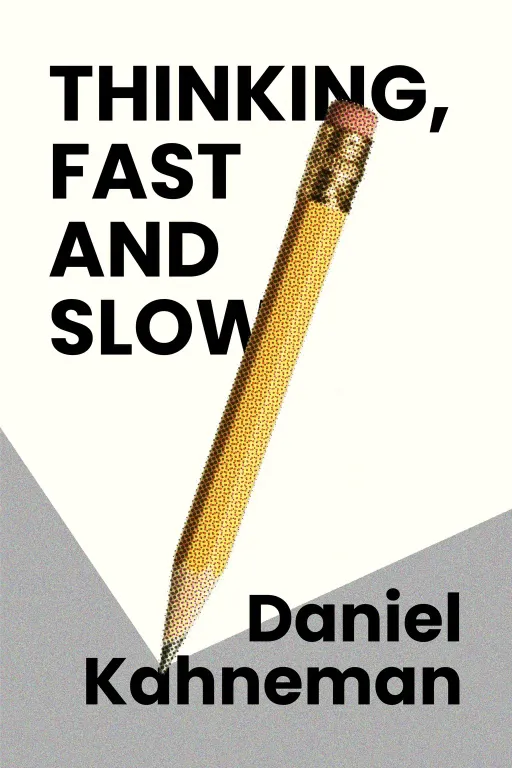
Nova: Have you ever been deep into a project, maybe one you've poured your heart, soul, and a serious amount of cash into, and you get that sinking feeling? The data is telling you to stop, but every fiber of your being is screaming to push forward, to invest just a little more to make it work. This isn't just bad luck; it's a predictable glitch in our mental wiring. It's one of the many cognitive traps explored in Daniel Kahneman's Nobel Prize-winning work, 'Thinking, Fast and Slow.'
Nova: Today we'll dive deep into this from two perspectives. First, we'll explore the two competing 'systems' that drive our thinking—one fast and intuitive, the other slow and logical. Then, we'll zero in on one of the most expensive biases for any entrepreneur: the sunk-cost fallacy, and how it hijacks our rational judgment.
Nova: And I'm so thrilled to be joined by Peris Karanga, an entrepreneur in the engineering and manufacturing space. Peris, welcome.
Peris Karanga: Thanks for having me, Nova. It's a topic I'm passionate about.
Nova: I can imagine. As someone who builds things in the real world, I feel like this book is a must-read, right? It's like the user manual for the mind that we were never given.
Peris Karanga: Exactly. It gives a language and a framework to so many of the invisible forces that you feel every day as a leader. It’s incredibly clarifying.
Deep Dive into Core Topic 1: The Two Minds: Our Brain's Fast and Slow Operating Systems
SECTION
Nova: So let's start with the book's central idea, which is almost an engineering concept in itself. Kahneman says our brain runs on two systems. He calls them System 1 and System 2. Peris, this is your world—systems and processes. How does this idea of two mental systems land with you?
Peris Karanga: It lands perfectly. It’s like thinking about a computer that has two different processors. One is optimized for speed and low energy use, and the other is a power-hungry beast for heavy lifting.
Nova: That's a great way to put it. Kahneman’s System 1 is that fast, automatic, intuitive processor. It's what's happening when you look at a photo of an angry woman. You don't have to think, "Her brows are furrowed, her lips are thin..." You just instantly, effortlessly, see 'anger.' That's System 1. It’s a marvel of efficiency. It handles everything from driving on an empty road to understanding simple sentences.
Peris Karanga: It's our brain's autopilot.
Nova: Exactly! But then there's System 2. And to feel System 2 kick in, I want everyone listening to try something. Try to solve this in your head: What is 17 times 24?
Peris Karanga: Right. I can feel my brain resisting already.
Nova: You can feel the effort, can't you? You have to retrieve the rules of multiplication from memory, hold numbers in your head, and focus. Kahneman points out that your pupils literally dilate when you engage System 2. It's slow, it's deliberate, and it's lazy. System 2 is that power-hungry processor, and it would much rather be doing nothing. It's happy to let System 1, the autopilot, take the wheel whenever possible.
Peris Karanga: And that's where the danger lies, especially in a professional context. System 1 is invaluable. It’s the experienced engineer who 'just knows' a piece of machinery sounds wrong before it fails. That's pattern recognition, and it's brilliant. But the danger is when we use that same autopilot for a complex, novel strategic decision, like a major capital investment or a new market entry.
Nova: So your gut feeling is just System 1 taking a shortcut?
Peris Karanga: Often, yes. The 'gut feel' is strong, but it might be based on a superficial resemblance to a past success, or just because the person pitching the idea is charismatic. We're biased towards what's easy to process. A compelling story is a System 1 feast. A dense spreadsheet is a System 2 workout. We all know which one the brain naturally prefers, and that can be a very expensive preference.
Nova: It's fascinating. We think of ourselves as rational beings, but most of the time, we're just endorsing the feelings and impressions generated by our automatic, and very fallible, System 1.
Peris Karanga: And the key insight for me is that System 2 has to be deliberately activated. It doesn't just turn on because a decision is important. You have to force it to engage, which requires creating the right environment and the right processes.
Deep Dive into Core Topic 2: The Sunk-Cost Fallacy: Why We Throw Good Money After Bad
SECTION
Nova: And that laziness of System 2, that desire to avoid the hard work of re-evaluation, leads us directly to our second topic—one of the most expensive biases in business: the sunk-cost fallacy. It's the reason we stay in bad jobs, bad relationships, and, most relevant for us today, bad projects.
Peris Karanga: The 'zombie project.' I know it well.
Nova: The zombie project! I love that. Kahneman tells this classic story that I think perfectly captures it. Imagine a company has already invested a staggering $50 million into a project. But it's in trouble. It's way behind schedule, and the forecasts for its eventual success are now looking bleak. A new CEO comes in and has a choice: invest another $60 million to salvage it, or cut their losses and walk away.
Peris Karanga: A tough spot.
Nova: A very tough spot. Now, the manager who has been running this project from the start, the one who is emotionally invested, argues passionately to continue. He says, "We've already invested so much! We can't just let that go to waste." Peris, you must have seen a version of this 'zombie project' before. What's happening in that room, psychologically?
Peris Karanga: Oh, absolutely. What's happening is a battle against pain. That $50 million isn't just a number on a spreadsheet; it represents thousands of hours of work, people's reputations, promises made to the board. To abandon the project is to officially declare all that past effort a 'loss.' And Kahneman's research shows us that the pain of a loss hurts about twice as much as the pleasure of an equivalent gain feels good.
Nova: Twice as much! That's a powerful asymmetry.
Peris Karanga: It's huge. So, to avoid that intense pain of booking a definite loss, we'll irrationally invest more. We'll take a bad gamble—throwing another $60 million at a long shot—in the desperate hope of turning a massive loss into a break-even. It's a gamble to avoid the certainty of pain. In the business world, we often call it 'escalation of commitment.'
Nova: And Kahneman has another great example of this, the 'disposition effect.' He talks about investors who have two stocks. One has gone up, and one has gone down. If they need cash, they are far more likely to sell the winning stock. Why? Because selling it allows them to feel the pleasure of a realized gain. They'll hold onto the losing stock indefinitely, because selling it would mean making the loss 'real' and feeling that pain. It's the exact same psychology.
Peris Karanga: And in manufacturing, it's even more tangible and, I think, even more powerful. You can literally walk past the physical assembly line you invested millions in. It's a constant, physical reminder of the sunk cost. It's not an abstract number in a portfolio; it's a hundred tons of steel on the factory floor. That makes it even harder to make the cold, rational decision to decommission it for a more promising new technology. You're not just writing off a loss; you're admitting that a thing you built has failed.
Nova: So your own creation becomes a psychological anchor, weighing down future decisions.
Peris Karanga: Precisely. It’s a trap. A very, very expensive trap.
Synthesis & Takeaways
SECTION
Nova: So, to bring this all together, Kahneman gives us this incredible model. We have these two systems in our mind: a fast, intuitive, and emotional System 1, and a slow, logical, but very lazy System 2. And because our powerful System 2 is so lazy, it often lets System 1 run the show, making us vulnerable to these incredibly powerful emotional biases, like the sunk-cost fallacy, where we'd rather gamble on a failing project than face the definite pain of a loss.
Peris Karanga: That's the perfect summary. And the key takeaway for me, as an entrepreneur and an engineer, is that you cannot trust your gut or your willpower to overcome this. It's a systemic problem that requires a systemic solution. You have to build a System 2 process to protect you from your own System 1.
Nova: A process to protect you from yourself. What does that look like in practice?
Peris Karanga: Well, Kahneman talks about creating a 'risk policy.' For a project, this could be a 'pre-mortem' analysis or, even more simply, a 'kill criteria' checklist that you create you invest the first dollar. You sit down with your team and you agree, in the cold light of day, on the conditions that would force you to stop. For example: 'If this project exceeds its budget by 20% and misses two consecutive major milestones, we will halt all work and re-evaluate from a zero-base, ignoring all prior investment.'
Nova: So you're making the decision when you're rational, to bind yourself for when you might become irrational.
Peris Karanga: Exactly. It's an organizational circuit breaker. It forces the lazy System 2 to wake up and do its job, instead of letting the pain-averse System 1 make a disastrously expensive decision.
Nova: That is such a powerful, practical tool. It's literally engineering a better decision-making process. So, for everyone listening, here's the question to ponder: Where in your work or your life are you letting a sunk cost dictate your future? And what's one small, pre-defined rule you could create right now to protect your future self from throwing good money, or good time, after bad?
Peris Karanga: A great question to end on.
Nova: Peris, thank you so much for bringing your insight to this. It was fantastic.
Peris Karanga: My pleasure, Nova. Thank you.