Unmasking the Mind's Tricks: Cognitive Biases & Rationality
Golden Hook & Introduction
SECTION
Nova: What if I told you that most of your 'rational' decisions aren't rational at all, but rather brilliant illusions crafted by your own brain?
Atlas: Whoa, brilliant illusions? That's quite a claim, Nova. I like to think I'm pretty logical.
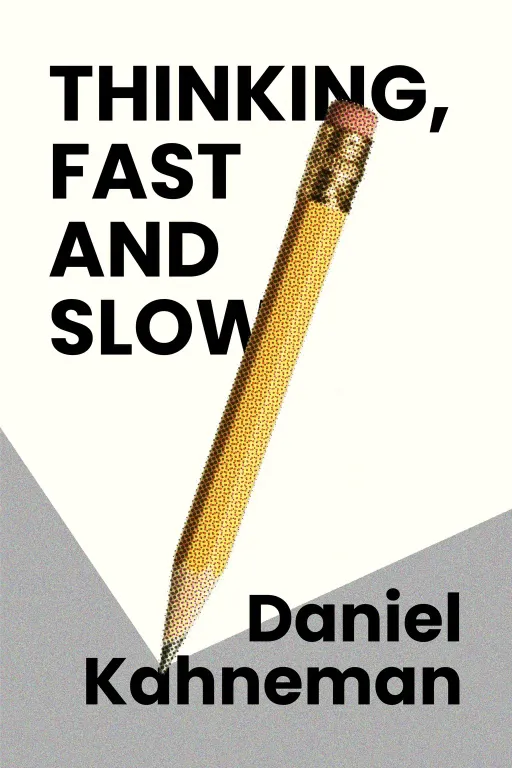
Nova: Well, prepare to have your mind delightfully unmasked, Atlas. Today, we're diving into the groundbreaking work of Daniel Kahneman, especially his seminal book, "Thinking, Fast and Slow." Kahneman, a psychologist who won the Nobel Prize in Economics, completely reshaped our understanding of human judgment and decision-making.
Atlas: A psychologist winning the Nobel in Economics? That’s fascinating. How does his background bridge those two worlds, and what does it tell us about how we perceive things?
Nova: It tells us that our perceptions are far more complex than we imagine, and it leads us directly into our first deep dive: the dual process of thought.
The Internal Machinery of Bias: System 1 vs. System 2
SECTION
Nova: Kahneman posits that our minds operate with two distinct systems. Imagine System 1 as your intuition: fast, automatic, emotional, and often unconscious. It’s what allows you to recognize a friend's face instantly or slam on the brakes without thinking.
Atlas: Oh, I like that. The instant reaction, gut feeling kind of thinking. It's efficient, right?
Nova: Absolutely. It’s incredibly efficient, a survival mechanism. But then there’s System 2: slow, deliberate, analytical, and effortful. This is what kicks in when you're solving a complex math problem or carefully weighing the pros and cons of a major life decision.
Atlas: So, System 1 is the autopilot, and System 2 is the conscious pilot. I can see how that would work. But where do the "brilliant illusions" come in?
Nova: Well, System 1 is prone to systematic errors, what we call cognitive biases. It loves shortcuts. Take this classic example from Kahneman's work: "A bat and a ball cost $1.10 in total. The bat costs $1.00 more than the ball. How much does the ball cost?"
Atlas: Oh, I fell for that one! My first thought was ten cents. But then my System 2 kicked in and said, "Wait a minute!" It's five cents, right?
Nova: Exactly! Your System 1 quickly offered "ten cents" because it's an easy, intuitive answer. Your System 2, if you engage it, can override that. The problem is, System 2 is often lazy. It takes effort.
Atlas: That makes me wonder, how often do we just let System 1 run the show, especially in moments that feel important? I mean, for someone who thrives on making well-informed decisions, this feels like navigating a minefield.
Nova: It can feel that way. Think about confirmation bias – our tendency to seek out and interpret information that confirms our existing beliefs. System 1 loves that. Or the anchoring effect, where an initial piece of information, even if irrelevant, disproportionately influences subsequent judgments.
Atlas: So, like when you see a really high price tag on something, even if you know it's overpriced, it makes other, slightly less expensive options seem more reasonable?
Nova: Precisely. System 1 latches onto that anchor. Your gut feels it's a "deal" even if System 2, if it bothered to calculate, would tell you otherwise. It sounds like we're constantly battling our own brains, which can be exhausting. How do we even begin to trust our own thoughts if they're so easily swayed?
Atlas: That raises a crucial point. It’s not just about trusting our thoughts, but understanding the mechanisms behind them. And that naturally leads us to the second key idea we need to talk about, which often acts as a counterpoint to what we just discussed: our blind spots when it comes to unpredictable events.
The External Blindness to Uncertainty: Black Swans and Rationalization
SECTION
Nova: While Kahneman illuminates the internal machinery of bias, another brilliant mind, Nassim Nicholas Taleb, exposes our blindness to external, high-impact uncertainties. He does this with his concept of 'Black Swans'.
Atlas: Black Swans? Like, the bird? What does that have to do with uncertainty?
Nova: Well, for centuries, Europeans believed all swans were white because that's all they had ever seen. Then, in the late 17th century, black swans were discovered in Australia. It completely upended their understanding. Taleb uses this as a metaphor for incredibly rare, unpredictable, high-impact events that, crucially, are rationalized the fact, making us think they were predictable all along.
Atlas: Oh, I see. So, it's about things that come completely out of left field, but then we look back and say, "Of course that was going to happen!"
Nova: Exactly. Taleb, coming from a background as a former options trader and philosopher, found that most risk models and human predictions completely fail to account for these outliers. We focus on the known, the normal, the bell curve, and we ignore the extreme.
Atlas: But surely, some people saw these things coming, right? We always hear about 'experts' who predicted this or that. Is Taleb saying we're all just completely blind?
Nova: He argues it's a systemic failure. Think about the 9/11 attacks or the 2008 financial crisis. Before they happened, they were largely considered impossible or highly improbable. Afterwards, countless books and analyses emerged, explaining why they were "inevitable." That's the narrative fallacy at work – our innate need to create coherent stories to explain the inexplicable, even if it means distorting reality.
Atlas: That's a bit unsettling. It's like our brains are trying to impose order on a fundamentally chaotic world, both internally with biases and externally with these Black Swans. If both our internal wiring and the external world are conspiring to trick us, how can anyone make a truly 'meaningful choice' or plan for anything? This feels profoundly unsettling for someone who seeks understanding and clarity.
Nova: Indeed. Taleb would argue that our models for predicting the future are often worse than useless because they give us a false sense of security. They make us vulnerable to the very events we fail to imagine. This isn't just about individual decisions, but about how societies and systems manage risk.
Bridging the Gap: Acknowledging Bias for Better Decisions
SECTION
Nova: That's exactly the question, Atlas! And it's where we can start to calibrate our inner compass. It's not about eliminating bias or predicting every Black Swan, but about acknowledging their presence. Michael Lewis’s "The Undoing Project" beautifully recounts the fascinating collaboration between Kahneman and his partner Amos Tversky, revealing how even these pioneers wrestled with these ideas, constantly challenging each other's assumptions. They showed us that even the smartest people are susceptible.
Atlas: So, what's our move? If our brains are flawed and the world is unpredictable, do we just throw up our hands?
Nova: Not at all. The first step is awareness. Kahneman suggests that System 2's primary role isn't to be constantly active, but to monitor System 1. Before making an important decision, pause and consider what cognitive biases might be at play. We call this a 'Tiny Step.' Are you falling for a confirmation bias? Is an anchor influencing you?
Atlas: That resonates with the idea of quiet reflection. So, it's about building a habit of pausing, actively looking for these mind tricks, and not just accepting the first answer? It's like building a mental checklist.
Nova: Precisely. And from Taleb, the 'Deep Question' is: how might acknowledging the 'black swans' of life change your approach to planning and risk assessment? Instead of building fragile systems that assume predictability, how can we build resilient systems that can withstand the unexpected?
Atlas: That's a powerful shift. It moves from trying to predict the exact future to preparing for a range of futures, including the truly improbable ones. It’s not about being flawless, but about being aware and adaptable.
Nova: Exactly. It's about cultivating intellectual humility, as our listener profile suggests. It's embracing the journey of not knowing, because that's where true discovery begins. It’s about building a robust decision-making framework that accounts for both our internal human quirks and the external world’s inherent unpredictability.
Synthesis & Takeaways
SECTION
Nova: Ultimately, what Kahneman and Taleb teach us is that true rationality isn't about being perfectly logical all the time or predicting every single outcome. It's about understanding the profound limits of our own minds and the inherent unpredictability of the world. It’s about building resilience and wisdom, not just precision.
Atlas: That’s a powerful reframing. It shifts from trying to control everything to understanding how to navigate the uncontrollable. It's not about achieving perfection, but about being aware and adaptable, finding clarity amidst the search.
Nova: Exactly. It's about cultivating a mindset where we're always questioning, always learning, and always ready for the unexpected. It's about finding clarity amidst the search, as our seeker listeners strive for, by embracing the journey of not knowing. It truly is where discovery begins.
Atlas: And that journey, that deep questioning, is truly where discovery begins. It's about making peace with uncertainty, while still striving for meaningful choices. It makes me want to dedicate time each week to just… observing my own thoughts and questioning my assumptions.
Nova: Precisely. So, for everyone listening, take a moment this week to just observe your own 'System 1' in action. Notice those quick judgments, those gut reactions, and then gently ask your 'System 2' to weigh in. It's a small step towards a more calibrated inner compass, helping you make those profound choices.
Atlas: A brilliant challenge. Thank you, Nova, for unmasking these mind tricks for us today.
Nova: My pleasure, Atlas. This is Aibrary. Congratulations on your growth!