The 'Rational Actor' is a Myth: Why Human Choices Aren't Always Logical
Golden Hook & Introduction
SECTION
Nova: You wake up, you choose your coffee, you plan your day. You're in charge, right? Making logical, rational decisions every step of the way? Well, what if I told you most of those choices were already made for you, by a part of your brain you barely know exists?
Atlas: Whoa. Made for me? By me? That sounds a bit out there, Nova. I like to think I’m pretty intentional about my choices. Are you saying my morning coffee choice wasn't entirely mine?
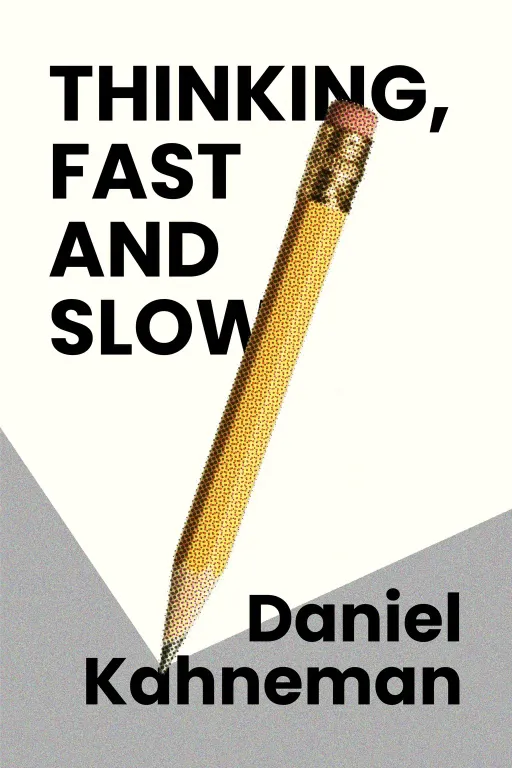
Nova: Absolutely, Atlas. And that's precisely what we're unpacking today. We're diving into the revolutionary insights from Daniel Kahneman's seminal work,, and then building on that with Richard H. Thaler and Cass R. Sunstein's incredibly practical book,. Kahneman, a psychologist, actually won the Nobel Memorial Prize in Economic Sciences for his work, which really underscores how deeply these psychological insights have reshaped our understanding of economics and human behavior.
Atlas: That’s a huge claim for a psychologist to win an economics Nobel. It tells me this isn't just abstract theory; it's got real-world teeth. So, if our decisions aren't as rational as we believe, where do we even begin to understand this?
Nova: We begin by dismantling the myth of the "rational actor."
The Myth of the Rational Actor and Our Two Minds
SECTION
Nova: For centuries, economic theory and even much of our everyday thinking assumed that humans are these perfectly logical beings. We weigh pros and cons, assess probabilities, and always choose what's best for us. The "rational actor." It’s a beautiful idea, but it’s a total fantasy.
Atlas: Right, like a perfectly optimized spreadsheet human. But wait, I mean, we think logically sometimes, don't we? We solve complex problems, we plan for the future. Are you saying all that is just an illusion?
Nova: Not an illusion, but only part of the story. Kahneman brilliantly dissects our minds into two systems. He calls them System 1 and System 2. Think of System 1 as the lightning-fast, intuitive, emotional, automatic pilot. It’s what lets you recognize a friend's face instantly, or slam on the brakes without thinking. It operates effortlessly.
Atlas: Okay, so System 1 is like the gut reaction, the instinct. It’s what jumps to conclusions.
Nova: Exactly. And System 2? That’s the slow, deliberate, effortful thinker. It’s what you use to solve a complex math problem, or carefully plan your next big project. It requires attention and uses up mental energy.
Atlas: I can see that. That makes sense, but the challenge for a deep diver like me is understanding how often we actually use System 1 versus System 2, and when System 1 might be leading us astray without us even realizing it.
Nova: That's the crucial part. System 1 is running the show most of the time, and it often presents its conclusions to System 2 as if they were fully reasoned. And System 2, being a bit lazy, often accepts them without much scrutiny. Here's a classic example: I’ll give you a simple problem. A bat and a ball together cost one dollar and ten cents. The bat costs one dollar more than the ball. How much does the ball cost?
Atlas: Oh, I've heard this one! My System 1 immediately screams "ten cents!" Because it’s so easy to subtract a dollar from a dollar ten. But that’s wrong, isn't it?
Nova: Precisely. If the ball cost ten cents, the bat would cost one dollar and ten cents, making the total two dollars and twenty cents. The correct answer is five cents for the ball, and one dollar and five cents for the bat. Your System 1 jumps to the intuitive, easy answer. Your System 2, if you engage it, would slow down, maybe set up an algebraic equation, and find the correct solution.
Atlas: That's incredible. So, even when we we're being logical, System 1 is still pulling strings, offering up an answer that feels right, and System 2 often just goes along with it. That’s a bit unsettling for someone who values rigorous, rational thought. It makes me wonder how many of my "well-thought-out" conclusions are actually just System 1 intuitions dressed up in System 2’s clothes.
Nova: It's pervasive. From making snap judgments about people based on their appearance, to vastly overestimating our chances of winning the lottery, to anchoring on the first price we see in a negotiation. System 1 is constantly generating intuitions, impressions, and feelings, and System 2 is often just there to rationalize them after the fact. It’s a profound insight that truly challenges our sense of free will and agency.
Atlas: That makes me wonder, if our minds are so prone to these quick, intuitive shortcuts, then how can we ever truly make decisions that align with our deepest values or long-term goals? It seems like we're constantly fighting an uphill battle against our own brains.
The Power of Nudges: Influencing Choices Ethically
SECTION
Nova: That's a brilliant question, and it’s exactly where the second book,, steps in. If we understand how System 1 works, how it responds to cues and defaults, then we can design environments that gently guide us toward better outcomes, without restricting our freedom. This is the concept of a 'nudge.'
Atlas: So, it's about making small changes in the environment to appeal to that fast, intuitive System 1, almost like a subtle suggestion? Like, instead of forcing me to eat vegetables, you just put them at eye level in the fridge?
Nova: Exactly! A nudge is any aspect of the choice architecture that alters people's behavior in a predictable way without forbidding any options or significantly changing their economic incentives. To give you a classic and rather amusing example, consider the men's restrooms at Amsterdam's Schiphol Airport. They had a problem with 'spillage,' if you catch my drift.
Atlas: Oh, I think I do. A common problem in public facilities, I imagine.
Nova: Right. Instead of putting up stern signs or increasing cleaning staff, the airport simply etched the image of a small housefly into the center of each urinal. And guess what happened?
Atlas: Let me guess… men, being men, instinctively aimed for the fly?
Nova: They did! Spillage dramatically decreased, by over 80%, if I recall correctly. No one was forced to aim at the fly, but that tiny visual cue provided a target for System 1, which loves clear, simple goals. It's a perfect example of a highly effective, non-coercive nudge.
Atlas: That’s incredibly clever, and genuinely funny. But it also raises a question for an ethical explorer like me. Isn't 'nudging' a bit manipulative? Where's the line between helpful guidance and subtle control? Especially if we're trying to align our values with daily choices, as many of our listeners are.
Nova: That’s a fundamental ethical tension in the world of nudges, and Thaler and Sunstein address it head-on. They advocate for what they call "libertarian paternalism." The "libertarian" part means preserving freedom of choice – no options are taken away. The "paternalism" part means that the choice architect, the person designing the environment, is still trying to steer people in directions that will improve their lives.
Atlas: Okay, "libertarian paternalism." That’s a fascinating oxymoron. It means we're still free to choose, but the default, the easiest path, is the one that leads to a better outcome. Like how many companies automatically enroll employees in retirement savings plans, but you can always opt out.
Nova: A perfect example! Opt-out defaults for things like retirement savings or organ donation are powerful nudges that have significantly increased participation rates. It leverages our System 1's tendency to stick with the default, while still allowing System 2 to step in and change it if we truly want to. So the ethical line is often drawn by transparency and whether the nudge benefits the individual and society, rather than exploiting biases for someone else's profit.
Atlas: That’s helpful. So, how can we, as practical scholars, use this understanding to 'nudge' ourselves or design better systems, without falling into the trap of being manipulated?
Synthesis & Takeaways
SECTION
Nova: The first step is awareness, Atlas. Just knowing about System 1 and System 2, and recognizing that we’re all susceptible to these biases, is incredibly empowering. It allows us to pause, to engage our System 2, and to question our initial impulses. It’s about building better choice architectures for ourselves.
Atlas: That really shifts how I think about everything from personal habits to large-scale policy. It's not just about knowing to do, but understanding our minds process that information, and how that processing can be gently guided. For someone interested in sustainable systems, this means designing systems where ethical choices are also the easiest choices.
Nova: Absolutely. And for our listeners, I encourage you to become an observer of your own System 1. Where in your daily life do you see it at play? Perhaps in your grocery store, or how you interact with technology, or even in your own decision to hit snooze. Just noticing it is the beginning of reclaiming a bit more agency.
Atlas: That’s a powerful call to action. It’s about cultivating a deeper understanding of ourselves and the world around us, and then using that knowledge purposefully for impact. It's about designing a more conscious, and perhaps more ethical, way of living.
Nova: Precisely. It’s a profound insight that offers both humility about our own rationality and immense power to shape our choices and our world.
Atlas: Thank you, Nova, for shedding light on such a complex yet crucial topic.
Nova: My pleasure, Atlas. And to all our listeners, keep exploring, keep questioning.
Nova: This is Aibrary. Congratulations on your growth!