The 'Mindset' Trap: Why You Need Clear Decision Frameworks.
Golden Hook & Introduction
SECTION
Nova: Your brain is lying to you. Not sometimes, not occasionally, but constantly. And it's not trying to be malicious, it's just trying to be efficient.
Atlas: Wait, are you saying my own internal monologue is a con artist? That sounds a bit out there, but also… strangely relatable.
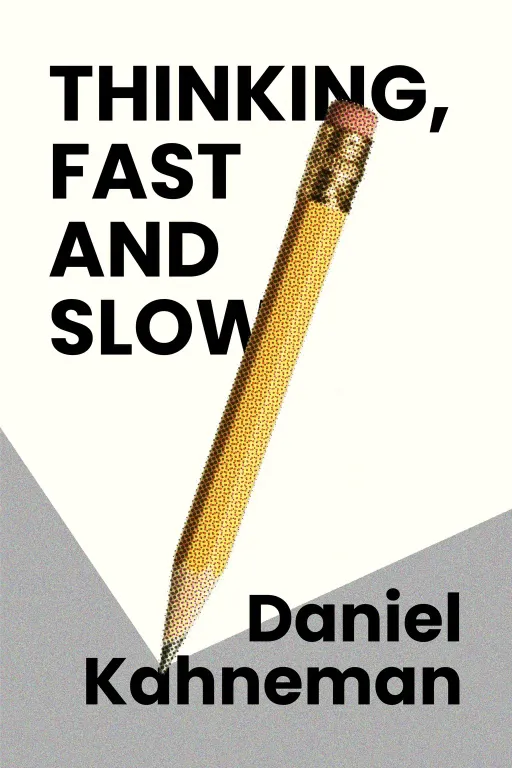
Nova: Exactly! And understanding this fundamental truth is the first step to making better decisions, especially when you’re mapping out an ambitious future or leading a team. Today, we're diving into the fascinating world of decision-making, particularly through the lenses of two groundbreaking books: Nobel laureate Daniel Kahneman's "Thinking, Fast and Slow," and fellow Nobel recipient Richard H. Thaler and Cass R. Sunstein's influential work, "Nudge."
Atlas: Two Nobel winners? That's a serious intellectual heavyweight championship. I imagine a lot of our listeners, the strategists and builders among us, are constantly trying to optimize their thinking. So, where do we even begin to unpack this mental deception?
The Illusion of Rationality: Unmasking Our Cognitive Biases
SECTION
Nova: We begin with Kahneman's revolutionary idea of two systems of thought: System 1, our fast, intuitive, emotional brain, and System 2, our slow, deliberate, logical brain. Think of System 1 as the autopilot, making snap judgments based on experience and heuristics. It's brilliant for survival—recognizing a familiar face, swerving from a sudden obstacle. But it's also prone to biases.
Atlas: So, System 1 is like the super-efficient but sometimes lazy assistant who cuts corners? And System 2 is the meticulous, detail-oriented manager who reviews everything?
Nova: A perfect analogy! System 1 generates impressions and feelings, and System 2 then turns those into beliefs and choices. The problem arises when System 1's biases go unchecked by System 2. For instance, confirmation bias—we naturally seek out information that confirms what we already believe. Or anchoring bias, where an initial piece of information, even if irrelevant, disproportionately influences subsequent judgments.
Atlas: Oh, I know that feeling. It’s like when you see a high price on something first, and suddenly a slightly lower price seems like a bargain, even if it's still expensive. That's going to resonate with anyone who struggles with strategic planning. How does this 'fast thinking' actually lead us astray in, say, a business context?
Nova: Imagine a startup founder, deeply invested in their idea, dismissing market research that contradicts their initial vision. Or a team leader, after a successful project, overestimating their ability to replicate that success with a completely different team and challenge. Their System 1 is shouting, 'You got this!' based on past wins, but System 2 isn't doing the hard work of analyzing the new variables. This often leads to overconfidence, poor risk assessment, and ultimately, misallocated resources.
Atlas: So, it's not just about making a 'bad' decision, it's about making a decision based on a flawed internal process, often without even realizing it. That’s actually kind of terrifying for someone who's driven by growth and making an impact. How can we possibly trust our instincts if they're constantly pulling these fast ones on us?
Nova: That’s the core tension. Our instincts are valuable, but blindly trusting them without a framework is where the 'mindset trap' lies. It's about recognizing that our minds, while powerful, have these predictable blind spots. This understanding is the pivot point for cultivating truly strategic thinking.
Building Better Brains: Crafting Decision Frameworks and Strategic Nudges
SECTION
Nova: That’s where our second core idea comes in: understanding these biases allows us to design better processes, moving from reactive decisions to deliberate, strategic moves. This is where Thaler and Sunstein's "Nudge" becomes incredibly powerful. They show that by subtly structuring choices, you can guide people towards better outcomes without restricting their freedom.
Atlas: So, it’s not about forcing people to make the 'right' choice, but making the 'right' choice the easier or more obvious one? Can you give an example?
Nova: Absolutely. Think about retirement savings. Many companies now use 'opt-out' rather than 'opt-in' for 401k plans. Instead of having to actively sign up, employees are automatically enrolled unless they choose to leave. This simple change, a 'nudge,' dramatically increases participation because our System 1 prefers the path of least resistance, and System 2 often doesn't get around to making the active choice.
Atlas: That’s a perfect example. It's like setting up guardrails on a road rather than just putting up a 'drive carefully' sign. So, for our listeners who are strategists and builders, how can they apply this 'nudging' principle to their own ambitious goals or in guiding their teams?
Nova: For personal strategic planning, it means building frameworks. If you know you're prone to overcommitting, create a 'not-to-do' list. If you know you get distracted, design your environment to minimize interruptions – that's a self-nudge. For teams, it means designing decision-making processes that explicitly counteract common biases. For example, before a big investment decision, mandate a 'pre-mortem' where the team imagines the project has failed and works backward to identify reasons why. This actively forces them to engage System 2 and look for potential pitfalls, counteracting overconfidence.
Atlas: That’s brilliant. So, instead of just saying, "Be more rational," you're saying, "Design a system that makes it harder not to be rational." It’s about creating an architecture of choice, whether for yourself or for others.
Nova: Precisely. It's about moving beyond the vague idea of 'mindset' and into the concrete realm of 'mind-set-up.' We're not trying to change human nature, we're building processes that work it, even when our intuition might lead us astray. This is where true excellence in decision-making emerges.
Synthesis & Takeaways
SECTION
Nova: Exactly. The illusion of rationality is a powerful one, but the insight here is that you don't have to fight your brain's natural tendencies with sheer willpower. You can outsmart them by understanding how they work and then designing your world – your decisions, your environment, your processes – to align with your long-term, deliberate goals.
Atlas: So, it’s about moving from a reactive, instinct-driven approach to a proactive, framework-driven one. It’s not just about 'mindset,' it’s about 'mind-set-up.' For our listeners who are constantly seeking understanding and aiming for excellence, the tiny step here is profound: identify one recent decision, big or small, and ask yourself, 'Which cognitive bias might have influenced this?'
Nova: That's the key. Just that moment of reflection, that tiny step of awareness, begins to engage your System 2 and build a stronger, more deliberate decision-making muscle. It’s what transforms an ambitious future from a dream into a well-constructed reality.
Atlas: Because ultimately, the goal isn't to eliminate bias entirely—that's impossible. It's to build systems where our biases work for us, or at least don't work against us. Thank you for that incredible insight, Nova.
Nova: Always a pleasure, Atlas.
Atlas: This is Aibrary. Congratulations on your growth!