The Information Overload Trap: Why You Need Curated Clarity Now
Golden Hook & Introduction
SECTION
Nova: Alright, Atlas, quick game. Five words. Give me your instant, gut reaction to the idea of information overload.
Atlas: Brain. Full. Can't. Process. Anymore.
Nova: Oh, I know that feeling! Mine would be: Too many tabs, too little brain. And that, my friends, is exactly what we're diving into today: The Information Overload Trap. We’re talking about that relentless digital deluge that leaves us feeling scattered and overwhelmed.
Atlas: Oh, I love that. Too many tabs, too little brain. Honestly, that sounds like my Monday mornings. But you’ve mentioned some heavy hitters today, some serious intellectual firepower.
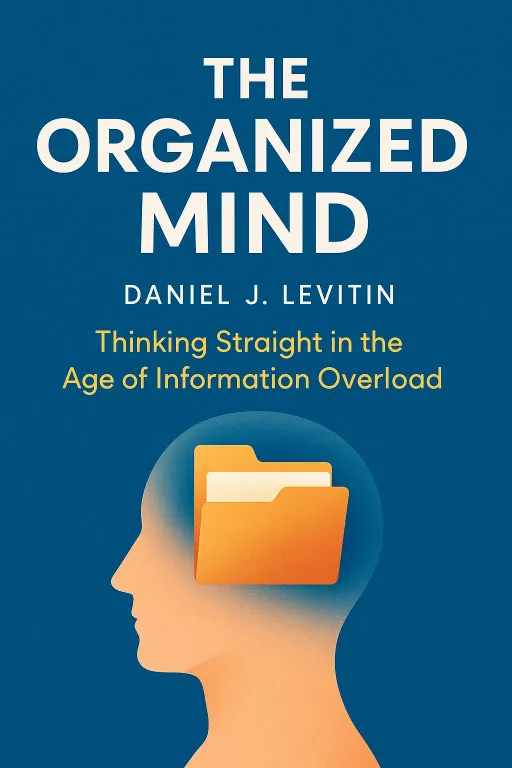
Nova: Absolutely. We're drawing insights from two titans of cognitive science: "The Organized Mind" by Daniel J. Levitin, and "Thinking, Fast and Slow" by Daniel Kahneman. And for anyone unfamiliar with Kahneman's work, he's a Nobel Memorial Prize winner in Economic Sciences for his groundbreaking work on prospect theory. This isn't just theory; it's deeply researched science.
Atlas: Wow, that’s serious credibility right there. But how do these two seemingly different books connect to that feeling of being scattered, or that constant struggle to keep up with new knowledge when you feel like your mental hard drive is always full?
Nova: That's the perfect question, because they both tackle the same fundamental problem from different angles. And it all starts with understanding why our human brains, these incredibly complex organs, are actually terrible at handling the sheer volume of information we face every single day.
The Inherent Flaws: Why Our Brains Buckle Under Digital Deluge
SECTION
Nova: The cold, hard fact is, our brains are not built for today's information firehose. Evolutionarily speaking, we're designed for pattern recognition, for navigating a savannah, for remembering where the berries are, not for sifting through a million emails or endless news feeds.
Atlas: So you’re saying our ancient brains are trying to run modern software, and it’s just crashing?
Nova: Exactly! And Daniel Kahneman, with his Nobel-winning insights, gives us the framework to understand it crashes. He talks about two systems of thinking: System 1, which is fast, intuitive, and emotional, and System 2, which is slower, more deliberate, and logical.
Atlas: Okay, so our brains have two speeds. Can you give us an example of how System 1 and System 2 work in our daily lives? Like, when am I using which system?
Nova: Think about it this way: System 1 is what you use when you instantly recognize a friend's face or catch a ball. It's automatic. System 2 is what you engage when you're solving a complex math problem, trying to decide on a new career path, or, crucially, when you're trying to learn a completely new, abstract concept.
Atlas: I can see that. So when we’re hit with a constant stream of notifications, headlines, and demands, which system takes over?
Nova: That's where the overload trap springs. This constant barrage pushes us to rely almost exclusively on System 1. It’s faster, less energy-intensive, but also more prone to biases, snap judgments, and, frankly, less reliable. We skim, we react, we don't deeply process. Levitin adds to this by explaining that our brains excel at forming patterns and making connections, but they're terrible at endless data storage.
Atlas: But wait, modern society almost glorifies being busy, being able to juggle multiple things at once. Aren't we supposed to be good at multitasking? Isn't that what modern life demands of a curious learner trying to soak up everything?
Nova: That's a powerful misconception, Atlas. The idea of true multitasking is a myth. What we're actually doing is 'task-switching' rapidly. Every time you switch from one thing to another, there's a cognitive cost. It's like constantly stopping and restarting your car engine. It burns more fuel, causes more wear and tear, and gets you nowhere fast. Your attention fragments, your memory suffers, and you end up feeling scattered precisely because your brain can't deeply engage with anything.
Architecting Clarity: Building External Systems to Reclaim Your Mental Bandwidth
SECTION
Nova: So, if our internal hardware is struggling, what's the upgrade path? That brings us to Levitin's brilliant insights on building external systems. If our brains aren't great at endless data storage, then let's offload that storage to something else.
Atlas: I guess that makes sense. So, we shouldn't be trying to remember all the time? We should be outsourcing our memory?
Nova: Precisely. Levitin argues that by creating reliable external structures – whether that's a sophisticated note-taking app, a simple to-do list, or even just a designated 'capture zone' for random thoughts – we free up precious mental bandwidth. This isn't about being 'organized for organization's sake.' It's about freeing up your System 2, your deep thinking capacity, to do what it does best: analyze, synthesize, innovate.
Atlas: Okay, so if I faithfully put every idea, every task, every random thought into, say, a digital note-taking app, how does that actually make me or more capable of deep thinking, beyond just remembering stuff?
Nova: That’s a great question. Think of it like this: imagine you're trying to have a profound conversation, but you're also desperately trying to remember if you turned off the stove, what you need from the grocery store, and that brilliant idea you had in the shower. Your System 2 can't fully engage with the conversation because System 1 is constantly pinging with these other concerns.
Atlas: Oh, I’ve been there! That's a perfect example.
Nova: Right? Now, if those thoughts are reliably captured in an external system, your brain knows it doesn't need to hold onto them. It's like having a trusted assistant. Your mind can then fully dedicate itself to the complex problem, the new concept you're learning, or the creative challenge. This is how curated clarity leads to true growth; it allows you to focus on comprehension and synthesis rather than mere retrieval.
Atlas: I imagine a lot of our listeners, especially those who love diving into new knowledge areas, struggle with feeling like they’re constantly forgetting details, or that their learning isn’t sticking. So this 'offloading' isn't just about productivity; it's about making our learning more effective?
Nova: Absolutely. It transforms learning from a frantic attempt to store everything internally into a more elegant process of connecting and understanding. By building these external structures, we're essentially building a more efficient 'second brain' that complements our natural cognitive abilities. It allows our System 2 to shine. And this is why the 'Tiny Step' the book suggests is so powerful: pick one digital tool – a note-taking app, a task manager – and commit to using it consistently for all new information for just one week.
Synthesis & Takeaways
SECTION
Nova: So, bringing it all together: Kahneman shows us the inherent limitations of our internal cognitive systems, especially under overload. Levitin then provides the antidote, demonstrating how strategically designed external systems can work our brains, rather than against them.
Atlas: It's not just about being organized for the sake of it. It's about reclaiming our mental sovereignty in a world that constantly tries to hijack our attention. It’s about understanding that our brains are not infinite hard drives, and that’s okay.
Nova: Exactly. It's about recognizing that feeling scattered isn't a personal failing; it's a systemic problem that requires systemic solutions. And those solutions start with a deliberate choice to curate our information flow and create reliable homes for our thoughts.
Atlas: What if by simply structuring our external world, we could fundamentally change our internal experience of learning and focus? It's a powerful thought. And that tiny step, picking one tool, seems so manageable.
Nova: It truly is. Because the goal here isn't perfection, it's progress. It's about freeing up your mind to engage in the deep thinking and learning you're passionate about, rather than just reacting to the next notification. Start small, gain clarity, and watch your capacity for growth expand.
Atlas: That’s actually really inspiring. It feels less like a chore and more like an act of self-care for our brains.
Nova: Couldn't agree more.
Nova: This is Aibrary. Congratulations on your growth!