The Hidden Logic of Decision-Making: Why Your Brain Isn't Always Your Friend.
Golden Hook & Introduction
SECTION
Nova: Alright Atlas, rapid-fire word association. I say a word, you give me the first thing that pops into your head. Ready?
Atlas: Oh, I like that! My brain is primed for spontaneity. Hit me.
Nova: "Coffee."
Atlas: "Survival."
Nova: "Workout."
Atlas: "Regret... then triumph."
Nova: Okay, how about, "Decision"?
Atlas: "Overwhelm." Or sometimes, "Instant." But usually, "overwhelm."
Nova: "Overwhelm" and "instant." That's actually a perfect segue into what we're dissecting today, Atlas. Because those two words perfectly capture the hidden logic, or sometimes, the hidden, of how our brains make decisions.
Atlas: Oh, I'm curious. Are we talking about that little voice that tells you to hit snooze five times even though you know you'll be late? Because I know that voice intimately.
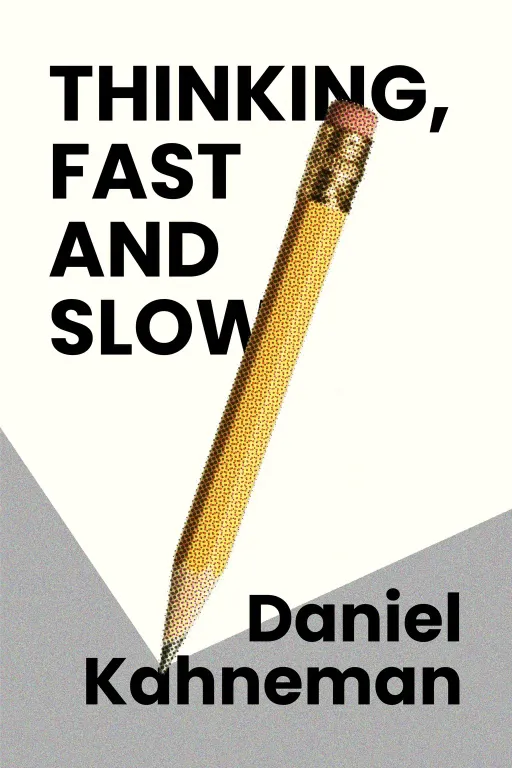
Nova: Exactly that voice, and so much more! Today, we're diving into the brilliant, often counterintuitive world of decision-making, largely inspired by the monumental work of Daniel Kahneman, especially his book "Thinking, Fast and Slow."
Atlas: Kahneman, right? Wasn't he a psychologist who won the Nobel Memorial Prize in Economic Sciences? That always struck me as fascinating—a psychologist shaking up economics.
Nova: Absolutely! And it's precisely he's a psychologist that his work is so paradigm-shifting. He showed the economic world that humans aren't the perfectly rational actors classical economics assumed. He, along with Amos Tversky, pioneered behavioral economics by revealing the systematic biases that influence our judgment. It's a foundational text, and we'll also be touching on how others, like Richard Thaler and Cass Sunstein in their book "Nudge," built upon these insights to show how our environment subtly shapes those very decisions.
Atlas: That makes me wonder about all those "rational" choices I think I'm making every day. So, if even Nobel laureates confirm our brains are playing tricks, how do these mental shortcuts actually work?
The Dual Mind: System 1 vs. System 2
SECTION
Nova: Well, Kahneman's genius was in simplifying this complexity into two distinct systems. Imagine your brain has two modes of operation: System 1 and System 2.
Atlas: Okay, so like a 'default setting' and a 'manual override'?
Nova: That’s a great way to put it! System 1 is your fast, intuitive, emotional, automatic mode. It's what allows you to recognize a friend's face instantly, or slam on the brakes without thinking. It operates almost effortlessly. But System 2 is your slow, deliberate, logical, effortful mode. It kicks in when you're solving a complex math problem, or carefully weighing the pros and cons of a major life decision.
Atlas: So, System 1 is the gut feeling, and System 2 is the deep thought. Is one better than the other? Because I'm often told to "trust my gut."
Nova: And that's where the "hidden logic" comes in. System 1 is incredibly efficient, but it's also prone to systematic errors, or biases. It's a storyteller, always trying to make sense of the world quickly, even if it has to fill in gaps with assumptions. System 2 correct System 1, but it's lazy. It takes effort, and we often default to System 1 unless we're consciously engaged.
Atlas: So you’re saying my brain, left to its own devices, will take the easy route, even if it's the wrong route? That sounds rough, but I can definitely relate. Give me an example where our System 1 really leads us astray.
Nova: Alright, here's a classic one. Don't overthink it, just tell me the first answer that comes to mind: A bat and a ball cost $1.10 in total. The bat costs $1.00 more than the ball. How much does the ball cost?
Atlas: Oh, I know this one! The ball costs 10 cents. That's a classic.
Nova: And that, Atlas, is your brilliant System 1 at work. It's fast, it's intuitive, it's confident... and it's wrong.
Atlas: Wait, hold on! Ten cents. Bat is a dollar more, so bat is $1.10. Total $1.20. Oh, I see my mistake now. So the bat is $1.05 and the ball is 5 cents. That's... humbling.
Nova: Exactly! The correct answer is 5 cents. The reason almost everyone, including highly intelligent people, initially thinks 10 cents is because System 1 jumps to the most coherent, easily accessible solution. It sees "$1.00 more" and "total $1.10" and quickly pairs "10 cents" with the ball, because it right. System 2, the deliberate, calculating part, has to actively override that strong intuition.
Atlas: That’s incredible. So, my instant answer, my "gut feeling" in that moment, was a complete misdirection. And if that happens with a simple math problem, what about bigger, more complex decisions in daily life? Like, choosing a career, or a partner, or where to invest?
Nova: Precisely. This is why understanding System 1's shortcuts is so crucial. It's not that System 1 is bad; it's incredibly useful for navigating the world efficiently. But when accuracy matters, we need to learn to recognize when to engage System 2. Otherwise, we're making predictable errors, often without even realizing it. It highlights how much of our decision-making operates beneath the surface of conscious thought.
The Power of the Nudge: Shaping Choices Through Environment
SECTION
Atlas: So, if our fast thinking is so easily swayed, and our slow thinking is often too lazy to correct it, what hope do we have? Does this mean we're just prisoners of our own biased brains?
Nova: Not at all! This is where the work of Thaler and Sunstein comes in with the concept of "nudges." They took Kahneman's insights and asked: if people are predictably irrational, can we design environments that "nudge" them towards better decisions without forcing them?
Atlas: Okay, so it’s like, if my System 1 is going to grab the easiest thing, can we make the easiest thing the thing for me?
Nova: You've got it. A nudge is any aspect of the choice architecture that alters people's behavior in a predictable way without forbidding any options or significantly changing their economic incentives. It's about subtle changes in context.
Atlas: That sounds a bit out there. Isn’t that just manipulation? Like, subliminal messaging for good?
Nova: That’s a common concern, and it's important to differentiate. A true nudge preserves freedom of choice. Think about it this way: if you walk into a cafeteria, the food is arranged way. There's no neutral arrangement. By putting the salad bar at eye level and the desserts in a less prominent spot, you're not stopping anyone from eating dessert. You're just making the healthier option slightly more salient, slightly easier to choose.
Atlas: Right, like where they place the impulse buys right by the checkout counter. That’s a nudge, but maybe not always for my benefit.
Nova: Exactly! That's a commercial nudge. But governments and organizations have used nudges for incredibly positive effects. Take organ donation, for example. In countries where the default option is "opt-in", donation rates are often very low. But in countries where the default is "opt-out", donation rates skyrocket.
Atlas: Wow, that’s a huge difference for something that's literally just a checkbox! So the default option, which our lazy System 1 just accepts, has massive real-world consequences. That’s actually really inspiring. It means we can strategically design systems for better outcomes.
Nova: Absolutely. It's about understanding human psychology and leveraging it. Another great example is retirement savings. When companies switch from an opt-in 401k program to an opt-out, where employees are automatically enrolled unless they decline, participation rates go way up. People intend to save, but System 1 prefers the path of least resistance, and filling out forms is effortful for System 2.
Atlas: So, for our listeners who are constantly trying to make better choices—whether it's eating healthier, saving more, or being more productive—how can we use this idea of a "nudge" for ourselves? How do we become our own choice architects?
Synthesis & Takeaways
SECTION
Nova: That's the million-dollar question, Atlas, and it ties directly into that deep question from our reading. The key is to recognize where your System 1 is likely to lead you astray, and then design your environment to make the desired choice the easiest default.
Atlas: In other words, make the good choices effortless.
Nova: Exactly. If you want to eat healthier, don't just to. Nudge yourself. Put healthy snacks at eye level in the fridge, prep your meals on Sunday, or even put the fruit bowl on your desk. If you want to exercise more, lay out your workout clothes the night before. If you want to reduce screen time, put your phone in another room to charge overnight. It’s about creating friction for the bad choices and removing friction for the good ones.
Atlas: That gives me chills, thinking about how much of my day is shaped by these invisible forces. It’s not about willpower; it’s about strategic design. Being aware of System 1 and the power of nudges isn't about becoming perfectly rational, but about making more informed decisions and designing better environments for ourselves.
Nova: Precisely. It’s about recognizing that our brains aren't always our friends, but they're predictable. And once you understand those patterns, you gain a new kind of agency. You can start to observe where in your daily life System 1 makes choices you later regret, and then, you can actively design your own 'nudges.' It’s a powerful shift from blaming yourself to strategically empowering yourself.
Atlas: I love that. It turns self-improvement into a design challenge rather than a battle of wills. So, for everyone listening, where in your daily life do you see System 1 making choices you later regret, and how can you design a small 'nudge' for yourself this week? Think about it, experiment, and see what happens.
Nova: It's a journey of self-discovery and self-design.
Atlas: This is Aibrary. Congratulations on your growth!