

The Hidden Code: Deciphering Human Irrationality for Better Decisions
Golden Hook & Introduction
SECTION
Nova: Most of your big decisions? You didn't make them. Not really. Your brain made them for you, on autopilot, often without your explicit permission. And it does it all the time.
Atlas: Whoa, Nova, that's a bold claim right out of the gate! Are you telling me I’m not even in control of my own mind? Because I like to think I’m a pretty rational guy.
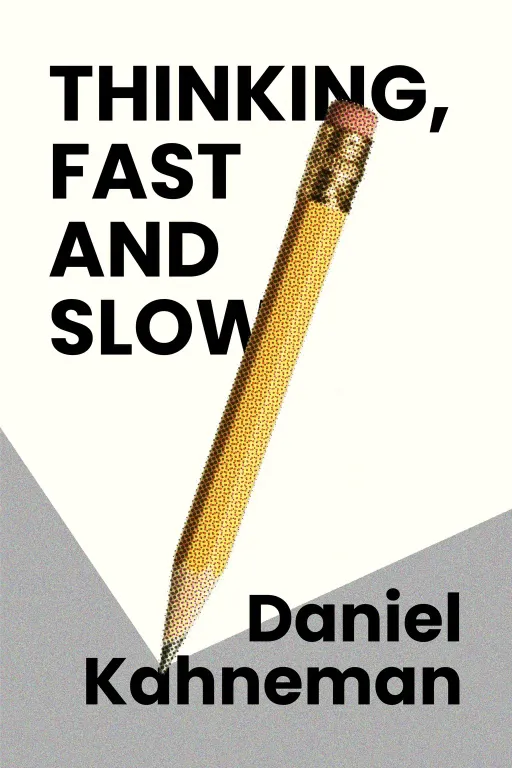
Nova: Oh, Atlas, we all do! That's the beautiful, terrifying blind spot we're going to dive into today. We're cracking open "The Hidden Code: Deciphering Human Irrationality for Better Decisions," drawing heavily from the groundbreaking work of Nobel laureates Daniel Kahneman, author of "Thinking, Fast and Slow," and Richard Thaler, who co-authored "Nudge" with Cass Sunstein. These aren't just academic texts; they're blueprints for understanding why we do what we do.
Atlas: Right. Kahneman and Thaler – two giants who fundamentally shifted our understanding of human behavior from purely rational economics to something far more… human. But how do these two distinct, though related, bodies of work combine to form this "hidden code" you're talking about? Where do we even begin to untangle it?
Nova: We begin with the architect hidden within us, the one pulling most of the strings without us even realizing it.
The Hidden Architect: Unmasking System 1 Thinking and Cognitive Biases
SECTION
Nova: Imagine you’re at a grocery store. You see a sign: "Organic Apples – Was $4.99, Now $3.99!" Without much thought, you grab a bag. Later, you realize those apples were never $4.99; the store just put up a fake "was" price to make $3.99 look like a steal. You fell for it, and it felt completely natural.
Atlas: Oh, I hate when that happens! It feels like such a tiny thing, but it’s infuriating when you realize you’ve been played. But how does that connect to a "hidden architect"?
Nova: That, my friend, is your System 1 thinking at play. Kahneman brilliantly laid out two systems of thought. System 1 is fast, intuitive, emotional, and automatic. It’s what makes you swerve to avoid an obstacle or understand a simple sentence. It’s incredibly efficient, but it's also prone to biases. It sees "discount" and immediately associates it with "good deal."
Atlas: So, are you saying our gut feelings, our quick judgments, are often leading us astray? Because sometimes that gut feeling is really powerful, you know? It right.
Nova: Absolutely, it right because System 1 is designed for speed, not always accuracy. It uses mental shortcuts, or heuristics, to make decisions quickly. Think of it like this: your brain is trying to conserve energy. If it can use a quick rule of thumb – "lower price equals better value" – it will, even if that rule doesn't apply. This is where cognitive biases like anchoring come in. You "anchored" to the fake original price, making the "discounted" price seem more attractive than it actually was.
Atlas: I can definitely relate to that. I remember once I had to hire someone, and one candidate just like the right fit, even though their resume wasn't as strong. My System 2, the slower, more deliberate thinking, tried to argue, but System 1 just had this overwhelming sense of "yes."
Nova: That’s a perfect example. That "feeling" is System 1 synthesizing information, often unconsciously, and presenting you with a conclusion. It might be influenced by a candidate's confidence, their similarity to someone you admire, or even just their firm handshake. These are all subtle triggers that bypass our deliberate, System 2 analysis. The challenge is, System 1 operates in the background, making it our primary blind spot. It distorts our judgment in everything from business negotiations to personal relationships, often leading to predictable errors that we only recognize in hindsight.
Atlas: That makes me wonder, how prevalent are these biases? Is it just a few bad apples, or is it really baked into how all our brains work?
Nova: It's universal, Atlas. We all have these biases. They're part of the human operating system. For instance, there's the availability heuristic: we overestimate the likelihood of events that are easy to recall. That's why news about plane crashes makes us fear flying more than driving, even though driving is statistically far more dangerous. Plane crashes are just more vivid and readily "available" in our minds.
Atlas: So basically, you’re saying our brains are constantly playing tricks on us, and we're often none the wiser. That’s actually really humbling. It makes you question every "logical" decision you've ever made.
Nova: Exactly. And that humility is the first step towards better decision-making. Because once we understand this hidden architect, we can start to see where its designs might be flawed. And that naturally leads us to the second key idea we need to talk about, which offers a fascinating counterpoint to what we've just discussed: if our minds are so susceptible, can we use that knowledge for good?
The Gentle Hand: How Nudges Reshape Our Choices (and How We Can Use Them)
SECTION
Nova: If our brains are so easily tricked, is there any hope? Is it just a losing battle against our own cognitive shortcuts? This is where Richard Thaler and Cass Sunstein come in with their concept of "nudges." A nudge is essentially any aspect of the choice architecture that alters people's behavior in a predictable way without forbidding any options or significantly changing their economic incentives.
Atlas: Okay, so it’s not about forcing people or offering huge rewards, but something more subtle. Can you give an example of one of these "gentle hands" at work? Because "choice architecture" sounds a bit abstract.
Nova: Think about the classic cafeteria experiment. If you arrange food in a cafeteria, simply by placing healthier options like fruit at eye level and less healthy options like desserts further down the line, people will consume significantly more fruit. No one is telling them they can't have cake; the cake is still there. But the environment subtly "nudges" them towards a better choice.
Atlas: That’s fascinating! It’s like the path of least resistance is also the path of best choice, in that instance. But isn't that a bit manipulative? If we're being "nudged" without realizing it, are we truly making free choices?
Nova: That's a critical question, Atlas, and one Thaler and Sunstein grappled with. They argue that choice architecture is unavoidable. Someone always designs the environment in which we make decisions, whether consciously or unconsciously. So the question isn't we'll be nudged, but we'll be nudged. Their concept of "libertarian paternalism" suggests we can design environments that gently guide people towards outcomes that are demonstrably better for them, while preserving their freedom to choose otherwise.
Atlas: So, for our listeners who are trying to make better personal decisions, how can use this idea of nudges for themselves? Beyond just getting a cafeteria to put fruit front and center.
Nova: Absolutely! Let's take saving for retirement, a notoriously difficult habit to start. Many companies now use "opt-out" enrollment for their 401k plans. Instead of having to actively sign up, new employees are automatically enrolled unless they specifically choose to opt out. That subtle default option, that "nudge," dramatically increases participation rates.
Atlas: Wow, that’s powerful. So, if I apply that to my own life, it’s about making the good choices the default, or the easiest option. Like, if I want to eat healthier, maybe I don't buy the sugary snacks in the first place, so they're not even an option when my System 1 is craving something fast.
Nova: Precisely! Or if you want to exercise more, lay out your workout clothes the night before, or sign up for a class that has a cancellation fee. These are all small nudges that make the desired behavior easier and the undesired behavior slightly harder. It's about becoming your own choice architect, understanding that your environment profoundly shapes your decisions, often more than sheer willpower.
Atlas: That's actually really inspiring. It frames self-improvement not as a battle of internal discipline, but as a smart design challenge. It's about designing a world where my future self makes better choices almost effortlessly.
Synthesis & Takeaways
SECTION
Nova: So, bringing it all together, "The Hidden Code" truly reveals that our minds are a fascinating interplay. We have System 1, the fast, intuitive, bias-prone decision-maker, and then we have the power of "nudges," which are essentially external architects leveraging those very System 1 tendencies to guide us towards better outcomes. The profound insight here is that understanding our predictable irrationality isn't a weakness; it's a superpower waiting to be harnessed.
Atlas: It makes you realize that true freedom isn't just about having choices, but about understanding the invisible forces influencing those choices. It’s about not being a passenger in your own decision-making process.
Nova: Exactly. Next time you face a decision, big or small, pause for just a moment. Ask yourself: "Is this my System 1 talking? Am I being swayed by a quick emotion or a familiar shortcut?" And then, "How could I subtly 'nudge' myself, or even my team, towards a better default next week?" These small moments of reflection are where the hidden code truly starts to work you.
Atlas: That's such a clear, actionable takeaway. It’s about becoming a conscious participant in your own cognitive architecture. For anyone who's ever wondered why they keep making the same "mistakes," this episode provides not just answers, but a path forward.
Nova: Absolutely. It’s about empowering yourself to literally rethink your thinking.
Nova: This is Aibrary. Congratulations on your growth!









