The 'Good Intentions' Trap: Why You Need to Design for Real Behavior Change.
Golden Hook & Introduction
SECTION
Nova: We all have them: those grand plans for a healthier life, a more organized workspace, or a bigger savings account. We start with the best intentions, fueled by logic and aspiration, only to find ourselves inexplicably veering off course. It's like our future selves are constantly sabotaging our present efforts.
Atlas: Oh, I know that feeling all too well. It's like I'm standing at a fork in the road, one path clearly labeled 'better for you,' and I still manage to take the one that leads to the snack drawer. Why does that happen, Nova? Why do our good intentions so often pave the road to... well, not quite where we wanted to go?
Nova: That's the million-dollar question, Atlas, and it's precisely what we're unraveling today. We often assume that if people just have enough information, they'll make the "right" choice. But as we're going to explore, having great ideas for change simply isn't enough. People often don't act in their own best interest, even with good information. To truly make an impact, to design systems that guide choices naturally, we have to understand human behavior. And to help us do that, we're diving into two foundational texts today.
Atlas: Okay, so we're talking about more than just willpower. What are these foundational texts giving us?
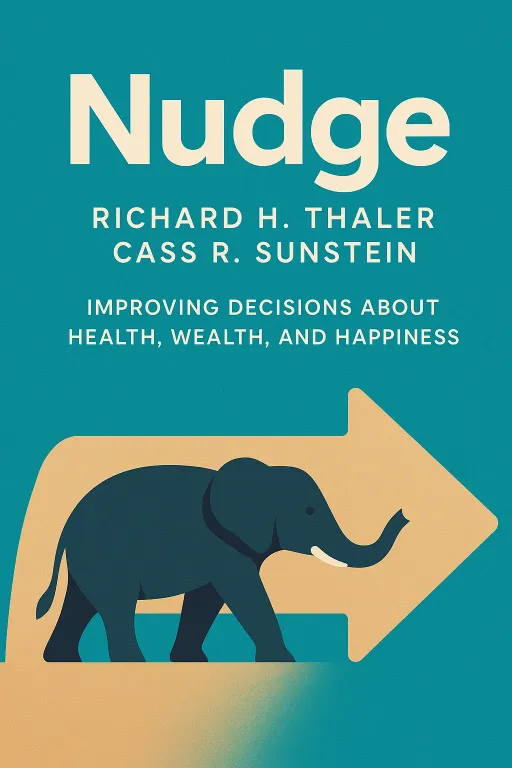
Nova: First up, we're exploring "Nudge: Improving Decisions About Health, Wealth, and Happiness" by the brilliant Richard H. Thaler and Cass R. Sunstein. Thaler, in particular, was awarded the Nobel Memorial Prize in Economic Sciences for his contributions to behavioral economics, which really underscores how groundbreaking this work was in challenging traditional economic thought. This book introduced the world to 'libertarian paternalism,' a concept that sounds like a contradiction in terms, doesn't it?
Atlas: It definitely does. 'Libertarian paternalism' sounds like something out of a political satire. How can you be both libertarian, meaning freedom of choice, and paternalistic, meaning guiding choices, at the same time? That makes me wonder if we're talking about subtle manipulation here.
The Subtle Art of Nudging: Designing for Better Choices
SECTION
Nova: That's a great question, and it's at the heart of what makes "Nudge" so powerful and, at times, controversial. The core idea is that a 'nudge' is any aspect of the choice architecture that alters people's behavior in a predictable way without forbidding any options or significantly changing their economic incentives. To be a true nudge, it must be easy and cheap to avoid. So, it's not a mandate; it's a gentle steer.
Atlas: So you're saying it's about making the "good" choice the easy choice, without forcing anyone?
Nova: Exactly. Think about retirement savings, a classic example. Traditionally, you had to actively opt-in to a 401 plan. People knew they save, but the friction of filling out forms, making decisions, it often led to inertia. So, what did some companies do? They flipped the default. Instead of opting, employees were automatically enrolled but had the freedom to opt at any time. The result? Dramatically higher participation rates. People's freedom to choose was preserved, but the default option nudged them towards a better long-term outcome.
Atlas: Wow. That's actually really clever. It’s not about taking away choice; it’s about understanding how we naturally react to defaults. So, for someone trying to design a new workflow in their organization, or even just set up their own home office more effectively, how would they even begin to 'nudge' themselves or their team towards better habits?
Nova: That's where understanding choice architecture comes in. Think about a school cafeteria. If the fruit is hidden in a corner and the desserts are prominently displayed at the beginning of the line, guess what kids are more likely to choose? But if you put the fruit at eye-level, make it easily accessible, and maybe even put the desserts further down the line or in a less obvious spot, you're not telling anyone what they eat. You're just making the healthier option the more salient, easier choice. The simple act of rearranging can have a profound impact.
Atlas: That’s a great way to put it. It’s kind of like how when I leave my running shoes by the door, I'm much more likely to go for a run than if they're buried in the back of my closet. It's a tiny, almost unconscious friction point that gets removed. But what's happening in our brains that makes these nudges so effective?
Unmasking the Mind: How Our Brains Make Decisions (and Mistakes)
SECTION
Nova: That's the perfect segway, Atlas, because understanding nudges work so well brings us to our second foundational text: "Thinking, Fast and Slow" by the Nobel laureate Daniel Kahneman. This book, building on his earlier work with Amos Tversky, fundamentally changed our understanding of human cognition. Kahneman explains that we have two primary systems of thought.
Atlas: Okay, so System 1 and System 2. Can you give me a quick mental exercise to show me the difference?
Nova: Absolutely. Imagine I ask you: "What is two plus two?" The answer, "four," pops into your head instantly. That's System 1 at work – fast, intuitive, automatic, and effortless. Now, what if I ask you: "What is seventeen times twenty-four?"
Atlas: Oh, I see. My brain just slowed down. I'd have to consciously think about that, maybe even grab a pen and paper. That's System 2, right? It's slower, more deliberate, effortful, and logical.
Nova: Precisely. The problem is, while System 2 is rational, it's also lazy. System 1 is always on, always trying to make sense of the world, and it often takes shortcuts – these are our cognitive biases. And these biases, while often efficient, can lead us to make systematic errors, even when we have all the information.
Atlas: So our brains are constantly playing tricks on us, even when we think we're being rational? That's quite unsettling, but also incredibly insightful for a curious explorer trying to understand the 'why' behind human behavior. Can you give an example of how one of these biases might lead us astray, despite our best intentions?
Nova: Consider the concept of 'framing.' Kahneman and Tversky famously showed how the way information is presented can drastically alter our decisions. Imagine a medical procedure with a 90% survival rate. Most people would view that as a very safe procedure. But what if I told you the same procedure had a 10% mortality rate? The information is identical – 90% survive means 10% don't – but the 'frame' of survival versus mortality evokes very different emotional responses and, consequently, different choices. People are far more likely to choose the procedure when it's framed in terms of survival.
Atlas: That's fascinating. So, our System 1, that fast, intuitive part of our brain, is reacting to the emotional weight of 'survival' versus 'mortality,' even though System 2, the logical part, knows they mean the same thing. It's like our primal instincts are overriding our rationality. For someone who's an impact seeker, driven to make a difference, this must be a critical insight. How do we design around these inherent mental shortcuts?
Synthesis & Takeaways
SECTION
Nova: That's the crucial link between "Nudge" and "Thinking, Fast and Slow." Nudges work precisely because they understand and leverage System 1. Instead of relying on people to engage their effortful System 2 to make the 'right' choice – which is often difficult, time-consuming, and prone to the laziness we mentioned – nudges make the positive choice the default, the easy option, the one that System 1 automatically gravitates towards. It’s not about outsmarting people; it's about designing environments where positive choices are the path of least resistance.
Atlas: That’s such a powerful synthesis. It's about designing the environment, not just dictating behavior. It's about understanding the psychology behind decision-making to create environments where positive choices become the easy, default option. So, for someone driven to make a difference, who wants to design better systems, what's one immediate thing they can do to start applying this?
Nova: The tiny step is actually quite simple, but profound. Observe a common decision point in your daily life or within a project you're working on. It could be how you decide what to eat for lunch, how your team manages tasks, or even how you organize your digital files. Then, ask yourself: How could a small change in presentation, or a slight alteration of the default option, 'nudge' a better outcome? What small tweak could remove friction or highlight the desired choice for that intuitive System 1?
Atlas: That makes so much sense. It's not about a grand overhaul, but about identifying those small points of leverage to create significant, positive shifts. It really emphasizes that genuine impact comes from understanding people, not just pushing ideas.
Nova: Absolutely. It's about recognizing that our environment shapes our choices far more than we often realize. By being intentional about that design, we can transform good intentions into real, effortless progress.
Atlas: That's an incredibly hopeful and practical insight. What a fantastic way to think about driving change.
Nova: This is Aibrary. Congratulations on your growth!