The Global Leader's Blind Spot: Why Culture Shapes Strategy More Than You Think
Golden Hook & Introduction
SECTION
Nova: What if the biggest obstacle to your grand global vision isn't a lack of resources, talent, or even market insight, but something far more insidious, something you can't even see?
Atlas: Whoa, Nova. That's a pretty heavy opener. Are we talking about, like, a secret society of shadow executives? Because I've got some theories.
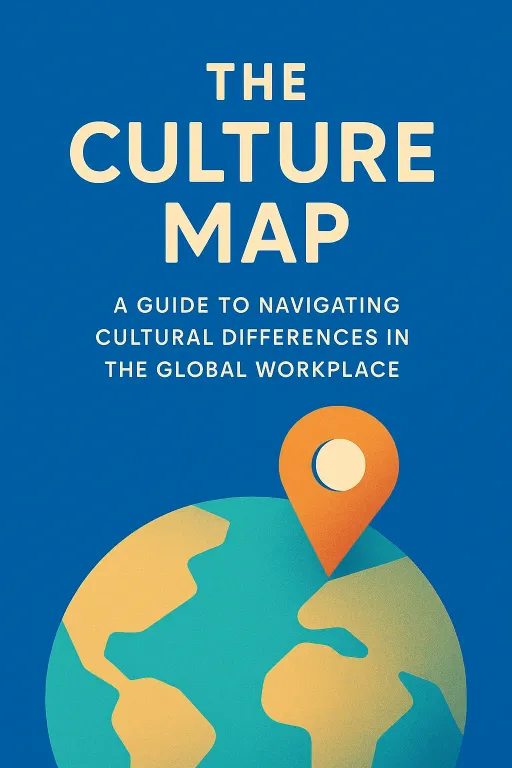
Nova: Not quite, Atlas, though it can feel just as elusive. We're talking about the invisible hand of culture, shaping our strategies, our communication, and ultimately, our success or failure on a global scale. Today, we're unpacking a concept that gets amplified beautifully in two seminal works: Erin Meyer's "The Culture Map" and Daniel Kahneman's "Thinking, Fast and Slow."
Atlas: Ah, Meyer, the renowned professor at INSEAD, literally wrote the book on deciphering cultural codes, drawing from years of advising global executives. And Kahneman, a Nobel laureate, reshaped our understanding of human decision-making itself. So we're talking about the 'how' and the 'why' behind our cross-cultural interactions, from two absolute titans in their fields. That’s a fascinating pairing.
Nova: Absolutely. Meyer’s work gives us the practical map, the observable cultural dimensions. Kahneman explains the cognitive machinery underneath, why we often misread those maps. It’s a powerful combination. The core of our podcast today is an exploration of how deeply culture permeates global leadership, not as a peripheral consideration, but as the very fabric that either strengthens or unravels our most ambitious strategies.
Atlas: That makes me wonder, if culture is so fundamental, how do we even begin to see its impact when it's so ingrained in us?
The Cultural Blind Spot: Unseen Forces Shaping Global Strategy
SECTION
Nova: Precisely, Atlas. That's the 'blind spot.' Most leaders, especially those operating on a global stage, strive for universal principles. They believe that good leadership is just good leadership, no matter where you are. But that assumption is where the trouble often begins.
Atlas: I can see that. I imagine a lot of our listeners, especially those managing global teams, might feel like they’re doing everything right by the book, only to hit unexpected walls.
Nova: Exactly. Let me tell you about a common scenario Meyer highlights. Imagine a large American tech company, known for its direct communication style and a culture of "radical candor," decides to expand aggressively into East Asia. Their HR department, with the best intentions, implements a new global performance review system that encourages employees to give their managers blunt, direct feedback—anonymously, of course, to foster psychological safety.
Atlas: Okay, I’m listening. Sounds progressive, right?
Nova: On paper, yes. In practice, it was a disaster. In many East Asian cultures, direct criticism, especially upwards, is seen as deeply disrespectful. It causes immense "loss of face" for the manager and creates profound discomfort for the employee delivering it. The system, designed to foster openness, instead led to silence, resentment, and a complete breakdown in trust. Employees either gave bland, unhelpful positive feedback or simply avoided the process altogether.
Atlas: Wow. So, it's not just about different languages, but literally different ways of thinking about communication itself? Like the very definition of 'helpful feedback' changes?
Nova: Precisely. The American leaders saw direct feedback as efficient and honest; the East Asian employees perceived it as aggressive and humiliating. The intent was positive, but the cultural interpretation created a chasm. This isn't about right or wrong; it's about different operating systems for human interaction. It's often unconscious, too, which links directly to Kahneman's work. Our 'System 1,' our fast, intuitive thinking, makes snap judgments based on our own cultural programming without us even realizing it.
Atlas: So, how much of this is conscious versus completely ingrained? Because if it’s ingrained, it feels like an almost insurmountable challenge. You can't just unlearn your culture overnight.
Nova: That's the power of the blind spot. We operate from our own cultural lens, assuming our way is the "normal" or "logical" way. Kahneman shows us how deeply ingrained these mental shortcuts are. We we're being objective, but our brains are constantly filtering information through our own experiences and cultural norms. A leader might genuinely believe they are being clear and concise, unaware that their communication style is perceived as rude or dismissive in another cultural context. It’s not a lack of effort; it's a lack of awareness of the invisible rules of the game.
Atlas: But wait, isn't good leadership just good leadership, no matter where you are? Like, empathy and clear vision are universal, right?
Nova: Empathy and clear vision are indeed universal values, Atlas, but their and are profoundly cultural. The way you show empathy, the way you convey a clear vision, the way you motivate a team—all of that is filtered through cultural lenses. Ignoring these deep-seated differences leads to miscommunication, missed opportunities, and ultimately, failed global initiatives. It's not about abandoning universal principles, but about understanding how to apply them effectively in diverse contexts.
Navigating the Invisible Map: Frameworks for Culturally Intelligent Leadership
SECTION
Atlas: Alright, so we've identified the blind spot. We understand that our own cultural operating system can unconsciously sabotage our global efforts. How do leaders actually it and then navigate this invisible map? Because that's the next logical step for anyone wanting to build bridges, not burn them.
Nova: That's where Meyer's "Culture Map" becomes an indispensable tool. It provides a framework, a set of eight scales, that allows us to decode how cultures typically operate across different dimensions. Think of them as cultural GPS coordinates. For example, one scale is "Communicating: Low-context vs. High-context."
Atlas: What does that mean? Low-context versus High-context?
Nova: Great question. A low-context culture, like the U. S. or Germany, tends to communicate very directly. The message is explicit, clear, and on the surface. What you hear is what you get. A high-context culture, like Japan or China, relies heavily on implied meanings, non-verbal cues, and shared understanding. You have to "read between the lines." The message is often embedded in the context.
Atlas: So, if I'm from a low-context culture and I'm leading a team in a high-context culture, my direct communication might come across as blunt, aggressive, or even ignorant of their subtle cues.
Nova: Exactly! And conversely, the high-context team's indirect communication might seem vague or evasive to the low-context leader. Meyer provides an example of a French-American team collaborating. The Americans, being low-context, expected clear, written action items from meetings. The French, high-context, often saw meetings as a forum for intellectual debate and relationship building, not necessarily for immediate, explicit decisions. The Americans felt the French were inefficient and indecisive, while the French found the Americans to be overly prescriptive and lacking nuance.
Atlas: That makes so much sense. I can imagine that leading to endless frustration on both sides. So, how do they bridge that gap?
Nova: By understanding the "why" behind the communication styles. Once both sides recognized their inherent cultural tendencies, they could adapt. The American leader learned to be more patient, to read the room, and to understand that consensus might be built through subtle cues rather than direct declarations. The French team, in turn, understood the American need for explicit action points and made an effort to provide them. It’s about adaptation, not assimilation. It’s about informed empathy.
Atlas: So, if I'm leading a global team, what's one immediate thing I can do to start applying this, beyond just reading the book?
Nova: One simple yet powerful step is to actively seek out diverse perspectives in every decision-making process. Don't just ask for opinions; ask for those opinions are typically formed and expressed in different cultural contexts. Observe non-verbal cues more closely. And, crucial from Kahneman's perspective, consciously challenge your own initial interpretations of situations. Ask yourself, "Is there another cultural interpretation of this behavior that I'm missing?"
Atlas: But isn't there a risk of overgeneralizing with these frameworks? Like, putting people into cultural boxes?
Nova: That's a vital point, Atlas. Meyer is very clear: frameworks are guides, not rigid stereotypes. They describe general tendencies, not individual behavior. The goal isn't to say "all people from X culture do Y," but rather "people from X culture to operate this way, so be aware and adapt your approach, while still treating each individual as unique." It’s about increasing your observational capacity and your adaptability, not about pre-judging. It's about moving from unconscious bias to conscious, informed empathy.
Synthesis & Takeaways
SECTION
Nova: So, what both Meyer and Kahneman ultimately reveal is that true global leadership isn't about imposing one's own cultural norms, or even just being generally 'nice.' It's about informed adaptation. It's about recognizing that the unconscious biases Kahneman discusses—our 'System 1' shortcuts—are amplified exponentially in cross-cultural settings. Meyer’s frameworks become essential tools for bringing those blind spots into the light, allowing us to build strategies that truly resonate across diverse landscapes. It’s the difference between merely existing globally and truly thriving globally.
Atlas: That’s actually really inspiring. It feels like a call to a deeper form of leadership, one that demands more of us than just business acumen. For all the global architects and foundational seekers listening, how might your own leadership strategies unconsciously reflect a single cultural lens, and what new approaches could you adopt right now to bridge those global divides?
Nova: A profound question, Atlas. The answer likely lies in cultivating that informed empathy, one interaction at a time.
Atlas: This is Aibrary. Congratulations on your growth!