

The Decision-Making Trap: Why More Information Isn't Always Better
Golden Hook & Introduction
SECTION
Nova: What if everything you thought you knew about making good decisions was actually setting you up for predictable failure? We often pride ourselves on rationality, but our brains, it turns out, have other plans entirely.
Atlas: Oh, I like that. Predictable failure. Because I think a lot of us, especially in demanding roles, really believe we're the captains of our logical ships. We make the pros and cons list, we analyze the data. Is that all just... a comforting illusion?
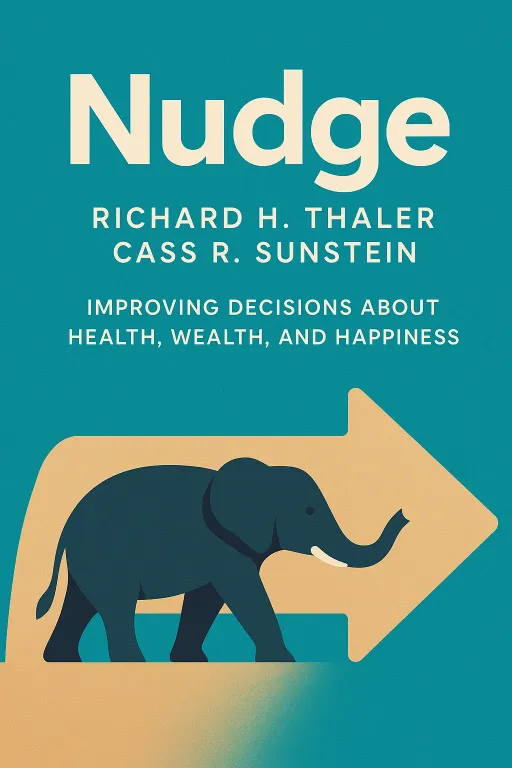
Nova: It absolutely can be, Atlas. And two books, in particular, completely blew apart that illusion for me, and for the entire field of economics, frankly. We're talking about by Richard H. Thaler and Cass R. Sunstein, and by Daniel Kahneman.
Atlas: Ah, the titans of behavioral economics.
Nova: Exactly. Both Thaler and Kahneman are Nobel laureates, and their work didn't just add to our understanding of decision-making; it fundamentally reshaped it. Kahneman, with his decades of research alongside Amos Tversky, really laid the scientific groundwork for understanding our cognitive biases. And Thaler, with Sunstein, took those insights and showed how they could be applied to real-world problems. They're not just academic texts; they're blueprints for understanding and improving human judgment.
Atlas: That's fascinating. Because for anyone trying to navigate complex organizational strategies, or even just daily team decisions, the idea that our own brains are working against us... that's a pretty critical insight. So, where do we even begin to unpack this? What's the core deception?
The Illusion of Rationality: Unmasking Our Hidden Biases
SECTION
Nova: The core deception, Atlas, is our overconfidence in our own rationality. Kahneman gives us the most powerful framework for this: System 1 and System 2 thinking. System 1 is our fast, intuitive, emotional brain. It operates automatically and quickly, with little or no effort and no sense of voluntary control. Think about recognizing a friend's face, or completing the phrase "bread and..."
Atlas: ... Butter! Got it. That's lightning fast.
Nova: Precisely. Now, System 2 is the slow, deliberate, analytical brain. It allocates attention to effortful mental activities that demand it. This is what you use when you're solving a complex math problem, or filling out a complicated form. It feels effortful, right?
Atlas: Yeah, I'm already feeling tired just thinking about it. So, we've got this fast, almost subconscious system, and then the slow, conscious one. Where does the "predictable failure" come in?
Nova: The problem isn't that we have System 1; it's incredibly efficient and often accurate. The problem is that System 1 is lazy. It jumps to conclusions, relies on heuristics – mental shortcuts – and when faced with a difficult question, it often substitutes an easier one without us even realizing it. And System 2, our supposedly rational overseer, is often too busy or too tired to correct System 1's mistakes.
Atlas: So you’re saying even top executives, people who pride themselves on being data-driven and analytical, are constantly falling for these cognitive shortcuts? How does that actually play out in a high-stakes scenario?
Nova: Let’s take a classic example, the anchoring effect. Imagine you're negotiating a budget for a new project. If the first number mentioned, the "anchor," is extremely high, say, ten million dollars, even if it's completely unrealistic, subsequent negotiations tend to hover around that initial figure. People will argue over whether it should be eight million or seven million, never questioning if the project should perhaps cost five million. Why? Because System 1 grabs onto that initial anchor, and System 2 then works to justify adjustments around it, rather than re-evaluating from scratch.
Atlas: That makes me wonder about every salary negotiation I've ever had! So the first number thrown out, even if it's a wild guess, can dramatically skew the final outcome. That’s kind of alarming. But what if someone prides themselves on being incredibly thorough, on gathering all the data? Doesn't more information help System 2 make a better decision?
Nova: That's the trap, Atlas, and it's why our episode title is "Why More Information Isn't Always Better." While System 2 process more information, the way we that information is still heavily influenced by our biases. We suffer from confirmation bias, for instance, where we actively seek out information that confirms our existing beliefs and dismiss information that contradicts them. So, an abundance of data can just give us more material to selectively confirm what System 1 already suspects, making our flawed decisions feel even more robust and 'data-backed.'
Atlas: That’s a perfect example of how our brains can betray us. It's like we're building a beautiful, data-rich case for the wrong conclusion, all because of an initial, subconscious lean. This is why understanding our psychology is really the first step.
Designing Better Choices: The Power of Choice Architecture
SECTION
Nova: Exactly. And that naturally leads us to the second key idea we need to talk about, which often acts as a powerful counterpoint to what we just discussed: choice architecture. If our brains are wired this way, making these predictable errors, the question becomes: how can we design our environments to work our psychology, rather than fighting against it? This is where Thaler and Sunstein's concept of a "nudge" comes in.
Atlas: So it's not about forcing people into decisions, or restricting their freedom, but about gentle, almost invisible, persuasion? Like a subtle suggestion?
Nova: Precisely. A nudge, in their definition, is any aspect of the choice architecture that alters people's behavior in a predictable way without forbidding any options or significantly changing their economic incentives. It's about making it easier for people to make choices that are good for them, without taking away their ability to choose otherwise.
Atlas: Can you give me a really clear, powerful example of a nudge in action, maybe one that’s had a massive impact? Because I'm thinking about organizations trying to get employees to do things, whether it's sign up for benefits or adopt new software.
Nova: One of the most famous and impactful examples is automatic enrollment in retirement savings plans. Historically, employees had to to their 401 or pension plan. What happened? Many people, due to inertia, procrastination, or simply the effort involved, never signed up. Their System 1 just kept them on the default path of doing nothing.
Atlas: Oh man, I totally know that feeling. The "I'll get to it later" trap.
Nova: Exactly. But when companies switched to, making employees if they didn't want to participate, participation rates soared dramatically. In some cases, from around 30-40% to 80-90%. The choice wasn't removed; employees could still opt out with a simple form. But by changing the default, by making saving for retirement the path of least resistance, millions more people started saving for their future. That's a powerful nudge.
Atlas: Wow. That's incredible. It's not about telling people what to do, it's about making the best choice the easiest choice. But wait, isn't there a risk here, a line between nudging and manipulation? For an aspiring leader, the idea of subtly guiding people... it could be misused, right?
Nova: That’s a really important question, Atlas, and Thaler and Sunstein are very clear on this. They advocate for what they call "libertarian paternalism." The "libertarian" part means preserving freedom of choice – no options are taken away. The "paternalism" part means that choice architects are trying to steer people in directions that will make their lives longer, healthier, and better. The key is transparency and intent. A good nudge is designed to benefit the individual, and they should still be able to easily choose differently if they wish. It's about helping people overcome their own biases to achieve their stated goals, not coercing them into something they don't want.
Atlas: Okay, that clarifies things. So, it's about understanding human behavior and then ethically designing environments to facilitate better outcomes. That naturally brings us back to the deep question posed in the book: where in an organization could a small nudge significantly improve a common decision? Because leaders are constantly trying to optimize processes and behaviors.
Synthesis & Takeaways
SECTION
Nova: That's the million-dollar question, isn't it? The synthesis here is profound: once you understand that human decision-making isn't purely rational, you gain a powerful lens for improvement. It means we stop blaming people for "bad choices" and start looking at the "choice architecture" around them. Whether it's how you present options for project management tools, how you structure meeting agendas to encourage participation, or even the default settings on internal software, tiny changes can have massive ripple effects.
Atlas: I can see that. It's about moving beyond just telling people to "make better decisions" and actually designing the system to support those better decisions. For someone focused on leadership development, this isn't just theory; it's a practical toolkit. So, for our listeners, the aspiring leaders and strategic thinkers out there, what's one practical step they can take this week to apply this concept?
Nova: Start small. Pick one common decision in your team or organization that consistently leads to suboptimal outcomes. Maybe it's people submitting incomplete reports, or struggling with a particular workflow. Then, instead of just repeating instructions, ask yourself: "What's the default choice here? What's the path of least resistance? How could I change the environment, the way options are presented, or the default setting, to make the desired outcome the easiest one?" It's a shift from 'fixing people' to 'fixing the system.'
Atlas: That's a great way to put it: fixing the system, not the people. And it aligns perfectly with the idea of being an adaptive learner, continually looking for smarter ways to achieve growth. Understanding these decision-making traps and the power of nudges really feels like unlocking a new level of strategic thinking. It's about leading with empathy for human psychology.
Nova: Absolutely. It’s an empowering perspective, turning our predictable irrationality into a predictable path to improvement.
Atlas: This is Aibrary. Congratulations on your growth!









