The 'Data Delusion' is a Trap: Why You Need Behavioral Insights.
Golden Hook & Introduction
SECTION
Nova: Everyone says "trust the data." It's the mantra of our age, right? Data is king, data is truth, data will set you free. But, Atlas, what if I told you the data is subtly, invisibly, shaping your decisions without you even knowing it, and sometimes, it's actually obscuring the truth?
Atlas: Oh, I like that. As an analytical architect, my world is built on data. It’s the bedrock of understanding, precision. But you're telling me this bedrock might have hidden fissures, or even quicksand? That sounds like a profound challenge to how many of us operate. What are we actually missing here?
Nova: Exactly. We're missing the 'why.' The 'Data Delusion' is this trap where we get so good at collecting and analyzing people do, that we completely overlook they do it. And that 'why' is where the hidden levers of human behavior truly lie. It's the irrational, human element that spreadsheets just can't capture.
Atlas: Okay, but for someone like me, who seeks data, who craves understanding, who builds entire systems based on metrics, how can data be enough? What kind of blind spot are we talking about if we're so data-driven?
Nova: It's a blind spot that costs companies untold opportunities and leaves even the most brilliant minds scratching their heads. And today, we're going to dive into how behavioral insights, illuminated by two groundbreaking books, can not only reveal that blind spot but give you the tools to see beyond it.
The Blind Spot – The Data Delusion
SECTION
Nova: So, let's set the scene. Imagine you're a product lead. You've launched a new feature, poured countless hours into its design, A/B tested every button color, optimized every user flow. Your dashboards are glowing green. Engagement metrics are high, users are clicking, they're spending time on the feature. The data says: success!
Atlas: Sounds like a dream scenario for any analytical mind. High engagement, positive metrics… that's the win.
Nova: Right? But then, you look at the ultimate goal – let's say, converting those engaged users into subscribers, or getting them to complete a critical task that drives the business forward. And suddenly, those numbers are flat. Or worse, declining. The data tells you happened – high engagement, low conversion – but it offers no clue as to. Your analytical mind hits a wall. You're left staring at perfect data that gives you answers about the core human motivation.
Atlas: Huh. That’s a common frustration, actually. You see the numbers, you know the outcome, but the path from A to B is a black box. So, it's not that the data is wrong, it's just… incomplete? It's telling us a part of the story, but not the whole narrative?
Nova: Precisely. It’s like having a detailed map of a city, showing every street and building, but no information about the people living there, their habits, their culture, why they choose to walk one street over another. You see the traffic flow, but not the intention behind the journey. This is where the 'Data Delusion' becomes a trap. You think you have all the information because you have data, but you're missing the most critical piece: human psychology.
Atlas: I can see how that would be limiting. For someone who’s not just building products, but building people, building purpose, understanding that 'why' feels foundational. Data alone can’t tell you if your team feels connected, or if a new policy is actually fostering innovation versus just being complied with. It’s the difference between observing a symptom and diagnosing the root cause.
Nova: Exactly. And to truly diagnose that root cause, to understand the hidden levers that shape user decisions and even team dynamics, we need to shift our perspective. We need to embrace behavioral insights.
The Shift – Nudge and Thinking, Fast and Slow
SECTION
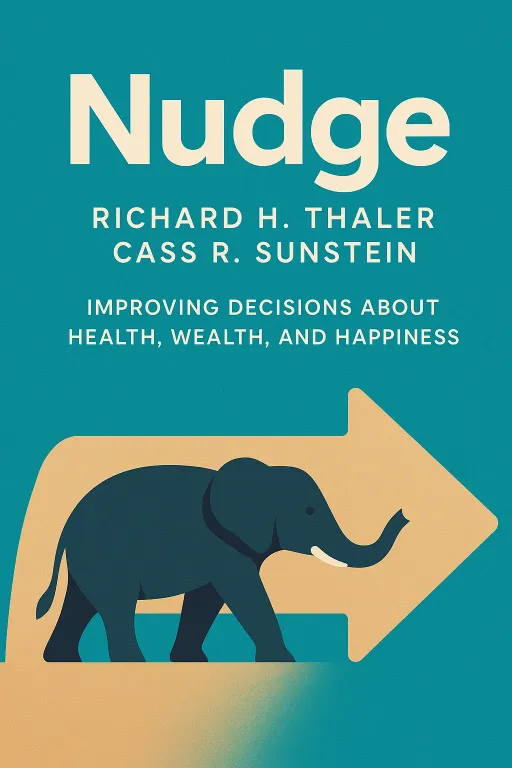
Nova: To truly understand that 'why,' we need to look beyond the spreadsheet and into the human mind, which is exactly what two seminal works in behavioral economics help us do. Let's start with "Nudge: Improving Decisions About Health, Wealth, and Happiness" by Richard H. Thaler and Cass R. Sunstein. Thaler, of course, later won the Nobel Memorial Prize in Economic Sciences largely for these very insights.
Atlas: Oh, I like that. The idea that tiny, almost invisible changes can dramatically alter choices. So, it's about context, not coercion?
Nova: Absolutely. Thaler and Sunstein introduced the concept of 'choice architecture.' They show how the way choices are presented can 'nudge' people towards certain decisions without restricting their freedom. Think about a school cafeteria. If healthy food is placed at eye level and unhealthy options are tucked away, kids will naturally choose more healthily. Or in retirement savings, if you make opting a 401k the default, rather than requiring people to actively opt, participation rates skyrocket. It's not about forcing anyone, it's about understanding human psychology to design environments that make beneficial choices easier.
Atlas: So it's about subtle manipulation, then? For someone building a product, or even a healthy organizational culture, how do you use this ethically? How do you nudge people towards, say, better collaboration or more mindful decision-making, without it feeling… underhanded?
Nova: That's the key: it's about decisions, as the title implies. It’s about designing systems that align with people’s long-term best interests, even when their short-term impulses might lead them astray. For a culture cultivator, it might mean designing meeting structures that naturally encourage equal participation, or setting up feedback loops that make constructive criticism the default. It's about designing for human tendencies, not against them.
Nova: And building on that understanding of our tendencies, we then turn to Daniel Kahneman’s monumental work, "Thinking, Fast and Slow." Kahneman, too, won the Nobel Prize, building on decades of groundbreaking research with Amos Tversky, which fundamentally reshaped our understanding of human judgment and decision-making.
Atlas: I've heard of this one! System 1 and System 2 thinking. That's the 'irrational human element' in action, right?
Nova: Exactly. Kahneman unpacks our two systems of thought. System 1 is fast, intuitive, emotional, automatic. It’s what tells you 2+2=4 instantly. System 2 is slow, deliberate, analytical, and effortful. That’s what you use to solve a complex math problem or decide on a major life investment. The genius of Kahneman is showing how much of our lives are governed by System 1, and how prone it is to cognitive biases.
Atlas: So, the biases in System 1… that's the 'irrational human element' you mentioned earlier. How does knowing about those biases help us, not just understand users, but build better teams and foster connection? Because when I'm building people and purpose, those biases can definitely get in the way.
Nova: They absolutely can. Think about confirmation bias, where we seek out information that confirms our existing beliefs. Or availability heuristic, where we overestimate the likelihood of events that are easily recalled. If you're building a team, understanding these biases means you can design processes to counteract them. You can create diverse teams to challenge groupthink, or structure decision-making to force a System 2, deliberate review before jumping to conclusions. It helps you build a culture where people are more aware of their own cognitive shortcuts and can, therefore, make more robust decisions and connect more authentically.
Atlas: So, 'Nudge' is about designing the external environment, the choice architecture, to guide behavior, and 'Thinking, Fast and Slow' is about understanding the internal landscape, the cognitive biases, that drive those behaviors. They really are two sides of the same coin, illuminating the 'why' from different angles.
Nova: They are. Data shows happened; these books explain. True product growth, true impact, and genuine connection come from understanding this deeper, often irrational, human element behind the data. It's about moving from observation to profound insight.
Synthesis & Takeaways
SECTION
Nova: So, Atlas, when we synthesize these ideas, it becomes clear that the 'Data Delusion' isn't just about missing a few metrics. It's about missing the very essence of human behavior. It's about failing to connect with people on a fundamental level, because you're only seeing their output, not their input, their motivations, their biases. It's the difference between building a product that technically works, and building one that resonates deeply because it understands the human using it.
Atlas: That’s actually really inspiring. For someone driven by connection, by impact, by legacy, this isn't just about optimizing a funnel; it’s about understanding the human condition itself. It's about building with empathy and foresight. So, for all the analytical architects, the culture cultivators, the talent magnets out there, let me ask the deep question: Where in your product, or even in your organizational culture, are users making choices without realizing the subtle nudges you're already providing, or could be providing?
Nova: And how are your own cognitive biases, or those within your team, unknowingly shaping the very data you collect and the conclusions you draw from it? The challenge isn't to abandon data, but to enrich it with behavioral insights. To ask not just 'what,' but 'why,' and then to design with that profound understanding.
Atlas: So much to think about. It really shifts the perspective from just reacting to numbers, to proactively designing for human nature.
Nova: Indeed. It's about moving from being a data-driven observer to a human-centric architect.
Atlas: Fascinating.
Nova: This is Aibrary. Congratulations on your growth!