The 'Black Box' Trap: Rethinking How You Explain Complex AI.
Golden Hook & Introduction
SECTION
Nova: You know, it’s a common belief in the tech world that if your AI model is brilliant enough, if your deep learning architecture is sufficiently complex, it will speak for itself. That its sheer technical genius will be undeniable.
Atlas: Whoa, that sounds almost… heretical coming from you, Nova. Are you implying that technical brilliance the ultimate mic drop? Because I know a lot of deep divers out there who pour their soul into that brilliance.
Nova: Absolutely not heretical, Atlas! It’s a reality check. Because the cold, hard fact is, even the most groundbreaking AI insights can remain utterly lost in translation. They become what we affectionately, or perhaps not so affectionately, call a 'black box.'
Atlas: Ah, the 'Black Box' Trap. I've heard that phrase before. So, we're talking about 'The 'Black Box' Trap: Rethinking How You Explain Complex AI' today. That title alone feels like it’s calling out a very specific pain point for anyone working with cutting-edge tech.
Nova: Exactly. It's about how to prevent your incredible work from being trapped in that opaque box. Because without clear, compelling communication, even the most transformative algorithms just sit there, limiting their impact, regardless of their inherent genius.
Unlocking the AI 'Black Box': Strategies for Clear Communication
SECTION
Nova: Think of it this way: imagine a brilliant inventor in a lab, surrounded by incredible contraptions that could change the world. But when they try to explain it, they use a language only other brilliant inventors understand. To everyone else, it’s just a lot of whirring gears and flashing lights. That’s the 'black box' trap in action for deep learning architectures.
Atlas: That’s a great analogy. It makes me wonder, though, for those growth architects listening, what are the actual stakes here? Beyond just general understanding, why is it so critical that we translate these complex AI concepts into understandable language? What's really at risk if we don't?
Nova: What's at stake is everything from project funding to adoption, to ethical oversight, and ultimately, the impact of the technology itself. If stakeholders, whether they are investors, end-users, or policy makers, can't grasp the 'what' and the 'why' of your AI, they can't trust it. They can't champion it. They certainly can't integrate it effectively or responsibly.
Atlas: So, it's not just about being 'understood' in an academic sense. It’s about unlocking the strategic value. Give me a concrete example. Where have you seen this 'black box' communication directly hinder a project or even a career trajectory in the AI space?
Nova: I’ve seen brilliant computer vision teams develop algorithms that could detect anomalies in manufacturing processes with near-perfect accuracy. But when they presented it, they dove straight into the intricacies of convolutional layers, activation functions, and gradient descent. The factory manager, a non-technical person, just saw "magic" – something they couldn't explain to their team, couldn't justify the cost of, and ultimately, couldn't integrate into their workflow. The project stalled, not because the tech wasn't good, but because the explanation was impenetrable. The potential impact on efficiency and cost savings, massive as it was, remained locked away.
Atlas: That's a powerful example. It sounds like they were speaking a different language entirely. It highlights that communication isn't just a 'nice-to-have' skill; it's fundamental to the success of any advanced AI project, especially for those looking to architect growth.
The Psychology of Persuasion: Making AI Concepts Stick
SECTION
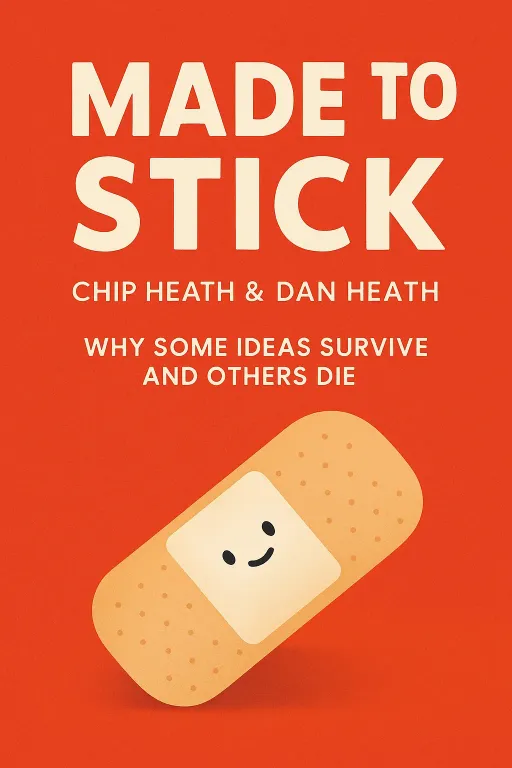
Nova: Absolutely. And if the problem is clear, the next question is: where do we get the tools to fix it? This is where we turn to some unexpected places, like the brilliant work of Chip and Dan Heath in "Made to Stick." They outline six principles for making ideas memorable and impactful: Simplicity, Unexpectedness, Concreteness, Credibility, Emotional, and Stories.
Atlas: Okay, 'simple' and 'concrete' sound like obvious wins for AI. But how do you actually that with something as inherently complex as a convolutional neural network? It feels like trying to simplify a rocket science equation for a kindergartener.
Nova: It’s not about dumbing it down, it’s about smartening up the explanation. For simplicity, you strip away jargon. Instead of "convolutional layer," you might say, "It's like having a tiny magnifying glass that scans every part of an image, looking for specific patterns, like edges or curves." For concreteness, you use vivid, sensory language and relatable analogies. Think about explaining a computer vision algorithm that detects defects in products. Instead of just talking about feature extraction, you say, "This AI is trained to spot a hairline crack on a smartphone screen, just like a human eye would, but with superhuman consistency and speed." You make it tangible.
Atlas: That’s a great way to put it. 'Superhuman consistency and speed' – that's concrete! It’s like you're building intuition, rather than just delivering information.
Nova: Precisely. And that leads us to another master, Daniel Kahneman, and his book "Thinking, Fast and Slow." While not explicitly about communication, his work on System 1 and System 2 thinking is incredibly relevant. System 1 is our fast, intuitive, emotional thinking. System 2 is our slow, deliberate, logical thinking.
Atlas: So, are you suggesting we need to trick people's System 1 into understanding AI, or is it more about engaging both systems effectively? Because for a resilient explorer who needs to truly master a concept, just a quick intuitive hit might not be enough.
Nova: It’s about engaging both. You need to hook System 1 first with something simple, unexpected, or emotional. That’s your 'sticky' opening. Then, you gently guide them into System 2 with the more detailed, logical breakdown, but always in a way that’s still concrete and story-driven. For example, when explaining an AI's decision-making process, you might start with a simple analogy: "Imagine the AI is like a highly trained dog sniffing out a particular scent – its System 1 quickly identifies familiar patterns." Then you transition to, "But unlike the dog, we can actually trace it focused on that particular 'scent' by looking at its internal processing – that's where System 2 analysis comes in." You balance the intuitive hook with the analytical explanation.
Atlas: That makes perfect sense! It’s about building a bridge between the intuitive and the analytical. You give them a relatable entry point, then allow them to dive deeper if they choose, without overwhelming them from the start. That’s strategic learning in action!
Synthesis & Takeaways
SECTION
Nova: Exactly. So, what we're really talking about today is a powerful synergy: using the principles of 'Made to Stick' to craft unforgettable messages, and leveraging Kahneman's insights into human cognition to ensure those messages land effectively on both intuitive and analytical levels. It's the key to turning your AI 'black boxes' into transparent, impactful solutions.
Atlas: That’s actually really inspiring. It means our technical prowess isn't just about the code; it's about the clarity and impact of our communication. It's about mastering how convey our own brilliance. So, for all the deep divers, growth architects, and resilient explorers out there, what's one tiny step they can take right now to put this into practice?
Nova: Here's your tiny step: take one complex Computer Vision concept you recently worked on. Just one. Now, try to explain it to a non-technical person. But here's the rule: use the 'simple' principle from "Made to Stick." Strip away every piece of jargon. Use an analogy. Make it so clear your grandmother could understand the core idea.
Atlas: That's a powerful and practical challenge. No more hiding behind the tech, right? It forces you to understand it at a deeper level yourself.
Nova: Precisely. The clearer you can make it for others, the clearer it becomes for you. It's a fundamental step in self-mastery.
Atlas: I love that. And it's a skill that pays dividends far beyond just AI.
Nova: Absolutely. This is Aibrary. Congratulations on your growth!