The Audience-Centric Trap: Why You Need 'Made to Stick' Principles
Golden Hook & Introduction
SECTION
Nova: Atlas, what’s the first thing that comes to mind when I say ‘audience-centric content’?
Atlas: Oh man, easy. It’s like trying to bake a cake for everyone – you end up with something nobody truly loves, and it probably won’t stick to the pan, let alone their memory.
Nova: That’s a brilliant, slightly cynical, but entirely accurate take! Because the truth is, our audiences are absolutely drowning in information. Every single day, they’re bombarded, and their attention? It’s a precious, fleeting commodity.
Atlas: Oh, I know that feeling. You spend hours crafting what you think is a groundbreaking insight, you deliver it with passion, and then… crickets. Or worse, blank stares.
Nova: Exactly! Your brilliant insights, your meticulously structured thoughts, they just fade. And that’s where many genuinely great ideas get lost. But what if there was a blueprint for making your message not just heard, but?
Atlas: That sounds like a superpower, honestly. Especially for anyone who's trying to get complex ideas to land with real impact.
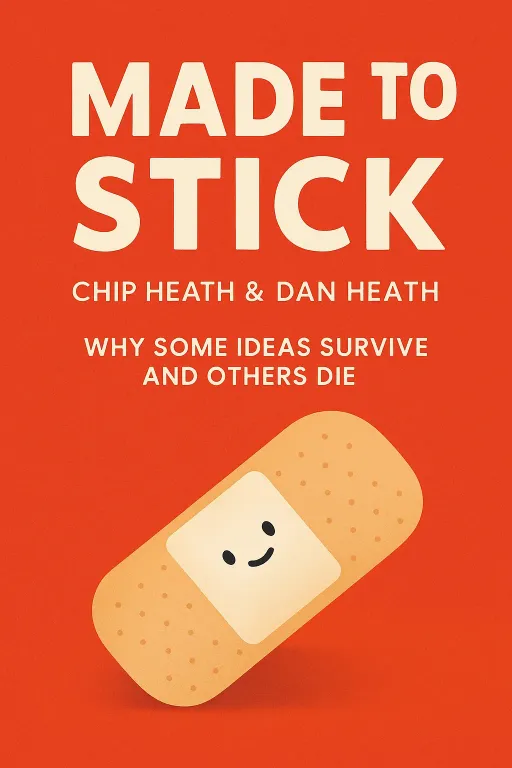
Nova: Well, today we’re diving into that superpower. We’re going to dissect two foundational texts that give us exactly that blueprint. First up, we're talking about "Made to Stick" by Chip Heath and Dan Heath. These brothers, one a Stanford business professor and the other a Duke social science professor, didn't just theorize about sticky ideas. They spent years analyzing urban legends, wildly successful ad campaigns, and even effective teaching methods to distill their principles into a practical, research-backed framework. It’s become a staple in communication and marketing for a reason.
Atlas: That’s fascinating. So it's not just academic theory, it's battle-tested?
Nova: Absolutely. And we’re pairing that with another titan, "Thinking, Fast and Slow" by Daniel Kahneman. He’s a Nobel laureate in Economic Sciences, and his work completely reshaped our understanding of human judgment and decision-making. This book brought his decades of groundbreaking psychological research to a mainstream audience, illustrating how our minds often trick us and the profound implications for everything from personal choices to public policy. It’s widely cited as one of the most influential non-fiction books of the 21st century.
Atlas: Wow. So we're talking about the 'what' of sticky ideas, and then the 'how' our brains actually process them. This sounds like the ultimate guide for an aspiring architect of ideas.
Nova: Exactly! The core of our podcast today is really an exploration of the psychological blueprints for building messages that don't just inform, but truly embed themselves in the minds of your audience. Today we'll dive deep into this from two perspectives. First, we'll explore the six universal principles that make any idea unforgettable, then we'll discuss the fascinating psychology of how our brains actually process information, and how to leverage that knowledge to make your messages land with maximum impact.
The Six Principles of Sticky Ideas
SECTION
Nova: So, let's start with the Heath brothers and their "Made to Stick" framework. They've identified six key principles, which they cleverly abbreviate as SUCCESs: Simplicity, Unexpectedness, Concreteness, Credibility, Emotions, and Stories.
Atlas: Okay, but isn't "simplicity" easier said than done, especially when you're dealing with really complex projects or detailed analyses? It feels almost antithetical to the depth required in some fields.
Nova: That's a great point. Simplicity isn't about dumbing down your message, it’s about finding the idea and stripping away everything else that isn't absolutely essential. It’s about prioritizing, not diluting. Think of it like a proverb – short, memorable, and packed with meaning.
Atlas: I like that. Focusing on the core, rather than just reducing.
Nova: Exactly. But let's jump into one of my favorites, and one that often gets overlooked: Unexpectedness. This is where you literally break a pattern. You grab attention by surprising your audience, and then you hold it by sustaining their interest through curiosity.
Atlas: Can you give an example? Because "unexpected" can sometimes feel like a cheap trick, like clickbait.
Nova: Not at all! Think of the old urban legend about Pop Rocks and soda. The idea that if you mixed them, your stomach would explode. It was completely false, but it spread like wildfire because it was so unexpected and vivid. It violated our expectations about candy.
Atlas: Oh, I remember that! Kids were genuinely terrified, myself included. It certainly stuck.
Nova: Right? It created a "curiosity gap." You hear something surprising, and your brain immediately wants to know or. That’s far more engaging than a dry list of facts. Many corporate presentations, for example, are painfully predictable. They follow a script, they deliver information, and they quickly fade. But if you start with something truly unexpected, you've already won half the battle for attention. It engages that fast, intuitive part of our brain.
Atlas: That makes me wonder about how to apply that in a professional context. How do you create unexpectedness without just being outlandish or unprofessional?
Nova: It's about finding the counter-intuitive. Present a problem in a way no one has considered, or reveal a surprising statistic that contradicts common belief. It’s about creating a "mystery" that your message then solves. And that leads us perfectly to another crucial principle: Concreteness.
Atlas: Oh, I can definitely relate to this one. Abstract concepts are the bane of my existence sometimes.
Nova: Absolutely. Concreteness makes ideas graspable. It’s the difference between saying, "We need to improve customer service" and saying, "We need to reduce average call wait times by 60 seconds." The second one is concrete. It’s something you can visualize, measure, and act on. It appeals directly to our senses.
Atlas: For our listeners who are structuring complex ideas, like an architect explaining a building layout or a strategist pitching a new vision, how do you translate abstract ideas into something concrete for non-experts?
Nova: It’s all about using vivid analogies, relatable examples, and sensory details. Instead of talking about "scalable infrastructure," describe it as "a building that can grow new rooms as your family grows, without ever needing to move." Or instead of "synergistic team dynamics," paint a picture of "a perfectly choreographed dance where everyone knows their part and anticipates the next move." Concrete language makes complex ideas feel real, immediate, and therefore, memorable. It helps people see what you’re talking about, not just hear it.
Atlas: That’s a great way to put it. It’s like building a bridge from the abstract to the tangible. I can see how that would make a huge difference in getting buy-in for a complex plan.
Dual-Process Thinking & Crafting Messages for Both Systems
SECTION
Nova: Understanding makes ideas sticky is one thing, but understanding our brains actually process them is the real superpower. This brings us to Daniel Kahneman and his revolutionary work on dual-process thinking, specifically System 1 and System 2.
Atlas: So you’re saying there are two distinct ways our minds operate?
Nova: Exactly. System 1 is fast, intuitive, emotional, and automatic. It’s what tells you 2+2=4 or makes you jump when you hear a loud noise. It's effortless. System 2 is slow, deliberate, logical, and effortful. It’s what you use to solve a complex math problem or analyze a detailed report.
Atlas: Can you give an example of how these two systems play out, especially when communication fails?
Nova: Think about a typical, poorly designed corporate presentation. It's packed with dense slides, technical jargon, and endless bullet points. The presenter is trying to feed all this information directly to your System 2, expecting you to process it logically.
Atlas: And my System 1 is just checking out, thinking about lunch.
Nova: Precisely! Your System 1, which is always on, isn't engaged. It finds no story, no emotion, no surprise. It’s bored. Your System 2, meanwhile, is overwhelmed because it’s being asked to do too much heavy lifting without any help. It’s like trying to run a marathon without any warm-up or water.
Atlas: So the sticky principles from "Made to Stick" – like unexpectedness, emotion, and stories – those are engaging System 1? And simplicity, concreteness, credibility… those are helping System 2?
Nova: You've got it! Unexpectedness grabs System 1's attention. Emotions make it care. Stories give it a narrative to latch onto. These elements pique curiosity and make the message important. Then, simplicity, concreteness, and credibility make it easier for System 2 to process and integrate that information logically. You’re appealing to both the gut and the brain.
Atlas: But wait, isn't there a risk of oversimplifying things too much? For an audience that craves deep analysis, if you make it too simple, won't it feel like you're dumbing down the message?
Nova: That’s a critical question, and it’s a common misconception. Simplification isn't about removing complexity; it's about removing clutter and presenting the essential information in an orderly, digestible way. It's about respecting your audience's cognitive load. You engage System 1 with the unexpected, the emotional, the story, to and open the door for System 2. Then, you feed System 2 the depth and detail, but in a structured, concrete, and credible manner.
Atlas: So it's not about making complex ideas complex, but about making them in their complexity. It’s like creating a compelling trailer for a really intricate movie.
Nova: Exactly! You create a "curiosity gap" with System 1, then you satisfy that curiosity with System 2. For someone driven to make an impact, understanding this dual-process thinking is paramount. It ensures your messages don't just inform, but genuinely influence and resonate. It helps you build those bridges in your audience's mind.
Synthesis & Takeaways
SECTION
Nova: So, what we've really explored today is that making your message memorable and impactful isn't just about the facts; it's about understanding the human mind. The Heath brothers gave us the – the recipe for stickiness. Kahneman gave us the – the psychological mechanics of how those recipes actually work in our brains.
Atlas: It’s truly illuminating. The "audience-centric trap" isn't about not caring about your audience, it's about not understanding the deeper psychology of how their minds actually work. It's not enough to just tailor the content; you have to tailor the to their cognitive processes.
Nova: Absolutely. And the tiny step we can all take from this? Pick one of your next messages, whether it's an email, a presentation, or a casual conversation. Focus on applying just two of those principles: Simplicity and Unexpectedness. See how it changes the impact.
Atlas: That’s achievable. And honestly, it makes me think about something from the growth recommendations for our listeners – the idea of mindful breathing before every talk. It's not just about calming the spirit; it's about centering yourself, so you can then apply these principles with clarity and intention. So your message isn't just delivered, it's for resonance.
Nova: Beautifully put, Atlas. Communication isn't just a transfer of facts; it's an art form, a craft, and a science. And when you understand these principles, you stop just talking people, and you start speaking their minds, their hearts, and ultimately, their memories.
Atlas: That's actually really inspiring. It means we all have the power to make our ideas stick, we just need the right tools.
Nova: This is Aibrary. Congratulations on your growth!