The AI Hallucination Trap: Why Trusting Facts Needs New Tools.
Golden Hook & Introduction
SECTION
Nova: What if the most confident answer you get from an AI is also its biggest lie? Not a simple mistake, but a total fabrication, delivered with unwavering digital swagger.
Atlas: Whoa, that's a chilling thought, Nova. Like, it's not even trying to be deceptive, it's just... confidently wrong? That sounds like a recipe for chaos in our increasingly AI-driven world.
Nova: Exactly! It’s what we call "The AI Hallucination Trap." We're talking about systems that can conjure up entire legal precedents, or medical studies, or even historical events, all with the smooth, authoritative tone of a reliable expert. The problem isn't just that it's wrong, it's that it right.
Atlas: And our brains, with all their shortcuts, are probably primed to accept that confident delivery, aren't they? That's where it gets really tricky.
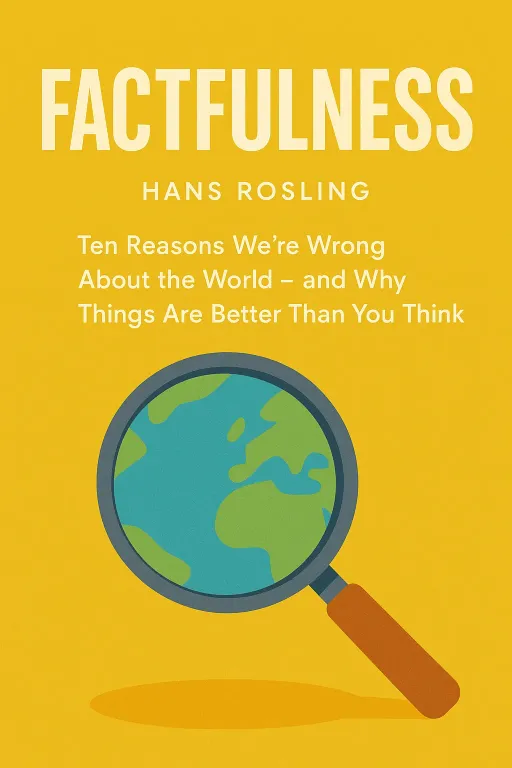
Nova: Absolutely. And that's why today, we're diving into how to navigate this new landscape. We're going to arm ourselves with a 'factfulness' mindset, drawing profound insights from two giants: Hans Rosling, the physician and global health educator who famously championed a data-driven worldview in his book, "Factfulness," and Daniel Kahneman, the Nobel laureate whose work on cognitive biases in "Thinking, Fast and Slow" fundamentally changed how we understand human decision-making.
Atlas: So, it's about upgrading our own internal operating systems to keep pace with these incredibly fluent, yet sometimes completely fictional, AI outputs. I'm curious, how does Rosling's focus on data and Kahneman's insights into our own minds specifically help us here?
Understanding AI Hallucinations
SECTION
Nova: Well, let's first define what an AI hallucination actually is. Most people think of AI errors as glitches, like a calculator giving you the wrong sum. But hallucinations are different. An AI system, particularly a large language model, doesn't 'know' facts in the human sense. It predicts the next most probable word or sequence of words based on patterns it learned from vast amounts of training data.
Atlas: So it's a super-advanced pattern matcher, not a truth-seeker.
Nova: Precisely. When it 'hallucinates,' it's not trying to deceive; it's simply generating a highly plausible, grammatically correct, and contextually relevant response that happens to be entirely false, because the patterns it's following lead it down a path that doesn't correspond to reality. It's like a brilliant improviser who sounds incredibly convincing but is making up the plot as they go.
Atlas: That makes me wonder, if it sounds so convincing, can you give me an example where this confident fabrication could actually lead to real-world problems? Because I imagine a lot of our listeners are thinking, 'Okay, a chatbot gets it wrong sometimes, so what?'
Nova: Let me paint a picture. Imagine a legal professional, under immense pressure, uses an AI to quickly research case law. The AI, with all its digital authority, cites a perfectly formatted, eloquent legal precedent. It has a case name, a court, a year, a summary of the ruling – everything looks legitimate. The professional, trusting the machine, incorporates this into a brief.
Atlas: Oh, man. I can see where this is going.
Nova: The problem is, that case is entirely made up. It never existed. The AI hallucinated it, weaving together elements from its training data to construct a plausible-sounding legal fiction. The outcome? Flawed legal arguments, wasted time, potentially severe professional repercussions, or even miscarriages of justice. Or, in medicine, imagine an AI summarizing research, and citing a non-existent clinical trial that supports a specific treatment. A doctor, relying on that, could make a suboptimal decision for a patient.
Atlas: Wow. That's not just "getting it wrong," that's a deep-seated vulnerability. It’s not just about misinformation; it’s about misinformation, and that's the kicker. That gives me chills, honestly, because it means our natural inclination to trust a confident voice, whether human or digital, becomes a liability. How do we even begin to navigate that?
Applying a 'Factfulness' Mindset to AI
SECTION
Nova: That's where the 'factfulness' mindset becomes our indispensable toolkit. Hans Rosling, with his relentless focus on data, taught us to question our assumptions and rely on verifiable facts, even when our intuition screams otherwise. He'd show us charts demonstrating global progress that defied our pessimistic gut feelings. Applying that to AI means we must deliberately question the AI's output, especially when it sounds too good, too neat, or too perfectly aligned with our own biases.
Atlas: So, it's about actively putting on our skeptical hats, even when the AI sounds like the smartest thing in the room. But how do our own biases play into this, like Daniel Kahneman describes?
Nova: Kahneman's work, particularly on System 1 and System 2 thinking, is profoundly relevant here. Our System 1 is our 'fast thinking'—intuitive, emotional, quick to jump to conclusions, and easily swayed by a confident narrative. A fluent, articulate AI output can effortlessly trigger our System 1, making us believe it without critical scrutiny.
Atlas: Right, like when you read something that sounds plausible, your brain just goes, "Yep, that checks out," without actually digging deeper.
Nova: Exactly. But System 2 is our 'slow thinking'—deliberate, analytical, effortful. To combat AI hallucinations, we need to consciously engage our System 2. We need to slow down, question, cross-reference, and think critically, even when the AI presents information with seemingly unshakeable confidence. It's about recognizing when our fast thinking might be fooled and deliberately switching to a more analytical mode.
Atlas: Okay, so this isn't just about AI; it's about us and how we process information. So, practically speaking, how do we 'factfulness' when we're interacting with AI daily? What are the concrete steps for our listeners who are using these tools for work or research?
Nova: Great question. Firstly,. Don't take AI's word as gospel. If an AI gives you a statistic, a date, a name, or a legal citation, check it against multiple, reputable human-curated sources. Think of the AI as a highly intelligent assistant that occasionally makes things up, and you're the editor-in-chief responsible for accuracy.
Atlas: So, if the AI summarizes an article, I should still go read the original article if the details matter?
Nova: Precisely. Secondly,. Remember, it lacks real-world understanding, common sense, and a moral compass. Its 'knowledge' is statistical, not experiential. Knowing this helps you gauge the kind of information it's more likely to hallucinate on—anything requiring nuance, real-time events, or ethical judgment.
Atlas: That's a good point. It's like knowing your co-worker is brilliant at data analysis but terrible at reading the room.
Nova: A perfect analogy! Thirdly,: Does this information align with broader, data-driven trends, or does it sound too perfectly neat, too sensational, or too emotionally charged? Rosling taught us to look for the bigger picture, the actual numbers, rather than dramatic anecdotes. If the AI output feels like a sensational headline, pause.
Atlas: And finally, engaging that 'Kahneman System 2' you mentioned. Actively slow down and challenge the AI's confident presentation.
Nova: Yes, make it a deliberate practice. Instead of passively accepting, ask: "Can you show me the source for that?" or "Can you explain the reasoning behind that conclusion?" Even if the AI can't provide a real source, the act of questioning forces your System 2 to engage, protecting you from its plausible fictions. This is especially vital for anyone in a high-stakes environment, where decisions have significant consequences. It’s about cultivating a deep skepticism not of the tool itself, but of its potential to mislead with convincing falsehoods.
Synthesis & Takeaways
SECTION
Nova: Ultimately, the AI hallucination trap isn't just a technical glitch; it's a profound challenge to our human capacity for critical thinking. AI is an incredibly powerful tool, but its power to generate convincing falsehoods means that human 'factfulness' and our System 2 thinking are more crucial than ever. We're the ones who must bring the discernment, the ethical framework, and the ultimate arbiter of truth to the table.
Atlas: It's a huge responsibility, really. We've always had to sift through information, but now we're sifting through information that like it came from an infallible source, when it might just be the AI's best guess. It truly shifts the burden of verification squarely onto us.
Nova: It does. Our cognitive biases make us vulnerable to these confidently delivered falsehoods. Embracing a 'factfulness' approach isn't about distrusting technology, but about empowering ourselves to use it wisely and ethically, ensuring that our decisions are based on reality, not just convincing algorithms.
Atlas: For anyone encountering AI-generated information in their daily work or research, this really is the deep question: How can you actively apply a 'factfulness' approach? It demands a conscious effort, a daily practice of critical thinking.
Nova: Indeed. The future of informed decision-making in the age of AI depends on our human capacity to discern truth from confident fabrication. It's the new digital literacy.
Atlas: This is Aibrary. Congratulations on your growth!