Stop Speaking in Jargon, Start Connecting: How to Explain Complex Concepts Simply.
Golden Hook & Introduction
SECTION
Nova: Alright, Atlas, challenge for you. If you had to review "Stop Speaking in Jargon, Start Connecting" in exactly five words, what would they be?
Atlas: Hmm, five words... "Clarity is power, simplify now."
Nova: Oh, I like that! Very direct. Mine would be: "Ideas stick when you connect."
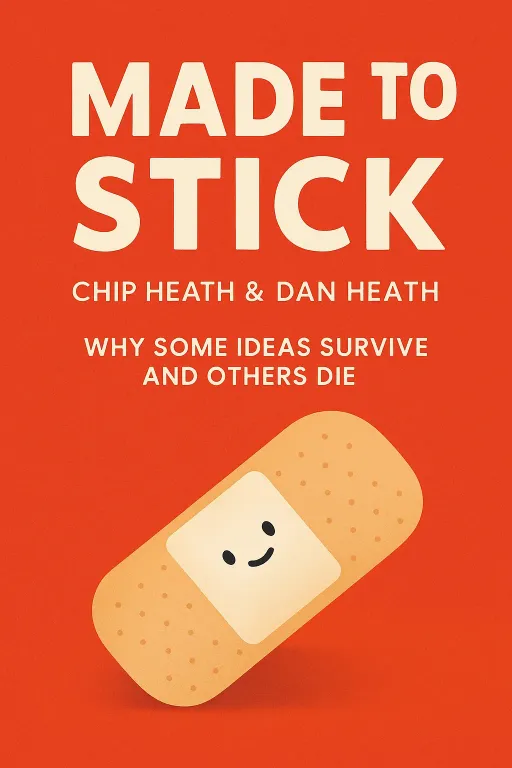
Atlas: And that's really the core, isn't it? Today we're diving into the brilliant work of Chip Heath and Dan Heath, specifically their insights from "Made to Stick," and weaving in Daniel Kahneman's groundbreaking "Thinking, Fast and Slow."
Nova: Exactly. Chip Heath, a professor at Stanford, and Dan Heath, a senior fellow at Duke, bring this incredible blend of academic rigor and real-world applicability to understanding why some ideas just… grab hold and never let go, while others, equally profound, just vanish into thin air.
Atlas: It’s fascinating how their academic backgrounds in business and social entrepreneurship really shine through, offering a practical blueprint. But Nova, for so many of our listeners, who are constantly grappling with complex information—think accounting standards, financial models, intricate client reports—how do these academic insights actually help them in the trenches?
Nova: That's the million-dollar question, Atlas. Because the cold, hard fact is, many brilliant insights are lost because they are not communicated clearly. It's not enough to understand something deeply yourself; the real challenge, especially for someone in a field like finance or accounting, is making others understand it, bridging that knowledge gap effectively.
The 'Stickiness' Formula: Principles of Memorable Communication
SECTION
Nova: And that brings us directly to our first big idea: what makes an idea 'sticky'? The Heath brothers identified six principles, a kind of secret sauce for communication that really resonates. They call them SUCCESs: Simplicity, Unexpectedness, Concreteness, Credibility, Emotional appeal, and Stories.
Atlas: SUCCESs. I appreciate a good mnemonic. But how do these principles actually work together? I imagine a lot of our listeners might think, "My job is to present facts, not tell bedtime stories."
Nova: Oh, but that's where the magic is! Take 'unexpectedness' and 'concreteness' for example. There's a classic story about Nordstrom, the department store. A customer once walked in, wanting to return a set of tires. The salesperson, without missing a beat, processed the return.
Atlas: Wait, Nordstrom sells tires?
Nova: Precisely! That's the unexpected part. They don't. But the story became legendary because of that surprise. It wasn't about Nordstrom actually selling tires; it was about their unwavering commitment to customer service, to doing whatever it takes. That unexpected element, combined with the concrete action of accepting a non-Nordstrom item, made the story incredibly sticky. It communicated their brand ethos far more effectively than any mission statement ever could.
Atlas: That’s a brilliant example. But how does a busy professional even begin to apply 'unexpectedness' when explaining, say, a quarterly earnings report? It’s hard to make a balance sheet surprising.
Nova: It's not about making the numbers themselves surprising, but the. Instead of just presenting rows of figures, you might start with a counter-intuitive outcome. "Despite a challenging quarter, our innovative cost-saving measure led to a 15% increase in efficiency, a first in our industry." That’s unexpected. Or, for concreteness, instead of saying, "Our new software improves workflow," you could say, "Our new software cuts the time spent on data entry from two hours to fifteen minutes, freeing up your team to focus on client strategy." That's a tangible, concrete outcome.
Atlas: So, it's about shifting the focus from the dry data to the surprising, concrete human impact or benefit. I can see how that makes it more relatable. It’s like the difference between saying “We improved our carbon footprint” versus “We planted enough trees to fill a football field.”
Nova: Exactly! And the 'stories' principle weaves through all of this. Stories provide context, they make ideas memorable, and they tap into our emotions. Think about John F. Kennedy's moon mission challenge. He didn't just say, "We need to advance space exploration." He said, "I believe that this nation should commit itself to achieving the goal, before this decade is out, of landing a man on the Moon and returning him safely to the Earth."
Atlas: That's incredibly simple, yet so powerful and emotionally charged.
Nova: It combined simplicity, a clear, concrete goal, and an emotional appeal to national pride and ambition. It was a story everyone could rally behind, not just a technical specification. That's the power of making an idea sticky. It’s about crafting a narrative that connects with what people already know and care about.
Bypassing Brain Fatigue: Communicating for 'System 1' Thinking
SECTION
Atlas: That's a really interesting point about connecting to what people already know. It actually makes me think about Daniel Kahneman's work in "Thinking, Fast and Slow." You mentioned our brains prefer simple, coherent stories. How does that tie into making ideas sticky?
Nova: It’s the foundational neuroscience behind it, Atlas. Kahneman introduces us to two systems of thinking. System 1 is fast, intuitive, emotional, and largely unconscious. It's what helps you recognize a face or react to a sudden noise. System 2 is slow, effortful, logical, and deliberate. It's what you use to solve a complex math problem or fill out a detailed form.
Atlas: Okay, so System 1 is like autopilot, and System 2 is when you're actively navigating.
Nova: Exactly. Now, here's the crucial part: our brains are inherently lazy. They prefer System 1. If you overload someone with too much data, too much jargon, too many nuanced details, you force them into System 2 thinking. And System 2 is effortful, it's draining, and frankly, most people try to avoid it unless absolutely necessary.
Atlas: I imagine a lot of our listeners, who deal with intricate data, might feel like they to present all the details to maintain accuracy or credibility. How do you simplify without oversimplifying or losing important nuances, especially in something like compliance or financial reporting?
Nova: That's the art, isn't it? It's not about dumbing down; it's about intelligent distillation. Kahneman's work shows us that when a message is simple, coherent, and connects to something familiar, it slides right into System 1. It right, it intuitive. When you present too much raw data, you trigger System 2, and people mentally check out because it requires too much cognitive effort.
Atlas: So, if I'm explaining a new accounting standard, how do I make it feel like a 'fast' thought, not a 'slow' one? Because those standards are notoriously complex.
Nova: You start with the 'why' and the 'what' in a simple, relatable way, before diving into the 'how.' Instead of launching into paragraph 3.1.2 of the new regulation, you might say, "This new standard is designed to prevent the kind of financial crisis we saw in 2008 by ensuring greater transparency in derivatives trading." You've immediately connected it to a familiar, significant event, and provided a clear, simple purpose. Then, you can use analogies.
Atlas: Like how? Give me an example.
Nova: Think about explaining a complex financial derivative. Instead of using technical terms, you might describe it as "a sophisticated insurance policy on a future event," or "a bet on whether a stock will go up or down, but with added layers of complexity." These analogies tap into existing mental models—insurance, betting—that System 1 can quickly grasp. You're making the abstract tangible, which is one of the Heath brothers' "concreteness" principles.
Atlas: That’s a great way to put it. It’s like building a bridge from something they already understand to the new, complex idea. It makes it less intimidating, less of a cognitive burden.
Nova: Absolutely. The goal is to make your message feel intuitive, even if the underlying concept is complex. It's about reducing the friction for understanding. When people don't have to work hard to understand, they're more likely to engage, remember, and act on your message.
Synthesis & Takeaways
SECTION
Nova: So, bringing it all together, whether we're talking about the SUCCESs principles from "Made to Stick" or Kahneman's System 1 and System 2 thinking, the central message is crystal clear: brilliant insights are lost without clear, compelling communication.
Atlas: It's about respect for your audience's attention and cognitive load, isn't it? It's not just about delivering information, but ensuring that information actually lands and sticks. And for our listeners, who are constantly striving for professional excellence and making a tangible impact, this skill is absolutely crucial.
Nova: It really is. The true power lies not just in the insight, but in the courage to simplify, to connect it to human experience, and to present it in a way that bypasses brain fatigue. It's about transforming what could be a dry lecture into an engaging conversation.
Atlas: That’s actually really inspiring. It frames communication not as a secondary skill, but as a primary driver of impact.
Nova: Exactly. So, here’s a challenge for our listeners, directly inspired by the insights we've discussed today. Pick one accounting concept, or any complex idea you find challenging to explain, and try describing it using a simple story or a vivid analogy, as if you were explaining it to a child.
Atlas: Just one concept, one simple story. That sounds like a powerful tiny step. And it will force you to distill the essence, making it resonate with that intuitive System 1 thinking.
Nova: Give it a try. You might be surprised at how much clearer your message becomes, and how much more effectively you connect.
Nova: This is Aibrary. Congratulations on your growth!