Stop Guessing, Start Nudging: The Guide to Ethical Influence.
Golden Hook & Introduction
SECTION
Nova: What if I told you the best way to get people to do what you want isn't through grand speeches or heavy-handed rules, but through something so tiny, so subtle, you might not even notice it?
Atlas: Wait, so we're talking about mind control, but, like, the polite version? The kind where you wake up and realize you've suddenly organized your entire garage without being explicitly told to?
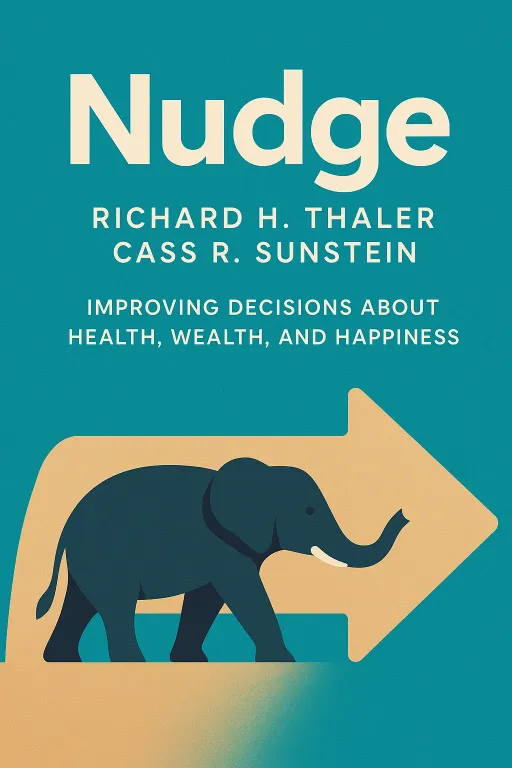
Nova: Precisely, Atlas! And it’s not just about garage organization, though that’s a noble pursuit. Today, we're diving into the fascinating world of ethical influence, inspired by our guide, "Stop Guessing, Start Nudging." This incredible framework draws deeply from two groundbreaking books: "Nudge: Improving Decisions About Health, Wealth, and Happiness" by the brilliant Richard Thaler and Cass Sunstein, and "Thinking, Fast and Slow" by the incomparable Daniel Kahneman.
Atlas: Oh, I know those names! Thaler and Kahneman both won Nobel Memorial Prizes in Economic Sciences for their work. That's some serious academic firepower. So we’re talking about scientifically-backed ways to get people to, well,?
Nova: Absolutely. Their work fundamentally cracked the code on why people often struggle to act, even when it's in their best interest. And our take, the core of "Stop Guessing, Start Nudging," is that these insights offer ethical, design-based solutions that truly respect human psychology. It’s about solving that problem you and I often see in community work, that feeling of pushing a heavy stone uphill, trying to get people engaged.
Atlas: That resonates deeply. It feels like a constant battle sometimes, trying to spark action. So how do these subtle interventions actually work?
Nova: That's a perfect segue, because it brings us directly to our first core idea: The Power of the Nudge.
The Power of the Nudge: Designing for Better Choices
SECTION
Nova: At its heart, a nudge is about choice architecture. It’s about designing environments that encourage positive behavior without restricting choices. Think of it as a gentle guide, not a forceful shove.
Atlas: Okay, so give me an example that really illustrates this. Something vivid, something I can picture.
Nova: Alright, let's go with a classic, one that Thaler and Sunstein themselves popularized: the notorious problem of urinal spillage at Amsterdam's Schiphol Airport. Not the most glamorous topic, but incredibly illustrative.
Atlas: Oh, I’m intrigued. This sounds like an engineering problem, not a psychology one.
Nova: Exactly! The cleaning staff had a persistent issue with, let’s say, 'aiming errors.' Instead of putting up stern signs or increasing cleaning frequency, they did something brilliantly simple. They etched a small, black housefly image the ceramic, right at the center of each urinal bowl.
Atlas: A fly? You’re telling me a tiny, fake fly made a difference?
Nova: A massive difference! Spillage was reportedly reduced by 80%. No one to aim for the fly. It didn't force them. But the subtle visual cue gave men a target, tapping into an almost unconscious instinct. It made the desired behavior—aiming more accurately—easier and more engaging. That’s a nudge.
Atlas: That’s wild. So it's not about forcing people, it's about making the desired choice almost irresistible without them realizing it? Like a benevolent puppet master, but for better hygiene?
Nova: You got it. And the implications are huge. Think about organ donation. In some countries, you have to to be a donor. In others, you're automatically a donor unless you. The opt-out countries have vastly higher donation rates. The default setting is a powerful nudge. Thaler and Sunstein's work, which received widespread acclaim and sparked a global policy movement, fundamentally shifted how governments and organizations approached public good. It showed that small, almost invisible changes can have monumental impact.
Atlas: But wait. This sounds powerful, sure, but what about free will? Doesn't this feel a little... manipulative if people don't know they're being nudged? Where's the ethical line?
Nova: That’s a crucial question, Atlas, and it’s one that Thaler and Sunstein emphasize heavily. An ethical nudge, by definition, is transparent and easily avoidable. It should always align with what people would want for themselves in the long run. It's about helping people overcome their own internal biases, not tricking them into doing something against their genuine interest. It’s about making the healthy choice the easy choice, the sustainable choice the default choice.
System 1 vs. System 2: Understanding Our Decision-Making Biases
SECTION
Nova: That question about free will is brilliant, Atlas, because it leads us perfectly into nudges work. It's all about how our brains are wired, which Daniel Kahneman so elegantly unpacks in "Thinking, Fast and Slow."
Atlas: Okay, so what's the brain wiring got to do with a fly in a urinal?
Nova: Kahneman introduced us to two systems of thought. System 1 is fast, intuitive, emotional, and operates automatically. It’s the part of your brain that knows how to drive, or instantly recognizes a familiar face. System 2 is slow, logical, effortful, and deliberate. It’s what you use to solve a complex math problem or plan a detailed project.
Atlas: So, System 1 is our gut reaction, and System 2 is our deep thinking?
Nova: Exactly. And the problem is, System 1 often takes shortcuts, leading to predictable biases. It’s efficient, but not always accurate. Kahneman's unique background as a psychologist winning a Nobel in economics underscored his interdisciplinary approach, showing that our economic decisions are far from purely rational.
Atlas: Give me an example of System 1 playing tricks on us. I love a good brain teaser.
Nova: Alright, try this: Linda is 31 years old, single, outspoken, and very bright. She majored in philosophy. As a student, she was deeply concerned with issues of discrimination and social justice, and also participated in anti-nuclear demonstrations. Now, which is more probable? Is Linda a bank teller, or is Linda a bank teller active in the feminist movement?
Atlas: Hmm. Well, based on the description, she sounds much more like a bank teller who's active in the feminist movement.
Nova: And that’s System 1 talking! Logically, it’s always more probable for an event to occur than for that event another specific event. Yet, our System 1 creates a compelling story, making the less probable option more probable. This is called the conjunction fallacy.
Atlas: Wow, that’s fascinating. So, essentially, our brains are lazy, and nudges exploit that laziness for good? Like leaving healthy snacks at eye level while hiding the cookies?
Nova: That’s a perfect analogy! Nudges work precisely because they understand these cognitive shortcuts. When you're trying to get people to volunteer for a community project, for instance, System 2 might tell them, "Yes, that's a good thing to do." But System 1 kicks in with, "Ugh, effort, time, unknowns." Nudges reduce that friction by making the 'good' choice the default, or by making it visually prominent, or by framing it in a way that appeals to System 1's quick processing.
Atlas: But what about when System 1 is actually? Are we always trying to outsmart our gut feelings, or is there a place for intuition?
Nova: That’s a brilliant point. Kahneman isn't saying System 1 is always bad. In many situations, it’s incredibly efficient and accurate, especially for experts in their field. The trick is knowing to trust System 1 and when to engage System 2. Nudges come in when System 1 is likely to lead us astray from our long-term goals or societal good. It's about understanding that our decision-making isn't always a purely rational process, and designing for that reality.
Synthesis & Takeaways
SECTION
Nova: So, bringing it all together, nudges work by understanding System 1's shortcuts and designing choice environments that make the System 2-approved decision the easiest one. It’s about recognizing that human behavior isn't just about willpower; it's heavily influenced by context. Our ethical, design-based solutions are about giving people a gentle push towards better outcomes.
Atlas: So, for our listeners who are building communities and driving impact, this isn't about manipulating people. It's about respecting their psychology and making it easier for them to do what they already know is good for them, or for the community. It’s shifting the burden from "convince them harder" to "design it better."
Nova: Exactly! And here’s a tiny step for everyone listening: identify one small decision point in your current work and redesign it to make the desired choice easier or more visible. Maybe it's how you ask for feedback, or how you encourage participation in a meeting, or even how you structure an email to get a response.
Atlas: That’s actually really powerful. It makes me think about how much subtle friction I might unknowingly be creating in my own processes. It’s not just about what you say, but you present the choice.
Nova: Absolutely. It’s about understanding that our environments profoundly shape our decisions, and with a little intentional, ethical design, we can create environments where positive choices are the default. It's not just about influencing; it's about enabling. It’s a testament to the profound impact of behavioral science on real-world problems.
Atlas: That gives me a lot to think about. It's a subtle shift, but one with massive potential for anyone trying to make a real difference.
Nova: Indeed. This is Aibrary. Congratulations on your growth!