How to Build a Thinking Machine: Understanding the Brain's Science of Learning
Golden Hook & Introduction
SECTION
Nova: What if the very thing you pride yourself on most – your sharp intellect, your careful analysis, that deep thinking you love – is secretly sabotaging your best decisions, especially when it comes to scientific inquiry or groundbreaking tech?
Atlas: Whoa, wait. Are you saying my own brain is… a saboteur? Like a tiny, internal Loki, whispering bad ideas? That sounds a bit out there.
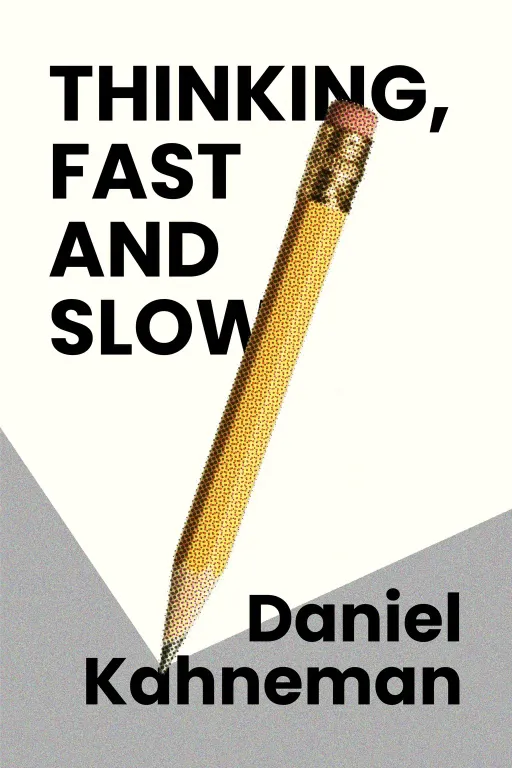
Nova: Not exactly a saboteur, Atlas, but it definitely has some sneaky shortcuts. Today, we’re diving into how our brains actually make decisions, drawing from two monumental books that completely reshaped our understanding of human judgment: by Daniel Kahneman, and by Richard H. Thaler and Cass R. Sunstein.
Atlas: Okay, so these are the big guns. I’ve heard those titles thrown around. But for those who haven't deep-dived yet, why are these books so foundational?
Nova: Well, for one, Daniel Kahneman, a psychologist, actually won the Nobel Memorial Prize in Economic Sciences for his groundbreaking work, proving that our economic decisions aren't purely rational. That completely upended traditional economic theory! And, fascinatingly, Richard Thaler, a co-author of, later won the same prize for his work on behavioral economics, showing the profound real-world impact of these psychological insights. It's a testament to how deeply psychology and economics are intertwined in understanding how we think and act.
Atlas: That’s amazing. A psychologist winning an economics Nobel just feels right, somehow. It tells you how much we often misunderstand ourselves. So, with that kind of intellectual firepower, how do these insights help us – especially those of us who love to dig deep – truly build a better 'thinking machine'? Where do we even start?
Nova: Exactly. It starts with understanding our brain's blind spots.
The Brain's Blind Spots: When Our Shortcuts Lead Us Astray
SECTION
Nova: Kahneman introduced us to two systems of thought, System 1 and System 2. Think of System 1 as the autopilot. It's fast, intuitive, emotional, and constantly running in the background. It's what lets you recognize a friend's face instantly or slam on the brakes without thinking.
Atlas: That makes sense. It's the gut feeling, the immediate reaction. We rely on that a lot, don't we? Especially when things need to happen quickly.
Nova: Absolutely. It’s incredibly efficient and essential for survival. But then there's System 2. This is the deliberate, logical, effortful part of your brain. It's what you use to solve a complex math problem, learn a new language, or carefully analyze a scientific paper. It's slow, but it's thorough.
Atlas: So, the problem arises when we use the autopilot for tasks that really need the manual transmission, right? Like trying to parallel park a semi-truck with your eyes closed.
Nova: Pretty much! The issue is that System 1, while brilliant for quick judgments, relies heavily on mental shortcuts, or heuristics. And these shortcuts, while often helpful, are also prone to systematic errors, what we call cognitive biases.
Atlas: Give me an example. How does this actually play out, say, in a scenario where a curious learner, someone who prides themselves on their logic, might get tripped up?
Nova: Okay, let's try a classic. It’s called the "Linda Problem." Imagine Linda. She's 31 years old, single, outspoken, and very bright. She majored in philosophy. As a student, she was deeply concerned with issues of discrimination and social justice, and also participated in anti-nuclear demonstrations. Now, which of these two statements is more probable? One: Linda is a bank teller. Or two: Linda is a bank teller and is active in the feminist movement.
Atlas: Hmm. My System 1 is screaming "Option two!" Immediately. She sounds exactly like someone who would be a feminist activist.
Nova: And that's precisely the trap! Your System 1 is creating a vivid, coherent story based on the description, making "bank teller and feminist" more probable. But logically, it cannot be. The probability of two events occurring together can never be greater than the probability of just one of those events occurring. All feminist bank tellers are bank tellers, but not all bank tellers are feminist bank tellers.
Atlas: Oh, I see. That’s a powerful illustration. My brain just built a narrative and ignored the basic rules of probability. Wow, that’s kind of embarrassing, but also really insightful. So, the 'blind spot' isn't about being dumb, it's about our brains being efficient, and sometimes, too good at storytelling for their own good?
Nova: Exactly! It's about our brain prioritizing coherence and ease of processing over strict logic. And this isn't just a fun parlor trick; these biases impact everything. Think about a scientist, deep into a research project, subconsciously seeking out data that confirms their initial hypothesis while dismissing contradictory evidence. That's confirmation bias, a System 1 shortcut. Or a tech developer, overestimating the success rate of their new product because they can easily recall similar successful ventures, ignoring the countless failures. That’s the availability heuristic at play.
Atlas: So, this isn't some abstract philosophical problem. This is a very real, very present danger to robust scientific inquiry and effective technological innovation. It's about getting in our own way, without even realizing it. How does someone who is constantly trying to push boundaries and innovate recognize when their quick, intuitive judgment is veering them off the best path? It feels like trying to spot the invisible.
Nova: That's the challenge, and the beauty, of understanding this. The first step awareness. Recognizing that your gut feeling, while powerful, isn't infallible, especially when the stakes are high or the problem is complex. It’s about cultivating a habit of pausing and asking, "Is this a System 1 response, or have I engaged my System 2 here?"
Designing for Better Decisions: The Power of the Nudge
SECTION
Nova: Knowing our brains have these default settings, these predispositions to certain shortcuts, the next logical step is: how can we work them, instead of constantly fighting them? This is where the concept of the 'nudge' from Thaler and Sunstein comes in.
Atlas: Okay, so we've identified the problem, the blind spots. Now for the solution. "Nudge." It sounds so gentle. What exactly is a nudge in this context?
Nova: A nudge is a subtle change in the "choice architecture" – the way choices are presented to us – that steers people towards better outcomes without restricting their freedom of choice. It's about influencing System 1's automatic responses.
Atlas: I’m curious. That sounds a bit like… manipulating people. Where's the line between helpful guidance and sneaky persuasion, especially for someone who values deep thinking and independent learning? We don't want to be what to think, right?
Nova: That's a crucial distinction, and it's why Thaler and Sunstein emphasize that a nudge preserves freedom of choice. It doesn't ban options. Think of it like this: if you design a cafeteria and put the salad bar at eye level at the beginning of the line, that’s a nudge. People are more likely to choose salad. But they can still choose the fries, which are just a little further down the line. You haven't removed the fries; you've just made the healthier option more salient.
Atlas: That’s a great analogy. So, it's about making the desired path easier, rather than blocking other paths. Can you give me another example, maybe one that’s a bit more surprising in its effectiveness?
Nova: Absolutely. There’s a famous example from Amsterdam's Schiphol Airport. They wanted to reduce 'spillage' in the men's restrooms. Instead of putting up signs or increasing cleaning staff, they simply etched a small image of a fly into the center of each urinal. The result? A significant reduction in spillage. Why? Because men, almost subconsciously, aimed at the fly. It was a tiny, almost invisible nudge that leveraged System 1's automatic targeting response.
Atlas: Huh. That’s brilliant in its simplicity, but also a bit humbling. It shows how easily our automatic responses can be guided. How does this translate to our earlier discussion about clear thinking in science or technology? How can we 'nudge' ourselves or our teams towards better research practices or more rigorous analysis?
Nova: That’s the exciting part. We can design our intellectual environments. Take confirmation bias, which we just discussed. A 'nudge' could be a mandatory "devil's advocate" step in a research proposal, where a team member is to find flaws in the hypothesis before the experiment even begins. Or, for data analysis, it could be a default setting in a software program that automatically flags outliers, forcing System 2 to engage with potentially contradictory data rather than System 1 simply dismissing it.
Atlas: So, it's about designing our intellectual environment, almost like building guardrails for our System 1, so System 2 can do its best work? It's about making the way of thinking the way to think.
Nova: Precisely. Another powerful nudge, especially in scientific integrity, is the pre-registration of hypotheses. Before you even run an experiment, you publicly declare what you expect to find and how you'll analyze the data. This significantly reduces the temptation to 'p-hack' or retroactively adjust your hypotheses to fit your results, which is a huge System 1 bias. It nudges you towards transparency and rigor.
Atlas: I see. That’s actually a really inspiring way to look at it. It's not about being inherently flawed, but about acknowledging those flaws and then proactively building systems that help us transcend them. It's like an engineer designing a machine with fail-safes.
Synthesis & Takeaways
SECTION
Nova: You've hit on the core insight, Atlas. True intellectual growth isn't just about accumulating more knowledge; it's about understanding and optimizing the very machinery of our thought. It's an ongoing process of self-correction and environmental design. We're not just consumers of information; we're architects of our own cognitive processes.
Atlas: And that's incredibly empowering. It means recognizing our biases isn't limiting; it's the first step to designing a smarter path for our own brilliant, yet beautifully flawed, brains. The quest for clearer thinking is a journey of continuous refinement, much like an engineer optimizing their most complex and vital machine.
Nova: It truly is. We have these incredible brains capable of profound insight, but they also come with built-in quirks. The real genius lies in knowing when to trust the fast, intuitive leap, and when to slow down and let the deliberate, logical system take over. And crucially, how to set up our world so we're gently guided towards that smarter choice.
Atlas: So, for all our listeners out there, especially those who love to explore new knowledge and engage in deep thinking, we have a question for you. Where in your own pursuit of knowledge, your own deep thinking, might a quick, intuitive judgment be leading you away from the best scientific or technological path?
Nova: And what small 'nudge' could you design for yourself this week to bring more deliberate thinking to that area? Perhaps it's a simple checklist, a mandatory pause, or a new default setting for your next big decision.
Nova: This is Aibrary. Congratulations on your growth!