Decoding Decisions: The Psychology of Choice
Golden Hook & Introduction
SECTION
Nova: Think you're always in control of your decisions? Think again. The latest research suggests your brain is playing tricks on you, and not always for the better.
Atlas: Whoa, hold on. 'Playing tricks'? That sounds a bit out there. I mean, I like to think I’m pretty rational, especially when it comes to big choices. Are you telling me my own brain is my biggest saboteur?
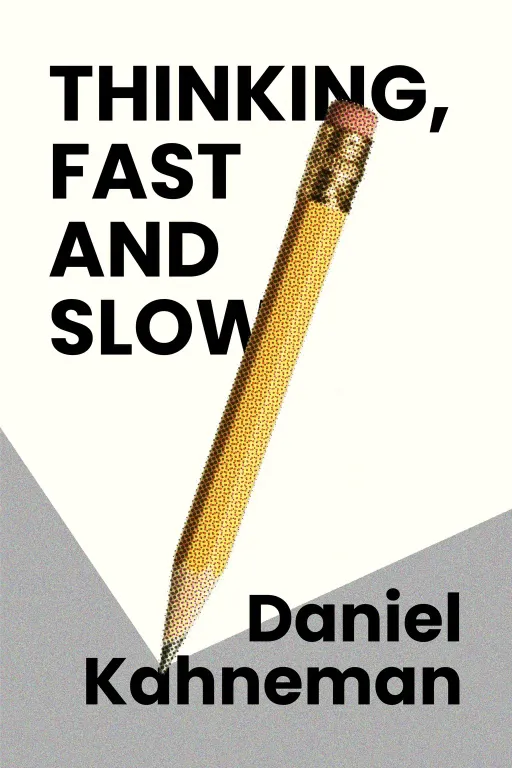
Nova: Well, 'saboteur' might be strong, but 'unseen influencer' is definitely on the table. Today, we're diving deep into the fascinating, often illogical, landscape of human decision-making, drawing incredible insights from two landmark books: "Thinking, Fast and Slow" by Daniel Kahneman, and "Nudge" by Richard H. Thaler and Cass R. Sunstein.
Atlas: Kahneman, Thaler, Sunstein... these are some heavy hitters in the world of behavioral economics. I know Kahneman even won a Nobel Prize for his work, right? But he’s a psychologist, so how did he end up with an economics Nobel?
Nova: That’s the beauty of it. Kahneman, a psychologist, won the Nobel Memorial Prize in Economic Sciences, not for traditional economics, but for demonstrating how psychological insights can be integrated into economic science. He fundamentally changed how we understand choices. And Thaler, co-author of 'Nudge,' also won a Nobel for his contributions to behavioral economics. It just underscores how deeply intertwined our psychology is with every decision we make, from buying groceries to designing global policies.
Atlas: So basically, our decisions are far more complex than a simple pro-con list might suggest. I guess that makes sense, but what exactly are these 'tricks' our brains are playing? Lay it on me.
The Duality of Decision-Making: System 1 vs. System 2
SECTION
Nova: Alright, let's start with Kahneman's groundbreaking idea of the two systems that drive our thinking: System 1 and System 2. Think of them as two distinct modes of operation in your brain.
Atlas: Okay, so you’re saying I have two brains? Or two operating systems running concurrently?
Nova: Exactly! System 1 is your fast, intuitive, emotional, almost automatic thinking. It's what allows you to understand a simple sentence, detect hostility in a voice, or slam on the brakes when a car swerves. It operates effortlessly, often without you even realizing it. System 2, on the other hand, is your slow, deliberate, logical, and effortful thinking. It's what you use to solve a complex math problem, fill out a tax form, or choose between two difficult career paths.
Atlas: Oh, I see. So System 1 is like the autopilot, and System 2 is when I actually have to pay attention and think hard. That makes sense on a surface level. But how does this lead to 'tricks'?
Nova: Here’s a classic example from Kahneman himself: the bat and ball problem. A bat and a ball together cost $1.10. The bat costs $1.00 more than the ball. How much does the ball cost?
Atlas: Oh, I know this one! My System 1 is screaming "10 cents!"
Nova: And that's exactly the 'trick.' Ten cents is the intuitive, immediate answer that pops into almost everyone's head. It feels right, it's fast, it requires no effort. That's System 1 in action. But if the ball costs 10 cents, and the bat costs $1.00 more, the bat would be $1.10. Together, they'd be $1.20, not $1.10.
Atlas: Oh man, you got me! My System 1 totally took over. So, the real answer is 5 cents for the ball, and $1.05 for the bat, making $1.10 total. That required actual calculation, a bit of mental heavy lifting. That's System 2, then?
Nova: Precisely. Your System 2 caught the error that System 1 quickly generated. The 'trick' isn't malicious; it's just System 1 being efficient and trying to conserve energy. It defaults to easily accessible answers, even if they're wrong. This efficiency, while usually helpful, is also the source of many cognitive biases.
Atlas: That's a great example. So, when we talk about biases, are we saying System 1 is inherently flawed? Because honestly, that sounds like my Monday mornings when I'm trying to make coffee before I'm fully awake.
Nova: Not flawed, but prone to predictable errors in certain situations. Take the availability heuristic, for instance. System 1 judges the frequency or probability of something by how easily examples come to mind. If you hear a lot about plane crashes on the news, your System 1 might tell you that flying is incredibly dangerous, even though statistically, driving is far riskier.
Atlas: I totally know that feeling. After watching a documentary about shark attacks, I suddenly feel like the ocean is a death trap, even though I know the odds are incredibly low. So, my System 1 is basically feeding me scary stories, and my System 2 has to come in and be the buzzkill with facts.
Nova: Exactly. Or the anchoring effect. If someone asks you if the population of Turkey is more or less than 30 million, and then asks you to estimate its population, your estimate will likely be lower than if they had asked if it was more or less than 100 million. That initial number, the 'anchor,' influences your subsequent judgment, even if it's completely arbitrary.
Atlas: Wait, so System 1 is like a fast-talking, charismatic salesperson who’s really good at first impressions and quick answers, and System 2 is the meticulous accountant who comes in afterwards to check the numbers?
Nova: That’s a great analogy! System 1 is the storyteller, System 2 is the editor. And understanding these two systems is not about 'fixing' them, but about recognizing their influence. It helps us pause, engage System 2 when the stakes are high, and be aware of when our intuition might be leading us astray. It’s about becoming better decision architects for ourselves.
Nudging Choices: Ethical Design and Choice Architecture
SECTION
Nova: And speaking of architects, this naturally leads us to the second key idea we need to talk about, which often acts as a counterpoint to what we just discussed: how our external environment can 'nudge' our choices. Atlas, have you ever noticed how the way something is presented subtly pushes you towards a certain decision without you even realizing it?
Atlas: Oh man, I’ve been there. Like when you go to a buffet, and the healthier options are at the beginning, or the smaller plates are available. I always wonder if that actually works, or if I’m just too stubborn to be nudged.
Nova: Well, that's exactly what Richard Thaler and Cass Sunstein explore in their book "Nudge." They introduce the concept of 'choice architecture' – how the way choices are presented can influence the decisions people make. It’s about subtle interventions that steer people towards better outcomes without restricting their freedom of choice.
Atlas: So, it’s like designing the environment to make the 'right' choice easier or more appealing. Can you give me a classic example? Because for someone who's building systems, the idea of subtly influencing behavior sounds powerful, but also a bit... manipulative?
Nova: That’s a critical question, and it’s at the heart of the ethical debate around nudges. A famous example comes from Amsterdam's Schiphol Airport. To reduce "spillage" in the men's restrooms, they etched the image of a fly into the urinals. It's a tiny, almost invisible target.
Atlas: A fly in the urinal? That gets people to aim better? Seriously?
Nova: Absolutely. It’s a classic nudge. It doesn't restrict choice—men can still aim wherever they want. But it provides a clear, subtle target that dramatically improved aim and reduced spillage by 80%. It's a prime example of how a small change in choice architecture can lead to a significant behavioral shift, often for the better.
Atlas: Wow, that’s actually really inspiring. So, the fly isn't telling you what to do, it’s just making it easier to do the right thing, or at least the cleaner thing. But where is the line between a helpful nudge and unwanted influence? Especially for our listeners who are designing software or public policy—they're literally creating choice architectures.
Nova: That's the ethical tightrope, and it's what Thaler and Sunstein call 'libertarian paternalism.' The 'libertarian' part means preserving freedom of choice—you can always opt out. The 'paternalism' part means guiding people towards choices that are generally considered beneficial for them, like opting into a retirement savings plan by default, or making organ donation an opt-out choice instead of opt-in.
Atlas: Okay, so it’s not about forcing decisions, but about making the default option the one that's generally good for people. I can definitely see how that applies to someone in a high-stakes tech environment, designing interfaces or user flows. You're not just building a product; you're building a system that influences how people think and act.
Nova: Exactly. Imagine designing an app where the default notification settings are privacy-enhancing, or where the 'unsubscribe' button is just as easy to find as the 'subscribe' button. Those are ethical nudges. Understanding both System 1 and System 2 thinking, and how to effectively 'nudge,' becomes a superpower for thoughtful innovators. It allows you to design systems that anticipate human irrationality and gently guide users towards outcomes that align with their long-term interests, or societal good. It’s about building with a conscience.
Synthesis & Takeaways
SECTION
Nova: So, bringing it all together, understanding our internal cognitive biases, the fast System 1 and the more deliberate System 2, isn't just an academic exercise. It's the foundation for ethically designing the external environments around us.
Atlas: That's a great way to put it. It’s like knowing the human brain's quirks allows us to build better roads, so to speak, to help people get to their desired destination more easily, even if they're prone to taking a shortcut that leads them off course. It sounds like a huge responsibility for anyone building anything that interacts with human beings.
Nova: Absolutely. Whether you're an architect of code, policy, or even just your own daily routine, recognizing that our decisions are shaped by these invisible forces gives you immense power. The power to anticipate, to design with intent, and to create systems that don't just function, but actually serve humanity better. It’s about making the default choice the beneficial choice, without ever taking away true freedom.
Atlas: That’s actually really inspiring. It shifts the focus from blaming individuals for 'bad' decisions to empowering designers to create better choice environments. It's a profound thought that our world isn't just a collection of individual choices, but a tapestry woven by the subtle nudges and cognitive shortcuts we all operate with.
Nova: Indeed. And it gives us a new lens to view every interaction, every product, every policy. How is this nudging me? How could this be nudged for the better? It’s a call to conscious design.
Atlas: This has been a fascinating dive into the psychology of choice. We'd love to hear from you, our listeners. Have you noticed a System 1 blunder in your own life recently? Or have you encountered a particularly clever or frustrating 'nudge' out in the wild? Share your experiences with us!
Nova: This is Aibrary. Congratulations on your growth!