Decision-Making in a Hazy World: Mastering Probabilistic Thinking
Golden Hook & Introduction
SECTION
Nova: I'm going to make a wild prediction right now. You, our brilliant listener, probably make most of your big decisions based on what you to be true, not what's to be true. And that, my friends, is why some of your best-laid plans, the ones you poured your heart and soul into, sometimes go sideways.
Atlas: Hold on, Nova, are you saying I'm about what I know? That’s a bold claim right out of the gate! I mean, for someone trying to build systems and find proven paths, certainty feels like the bedrock.
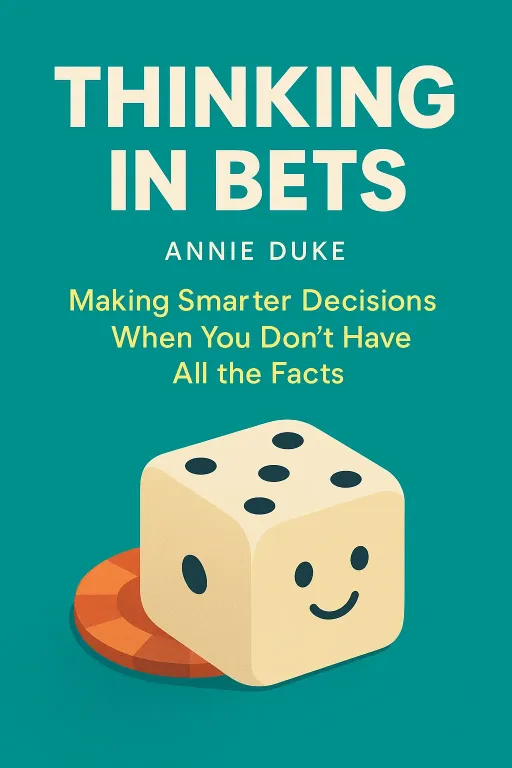
Nova: It feels like it, doesn't it? But that's the core of what we're exploring today: "Decision-Making in a Hazy World." We're diving into the profound insights from two seemingly disparate worlds that actually converge on a single, powerful truth. We're talking about Annie Duke, a former professional poker player and author of "Thinking in Bets," and the groundbreaking work of Daniel Kahneman and Amos Tversky, illuminated by Michael Lewis in "The Undoing Project." It's incredible how a poker champion and two Nobel-winning psychologists arrived at such similar conclusions about how our brains handle uncertainty. Their work has profoundly influenced fields from behavioral economics to product design, showing us how to navigate a world that rarely offers guarantees.
Atlas: That’s fascinating. Two very different journeys to the same conclusion. For those of us who are always looking for that next level of insight, that desire to build resilient systems for people, how does this 'haze' you mentioned impact those goals? Because if everything's uncertain, where do you even start?
Nova: Exactly. And that brings us directly to our first big idea: The Certainty Trap.
The Certainty Trap
SECTION
Nova: We, as humans, crave certainty. It's a deeply ingrained psychological blind spot. We want definitive answers, clear paths, and guaranteed outcomes. And because of that craving, we often make decisions based on incomplete information as if it were absolute fact. We fill in the blanks with what we were true, or what feels most comfortable.
Atlas: That makes sense. I can definitely relate. It feels safer to you know something for sure, especially when you're making high-stakes decisions. It's almost like a survival mechanism, right? If you're building a complex system, you need a blueprint. You can't just operate on a 'maybe.'
Nova: You're right, it a survival mechanism, but one that can actively sabotage us in the modern world. That blind spot prevents us from accurately assessing true risk and genuine opportunity, especially in truly complex systems. Think about a major product launch. Teams pour years into development, and there’s immense pressure for it to succeed. Often, the market research might be good, but not. Yet, the internal narrative quickly shifts from "high probability of success" to "this succeed."
Atlas: Wow, I can see how that would be a problem. So, we're essentially self-sabotaging by the messy truth? What does that even look like in practice? Can you give an example of how this certainty trap plays out?
Nova: Absolutely. Imagine a company deciding to invest hundreds of millions into a new technology based on projections that predict massive market adoption. The projections look great, the team is hyped, and everyone it to be a sure thing. But maybe there are underlying assumptions they haven't rigorously tested, or competitors they've underestimated. Because they're operating from a place of certainty, they don't develop robust contingency plans. They don't invest in understanding the potential failure points. And when the market doesn't behave as predicted, the entire venture collapses, not just because the initial assessment was off, but because they treated that assessment as an infallible prediction.
Atlas: Oh man, that's kind of heartbreaking, and incredibly costly. So, the comfort of that false certainty ends up being far more dangerous than just admitting you don't know everything. It's like building a skyscraper on a foundation of sand, but telling yourself it's concrete.
Nova: Exactly! It prevents us from even asking the right questions. We stop looking for disconfirming evidence because we're so invested in our perceived certainty. And that leads us to our next critical idea: the shift towards embracing probabilities.
Embracing Probabilities: The Power of 'Thinking in Bets'
SECTION
Nova: This is where Annie Duke's work, "Thinking in Bets," truly shines. As a former professional poker player, she operated in a world defined by incomplete information and probabilities. Poker isn't about knowing what cards your opponent has; it's about assessing the likelihood of what they have, and making your best decision based on those odds.
Atlas: I'm curious, for someone trying to make data-driven decisions, how do you even luck versus skill in real-world scenarios? It sounds like it could be an excuse for bad results, you know, "Oh, that didn't work out, must have been bad luck."
Nova: That's a brilliant question, and it's precisely what Duke helps us distinguish. A good doesn't always lead to a good. And a bad decision can sometimes lead to a good outcome, purely through luck. Think about a doctor diagnosing a rare illness. She gathers symptoms, runs tests, consults her knowledge, and makes the most probable diagnosis. That's a good decision, based on the best available probabilities. If the patient doesn't respond to treatment, that's a bad outcome, but it doesn't necessarily mean the was bad.
Atlas: Okay, so basically you're saying we need to separate the quality of the process from the final result. That’s actually really inspiring for anyone who's had a good plan fail due to circumstances outside their control. It reframes failure not as a personal indictment, but as a data point.
Nova: Precisely. It allows us to learn from both good and bad outcomes, rather than just celebrating wins and dwelling on losses. Duke argues that explicitly stating the probabilities of success or failure for your next big decision fundamentally changes your approach. If you say, "I'm 70% sure this project will succeed," you've immediately acknowledged that there's a 30% chance it. That naturally encourages contingency planning, risk mitigation, and a much more robust strategy.
Atlas: Could this actually backfire? What if expressing that level of uncertainty weakens conviction, or makes people hesitate too much, especially in a leadership role where you need to project confidence to your team?
Nova: That's a critical nuance. It's not about broadcasting every shred of doubt to your team. It's about your processing, your personal decision-making framework. Leaders who think probabilistically are not necessarily less confident, but they are more resilient and adaptable. They've already considered multiple futures, not just the rosy one. This thinking fosters a growth mindset, turning potential setbacks into learning opportunities, which is invaluable for building an unbreakable team.
Atlas: That's a powerful distinction. It's about being honest with yourself, even if you're projecting a vision of confidence. But even with all this intellectual understanding, our brains still seem to play tricks on us.
Conquering Cognitive Biases: The Kahneman & Tversky Legacy
SECTION
Nova: And that brings us to the monumental work of Daniel Kahneman and Amos Tversky, beautifully chronicled in Michael Lewis's "The Undoing Project." These two psychologists basically mapped out the 'bugs' in our mental software. They didn't just tell us to do; they showed us we so often fail to do it, even when we know better. They revealed our inherent cognitive biases.
Atlas: I totally know that feeling! It's like, I understand the logic, but then my gut tells me something else, or I jump to conclusions. So, they essentially revealed the hidden architecture of human thought, the shortcuts our brains take. But if these biases are 'inherent,' as you said, how do we ever truly overcome them? Is it even possible to fight our own psychology?
Nova: It's not about eradicating them entirely, Atlas, because they're part of how our brains are wired. It's about awareness and building systems to counteract their influence. Take the availability heuristic, for example. We tend to overestimate the likelihood of events that are easy to recall. After a plane crash, people often become irrationally fearful of flying, even though statistically, driving is far more dangerous. The vivid, dramatic news coverage makes plane crashes "available" in our minds, distorting our perception of risk.
Atlas: That's a perfect example. I mean, we see it everywhere. So, the first step is just knowing these biases exist, and then trying to spot them in ourselves? That’s deeply impactful for self-reflection. What's one practical thing our listeners can do when they're making a big decision to try and catch themselves in a bias?
Nova: A fantastic question for someone who seeks practical action. One powerful technique is called a "pre-mortem." Before you make a big decision, gather your team and imagine that it's a year later, and the project has failed spectacularly. Then, work backward. Ask yourselves: did it fail? What went wrong? This exercise helps uncover potential risks and blind spots that your natural optimism and certainty bias might otherwise hide. It forces you to think about failure scenarios they happen.
Atlas: That’s brilliant. It feels like you’re building a better system for your own brain, almost like stress-testing it in advance. It's about creating scenarios to challenge your own assumptions, which is a core tenet of good scientific inquiry.
Synthesis & Takeaways
SECTION
Nova: Absolutely. So, to bring it all together: mastering decision-making in a hazy world isn't about finding certainty where none exists. It's about acknowledging the inherent uncertainty, adopting a probabilistic mindset where you think in terms of likelihoods, and constantly being aware of your own cognitive biases that can distort your perception. Embracing the haze, paradoxically, makes us stronger, more adaptable, and ultimately, better decision-makers.
Atlas: Honestly, that’s such a hopeful way to look at it. It’s not about being paralyzed by uncertainty, but being empowered by understanding it. It feels like a fundamental shift in how you approach everything, from product development to team leadership. It’s about building in that resilience from the very start.
Nova: It truly is. And that leads us to our deep question for you, our listener: How might explicitly stating the probabilities of success or failure for your next big decision change your approach? Just asking that question, and being honest with the answer, can be a profound step forward.
Atlas: I think for anyone striving to build something meaningful and sustainable, this isn't just theory; it's a blueprint for resilience and robust planning. It’s about trusting your inner guide, as we often say, but equipping that guide with the best possible tools for navigating a complex world.
Nova: Absolutely. And we'd love to hear how this resonates with you. Share your thoughts with us on social media.
Atlas: This is Aibrary. Congratulations on your growth!