Engineering Effective Learning Environments
Golden Hook & Introduction
SECTION
Nova: Atlas, if this episode found you, you probably believe you know how to learn effectively. What if I told you most of what we think about learning is actually holding us back?
Atlas: Oh, I like that challenge, Nova. Because honestly, sometimes it feels like I'm trying to fill a bucket with a sieve. I put in the effort, I read the books, I watch the tutorials, and then a month later, it's like... where did it all go?
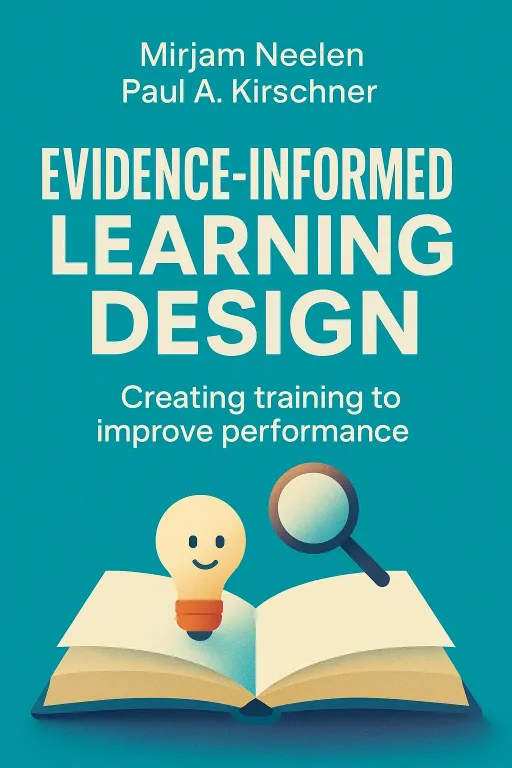
Nova: Exactly! That "sieve" feeling is incredibly common, and it’s precisely what Mirjam Neelen and Paul A Kirschner tackle in their groundbreaking book, "Evidence-Informed Learning Design." They, along with Jay McTighe and Grant Wiggins in "The Understanding by Design Handbook," are essentially saying: stop just to learn, and start learning.
Atlas: Engineering learning. That sounds... deliberate. And a bit like it's going to contradict every intuition I have about just diving in and "figuring it out." Which, for a lot of our listeners who are constantly trying to level up, is a very natural approach.
Nova: It absolutely does contradict intuition, and that's the point. These authors aren't just sharing opinions; they’re building bridges between cognitive science, empirical research, and practical application. They’re helping us move beyond fads and traditional, often ineffective, methods. It’s about creating learning experiences that genuinely work, not just like they work.
Atlas: That resonates. As a "strategic navigator," I'm always looking for frameworks that cut through the noise and deliver real results. I imagine many of our listeners, the "purposeful achievers" out there, feel the same way. So, where does this engineering process begin?
The Illusion of Intuitive Learning: Why Cognitive Science Matters
SECTION
Nova: Well, let's start with the problem. Neelen and Kirschner highlight how often we fall prey to what they call "intuitive learning." Think about someone trying to master a new skill, say, a marketing professional named Sarah who needs to get up to speed on data analytics.
Atlas: Oh, I know a few Sarahs. And a few Atlases, too, to be honest.
Nova: Right? Sarah decides to tackle it head-on. She signs up for a comprehensive 10-hour online course, dedicates her evenings to watching every video, and takes incredibly detailed notes in a beautiful new notebook. She feels productive. She feels like she's learning.
Atlas: That’s it! That’s the feeling! The dopamine hit of watching content and organizing notes.
Nova: Precisely. She finishes the course, feels a surge of accomplishment, and puts the notebook on the shelf. A month later, a new project lands on her desk that requires her to analyze a complex dataset and present insights. She opens her beautiful notebook, stares at the data, and suddenly...
Atlas: ... it’s all gone. The knowledge evaporated. The confidence plummeted. I’ve been there. It’s incredibly frustrating. Why does that happen if she put in all that effort?
Nova: It happens because she bypassed how our brains actually learn. Her method of passively consuming information and taking notes, while feeling productive, doesn't engage the cognitive mechanisms critical for long-term retention and transfer. She wasn't enough. She wasn't information from memory; she was just re-encoding it.
Atlas: So you're saying that feeling of ease, that sense of just "getting it" during the course, is actually a red flag? That’s counterintuitive. We’re taught that learning should be smooth.
Nova: Absolutely. The "ease" often means you're not actively building robust neural pathways. True learning, according to cognitive science, requires effortful processing. It requires spaced repetition, where you revisit material over time, and especially, where you actively pull information from memory. Sarah’s method was like filling a temporary RAM drive; it didn’t write to the long-term hard drive.
Atlas: That's a great analogy. So, for our clarity seekers out there, the core idea here is that effective learning isn't just about exposure to information; it's about the you do with that information, even if it feels harder in the moment. It’s about leveraging what we know about how the brain actually works.
Backward Design: Engineering Learning for Mastery and Impact
SECTION
Nova: Exactly. And if intuitive learning is the trap, how do we build effective learning experiences, whether for ourselves or for others? That's where McTighe and Wiggins come in with "The Understanding by Design Handbook" and their powerful concept of "backward design."
Atlas: Backward design. I like the sound of that. It implies intention, which is perfect for our strategic navigators.
Nova: It’s incredibly intentional. Instead of starting with "What content should I cover?" or "What activities should I do?", backward design flips the process. It starts with the destination. There are three stages:
Nova: First, Before you even think about what to read or watch, you ask: What should learners and by the end? What are the big ideas they should understand? What enduring understandings do they need?
Atlas: That sounds like setting a goal, but it feels deeper than just "learn Python." It's more like "be able to build a functional web scraper in Python."
Nova: Precisely! It's about defining the and you want to see. The second stage is Once you know the destination, how will you know if someone has arrived? What will they say, do, or produce that demonstrates mastery? These are your assessments, your proofs of understanding.
Atlas: So, for our Python example, the evidence isn't just passing a quiz on Python syntax. It's successfully demonstrating that web scraper, perhaps explaining the code, and troubleshooting it. That makes perfect sense for a purposeful achiever who wants to actually the skill.
Nova: Exactly. And only do you move to the third stage: With the end goal and the evidence of success clearly defined, you can now strategically design the activities, resources, and lessons that will learners to those desired results and prepare them for the assessments.
Atlas: That’s a revelation. Most of us, myself included, probably jump straight to stage three, right? We pick a course, or a book, or a project, and hope it leads somewhere useful.
Nova: It's the most common mistake! Think of Mark, a project manager who wants his team to truly adopt agile methodology. The traditional approach might be to send everyone to a two-day "Agile Fundamentals" workshop. Mark might hope they'll come back transformed.
Atlas: And then they don't. Because it was just consumption, not engineering.
Nova: Right. With backward design, Mark would first identify: "By the end of this quarter, my team should be able to independently run two-week sprints, manage a backlog, and consistently achieve 90% story point completion." Then, he'd determine how he'd that: observing sprint reviews, checking backlog health, tracking completion rates. would he select specific micro-learnings, practical exercises, and peer coaching sessions designed to build those specific capabilities and prepare them for those measurable outcomes.
Atlas: Wow. That makes so much more sense. It's like building a house. You don't just start laying bricks; you start with the blueprint and the vision of the finished home, then figure out how to get there. It gives you a clear path, and crucially, a clear way to know if you've succeeded. For anyone trying to refine their professional trajectory or master a craft, this is gold.
Synthesis & Takeaways
SECTION
Nova: Absolutely. What these two books really highlight, Atlas, is the power of intentionality. Neelen and Kirschner give us the — the cognitive science that tells us learning truly happens, pushing us beyond fads. McTighe and Wiggins give us the — "backward design" — a framework for applying those principles to build truly effective learning journeys.
Atlas: So, it's about understanding the science of how our brains learn, and then using a strategic framework to design our learning goals from the desired mastery backward. It means true mastery isn't just about putting in more hours; it's about putting in smarter, scientifically-aligned hours. It’s about designing your learning journey with the end in mind, every single time.
Nova: Exactly. It's about moving from accidental learning to architectural learning.
Atlas: That’s a fantastic way to put it. So, for all our listeners out there, our purposeful achievers looking for that tiny step to make a big difference, here's one: For your next learning goal, try outlining the desired end-state knowledge or skill first. Be incredibly specific. Then, work backward to define the steps and resources needed to get there. Don't start with the course; start with the capability.
Nova: And as you embark on that, consider this deep question: How might applying these principles of intentional learning design fundamentally transform your own professional development and your skill acquisition, not just in terms of what you learn, but you learn it?
Atlas: That’s a question that could genuinely reshape a career. Nova, this has been incredibly insightful.
Nova: Always a pleasure, Atlas.
Nova: This is Aibrary. Congratulations on your growth!