Designing Impactful Learning Experiences
Golden Hook & Introduction
SECTION
Nova: Alright Atlas, five words. Describe the traditional way we often approach learning something new, or even tackling a big professional project.
Atlas: Oh, that's easy. Haphazard. Overwhelmed. Unfocused. Frustrated. Abandoned.
Nova: Ouch. That hits close to home for far too many of us. Now, give me five words for the way. The way that actually leads to deep understanding and meaningful progress.
Atlas: Hmm. Clear. Purposeful. Aligned. Deep. Achieved.
Nova: Exactly. And that stark contrast, that journey from frustration to achievement, is precisely what we're dissecting today. We’re diving into the art and science of designing truly impactful learning experiences, both for ourselves and for others.
Atlas: That sounds like a game-changer for anyone who feels like they're spinning their wheels, trying to learn or achieve something, but not quite getting there. For a focused achiever, that promise of "achieved" is golden.
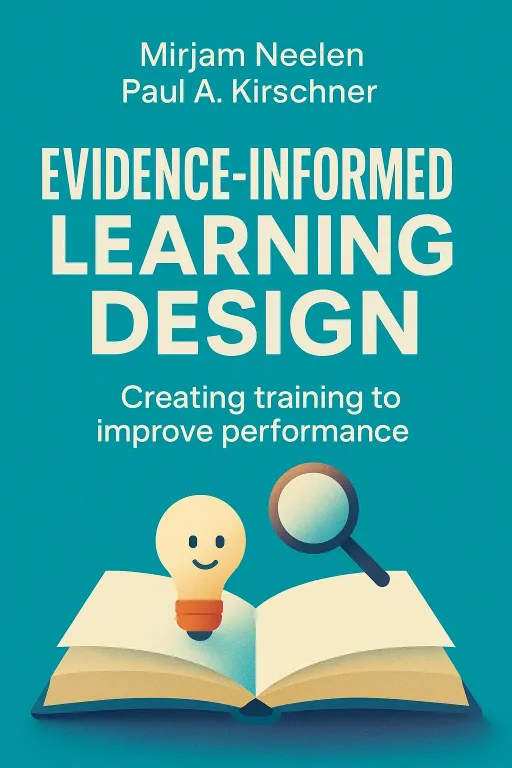
Nova: Absolutely. And our guides on this journey are two seminal works. First, we have "Evidence-Informed Learning Design" by Mirjam Neelen and Paul A Kirschner. These two are renowned cognitive scientists and instructional designers who quite literally wrote the book on moving beyond educational fads to apply scientifically proven methods. Their work gained significant traction by fearlessly debunking popular but often ineffective learning myths.
Atlas: So, cutting through the noise and getting to what actually works, based on science. I like that.
Nova: Precisely. And then, we have "The Understanding by Design Handbook" from Jay McTighe and Grant Wiggins. Their 'backward design' framework revolutionized curriculum development globally, shifting the focus from merely "covering content" to ensuring measurable understanding and performance. It was a radical idea for many educators at the time, but its principles extend far beyond the classroom.
Atlas: So, one book tells us the brain learns best, and the other tells us for that learning to be truly effective. That synergy sounds incredibly powerful.
Nova: It truly is. And it’s a synergy that offers profound insights for anyone, whether you're trying to master a new skill, lead a team through a complex project, or even just cultivate a more resilient personal philosophy.
The Science of Learning: Beyond Fads
SECTION
Nova: Let's start with Neelen and Kirschner, and the foundational science. For decades, education and even self-improvement have been plagued by fads – learning styles, brain-training games, even multi-tasking, which we now know is largely a myth. Their core message is that true learning design must be rooted in cognitive psychology.
Atlas: Hold on, so you're telling me all that time I spent highlighting textbooks, re-reading notes, or trying to figure out if I was a "visual learner" was potentially… counterproductive? That’s going to hit home for a lot of our pragmatic listeners trying to upskill for career advancement.
Nova: It’s not necessarily counterproductive in a harmful way, but often highly. It gives us a false sense of familiarity without truly deepening understanding. Neelen and Kirschner emphasize principles like spaced repetition and retrieval practice. Instead of just re-reading, you actively try to recall information from memory.
Atlas: So, instead of passively absorbing, you’re actively yourself, even if it feels harder in the moment?
Nova: Exactly. Think of it like this: Imagine you're trying to build muscle. Just passively looking at weights won't do anything. You have to actively lift them, struggle a bit, rest, and then lift them again. That struggle, that active engagement, is what builds strength. Retrieval practice—forcing your brain to pull information out—is the mental equivalent of lifting weights. It strengthens the neural pathways.
Atlas: That makes sense. I can see how that applies to learning a new language or memorizing facts. But how does that work for something more conceptual, like understanding a complex business strategy or developing a new mindset?
Nova: Great question. For conceptual learning, it’s about applying the same principle: active recall and elaboration. Instead of just reading about a strategy, try to explain it in your own words to someone else. Or, even better, try to how it would play out in different scenarios. That's a form of retrieval practice for abstract ideas. For a personal philosophy, it might mean regularly journaling about how your values align with your actions, or debating your beliefs with a trusted friend.
Atlas: So, small, consistent efforts of active recall, rather than marathon cramming sessions. That resonates with the idea of dedicating 15 minutes daily to a single, focused task. Consistency over intensity, even when it comes to how we learn.
Nova: Precisely. And understanding the brain learns effectively is one crucial piece of the puzzle. But what if we're learning the efficiently? What if our efforts, however well-designed cognitively, aren't actually aligned with our ultimate goals? That naturally leads us to our second big idea: backward design.
Backward Design: Starting at the Finish Line
SECTION
Nova: McTighe and Wiggins’ "Understanding by Design" framework is deceptively simple but profoundly powerful. It challenges the traditional approach of starting with content and then figuring out what to do with it. Instead, they propose we start at the finish line.
Atlas: That sounds a bit counter-intuitive. My instinct is always, "Okay, I need to learn X. Let me find a book on X and start at page one."
Nova: And that's exactly what backward design pushes us to question. It has three stages:
Atlas: So, it's like reverse-engineering your success. Instead of just hoping to get somewhere, you map out the journey from the destination. I'm curious, for someone aiming for mental clarity or building a personal philosophy, how does "acceptable evidence" translate? It sounds very academic, very measurable. How do you measure "understanding" of your own inner compass?
Nova: That’s a brilliant point, Atlas, and it highlights the flexibility of this framework. For something like mental clarity or personal philosophy, "acceptable evidence" isn't a multiple-choice test. It might be:
Atlas: That’s a much more tangible way to think about it. It moves from a vague aspiration to something you can actually track and work towards. It's about defining what "understanding" looks like.
Nova: Exactly. Let's take a practical example. Imagine someone wants to "learn to code" for career advancement.
Atlas: That’s a huge difference! It transforms "learning to code" from a potentially endless, overwhelming task into a focused, goal-driven mission. It ensures every minute spent learning is directly contributing to that desired outcome, which is exactly what a focused achiever needs.
Nova: And it prevents what McTighe and Wiggins call "activity without accomplishment"—doing a lot of things but not getting closer to your real goal. It ensures that the learning is not just about accumulating information, but about building enduring understanding and the ability to apply that understanding.
Synthesis & Takeaways
SECTION
Nova: So, what we have here are two incredibly powerful frameworks: Neelen and Kirschner giving us the science of to learn efficiently, and McTighe and Wiggins giving us the strategy of to learn for maximum impact. When you combine them, you're not just learning efficiently; you're learning the efficiently, and designing experiences that truly stick.
Atlas: It’s a powerful combination. For our listeners, applying 'backward design' to their personal learning goals or professional projects – where do they even start? What's the smallest, most pragmatic step they can take today?
Nova: The absolute first step is to pause before you start new, and explicitly state your "desired outcome" or "enduring understanding." Don't just say, "I want to get better at public speaking." Instead, ask: "What will I be able to differently? What will look like? Perhaps, 'I want to deliver a compelling 10-minute presentation to a leadership team that clearly articulates our strategic vision and earns their full buy-in.'"
Atlas: That specificity is key. That small, focused task for today could literally be defining that desired outcome. And once you have that, you can then apply the evidence-informed strategies to efficiently acquire the skills needed.
Nova: Exactly. The true impact of these approaches isn't just efficiency; it's about reclaiming agency in our learning, moving from passive consumption to active, intentional design of our own growth. It's about designing a life where every learning step genuinely moves you towards your defined 'next destination,' whether that's career advancement, mental clarity, or a robust personal philosophy.
Atlas: That's actually really inspiring. It frames learning not as a chore, but as a strategic path to meaningful advancement. It’s about building that resilient inner compass by intentionally charting your course.
Nova: It’s empowering. So, for our listeners, what's one "desired outcome" you're working towards right now? Share it with us. Let's start a conversation about how we can all design more impactful learning and achieve our goals.
Nova: This is Aibrary. Congratulations on your growth!