Personalized Podcast
Golden Hook & Introduction
SECTION
Nova: Imagine drinking a rich, six-hundred-and-twenty-calorie chocolate milkshake. Your body registers the indulgence, and your hunger hormones plummet. Now, imagine drinking the exact same milkshake, but the label says it's a one-hundred-and-forty-calorie sensible shake. Your body's physical metabolism reacts completely differently. Your hunger hormones barely budge. Same ingredients, different label, entirely different biology. Isn't that absolutely wild?
AsoisoT: It is a stunning demonstration of what cognitive scientists call top-down processing. Our brains aren't just passive receivers of sensory data. They are active prediction engines. In the milkshake study, the cognitive expectation of calories actually overrode the physical chemical receptors in the gut. The belief literally rewrote the biology.
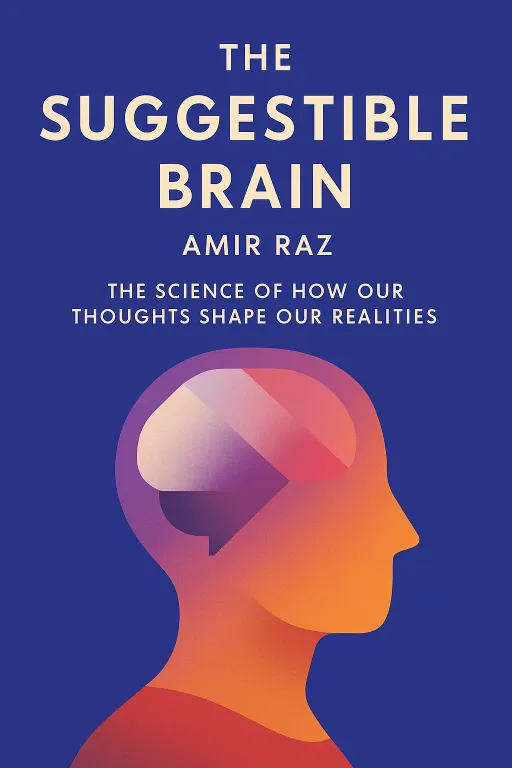
Nova: Exactly. And that is the perfect gateway into the book we are unpacking today: "The Suggestible Brain: The Science of How Our Thoughts Shape Our Realities" by Dr. Amir Raz. I'm Nova, and joining me to dissect this fascinating cognitive architecture is our resident analytical thinker, AsoisoT. We are so glad you're here!
AsoisoT: Thanks, Nova. I'm incredibly excited to dive into this. Dr. Raz has a unique background—he started as a professional magician and mentalist before becoming a world-class neuroscientist. That transition is highly logical when you think about it. Both magic and neuroscience are obsessed with the same core question: how does the human mind construct its version of reality, and where are the seams in that construction?
Nova: Oh, I love that. "Where are the seams in our reality." Today, we're going to tackle this book from three distinct perspectives. First, we'll explore the physical mind-body loop where expectations rewrite our biology. Then, we'll discuss how easily our memories and beliefs are hacked by suggestion and scientific authority. And finally, we'll focus on how these psychological vulnerabilities scale up into mass social contagions in our digital world.
The Physiological Puppet Master
SECTION
Nova: Let's start with the physical stuff, because most of us like to think our bodies are these objective, biological machines. But Dr. Raz shows that our physiology is incredibly suggestible. Take the story of Simon, a twelve-year-old boy diagnosed with severe Tourette's syndrome. His tics were so debilitating that his family had exhausted every traditional medical treatment. So, Dr. Raz decided to try something a bit... theatrical.
AsoisoT: Right, he built what he called a "Tic Detector." But here's the catch: it was entirely made of broken electronic scrap metal and a plastic helmet. It was a complete sham. Yet, Dr. Raz presented it with absolute clinical authority. He told Simon the machine could detect the absolute earliest neural signatures of a tic and "deflect" them before they manifested.
Nova: And the result was like magic! Simon sat in that chair, connected to this useless pile of scrap metal, completely tic-free for over thirty minutes. And the effect lasted for weeks, sometimes months, after the sessions. How does a fake machine do what powerful pharmaceuticals couldn't?
AsoisoT: From a neurological standpoint, Tourette's involves a dysfunction in the Cortico-Striatal-Thalamo-Cortical circuits—the CSTC loops, which govern motor control and habit formation. By introducing the "Tic Detector," Dr. Raz didn't just trick Simon; he provided a powerful cognitive scaffold. The intense belief and expectation of control actually regulated the overactive neural firing in those CSTC circuits. It's predictive coding in action. The brain predicted it wouldn't tic, so it adjusted its motor output to match the prediction.
Nova: It makes you wonder about the very nature of medicine. Dr. Raz also highlights some mind-blowing historical studies on sham surgeries. In the mid-twentieth century, there was a popular heart surgery called mammary ligation to treat angina. Doctors believed tying off certain arteries improved blood flow. But when researchers finally ran a controlled trial where they gave half the patients a sham surgery—meaning they just cut the skin and sewed it back up without touching the arteries—the sham surgery group actually showed an eighty-three percent improvement, compared to seventy-three percent in the real surgery group!
AsoisoT: That is a profound finding, Nova. And it's not an isolated incident. Similar results have been found in arthroscopic knee surgeries for osteoarthritis. Patients who received the placebo surgery—just the incisions and the theatrical sounds of the surgical tools—walked and climbed better than those who got the actual joint scraping. This suggests that a massive portion of medical efficacy is contextual. The white coats, the sterile smell, the drama of surgery—these are all highly potent suggestions that trigger our endogenous healing systems.
Nova: But it raises a huge ethical dilemma, doesn't it? As a scientist, how do you balance the desire to heal someone using these powerful psychological tools with the ethical requirement of informed consent? We can't just go around lying to patients, right?
AsoisoT: That is the central tension of "theatrical medicine." However, the emerging science of Open-Label Placebos, or OLPs, offers a fascinating compromise. Studies show that even when you tell patients, "Hey, this is a sugar pill with no active chemical ingredients, but clinical trials show that placebos trigger self-healing mechanisms," they still get better! The suggestion doesn't require deception; it requires a compelling narrative and a supportive clinical relationship.
Nova: That is so encouraging! It means our brains are wired to respond to care, ritual, and expectation, even when we know the trick behind it. It's like our biology wants to believe.
The Architect of False Realities
SECTION
Nova: But this suggestibility doesn't just stop at our physical organs. It goes deep into our cognitive core, shaping our memories and our very sense of truth. And this is where Dr. Raz's background as a magician really shines. He tells a story from his youth in Tel Aviv, where he noticed that the house numbers on a certain street were out of sequence. There was a missing number. So, he decided to run a little experiment on local taxi drivers.
AsoisoT: Ah, the "Vanishing Building" experiment. This is a classic example of planting a narrative seed.
Nova: Yes! He would get into a taxi, strike up a conversation about magic, and casually mention that he was a paranormalist who had once successfully vanished a building at that specific address, but tragically, he couldn't bring it back. He just left the seed there. Years later, he started hearing rumors in the city about a legendary magician who had vanished a physical apartment building. He even met a taxi driver who swore, with absolute certainty, that he had been there that night and saw the building disappear with his own eyes!
AsoisoT: It's a beautiful illustration of how memory is reconstructive, not reproductive. Our brains do not work like video recorders. When we recall an event, we don't play back a file; we assemble a jigsaw puzzle of sensory fragments, emotions, and... post-event suggestions. The taxi driver took the missing house number—which was a physical anomaly—and Dr. Raz's suggestion, and his brain seamlessly fabricated a vivid, firsthand memory to reconcile the two.
Nova: It reminds me of the legendary memory researcher Elizabeth Loftus, whom Dr. Raz profiles. She actually experienced this firsthand. When she was fourteen, her mother tragically drowned in a swimming pool. Years later, a relative mistakenly told her that she, Elizabeth, had been the one to find the body. Even though she had no memory of it initially, within days, she developed a detailed, emotionally wrenching memory of finding her mother in the pool, complete with the arrival of the firemen and the taste of the oxygen mask.
AsoisoT: And then, the relative realized they were wrong and apologized. Elizabeth hadn't found the body at all. But the memory felt completely real. This is the terrifying power of suggestion. If a world-renowned expert on memory can have a false memory implanted so easily, none of us are immune. Our narratives of the past are incredibly fragile.
Nova: And it gets even trickier when you combine this memory malleability with our deep-seated bias toward scientific authority. Dr. Raz and his team ran this hilarious, but slightly alarming, experiment at McGill University using a mock "Spintronics Scanner." They built this ridiculous machine out of medical scrap metal and an old hair dryer, and they told participants—including undergraduate psychology students and actual cognitive neuroscientists—that this machine could read their minds and influence their thoughts.
AsoisoT: This is what Dr. Raz calls "neuroenchantment." We live in a culture that treats brain imaging as the ultimate truth. If a claim has a picture of a brain scan next to it, or is wrapped in neuro-jargon, our critical thinking drops significantly. In the Spintronics study, the researchers used simple magic tricks to make it look like the machine was successfully guessing the numbers the participants were thinking of.
Nova: And almost everyone believed it! Even the neuroscientists, who literally knew that mind-reading technology doesn't exist, started rationalizing the machine's performance. They were saying things like, "Wow, the magnetic resonance must be coupling with my neural oscillations." They completely abandoned their scientific skepticism because of the theatrical context of a high-tech lab.
AsoisoT: It's a form of cognitive vulnerability. We are so conditioned to defer to the authority of "the scanner" and "the data" that we fail to see the hair dryer behind the curtain. It shows that analytical thinking isn't just a shield we carry; it's a practice we have to actively maintain, especially when presented with things that look and sound like cutting-edge science.
The Digital Echo Chamber
SECTION
Nova: This brings us to our third angle, which is how this individual suggestibility scales up into massive social phenomena. In the past, mass suggestion was limited by physical proximity. You had the famous cases of European convents in the fourteenth century, where nuns would suddenly start meowing like cats or having fits of demonic possession because they were living in these highly stressed, isolated environments.
AsoisoT: Yes, mass psychogenic illness. It's a well-documented phenomenon where psychological distress converts into physical symptoms and spreads through social contagion. But historically, it required a closed physical loop—a convent, a boarding school, or a factory.
Nova: But today, we have the internet. And Dr. Raz points out that virtual spaces have become the new convents. He highlights the Le Roy High School outbreak in 2011, in upstate New York. A group of teenage girls suddenly developed severe, uncontrollable tics, verbal outbursts, and seizures. The community was terrified. They thought it was environmental poisoning, maybe a toxic spill. But the medical consensus was that it was a mass psychogenic illness. And the vector of transmission wasn't physical contact—it was YouTube and social media.
AsoisoT: That is a massive paradigm shift. The girls were posting videos of their tics online, and other vulnerable teenagers who watched those videos began unconsciously mimicking the symptoms. The digital algorithm acted as a super-spreader event for a neurological symptom. It shows that our suggestible brains are now plugged into a global, high-speed feedback loop. We aren't just influenced by our immediate neighbors anymore; we are influenced by the collective anxieties of the entire world, curated by algorithms designed to maximize emotional arousal.
Nova: That is honestly a bit terrifying. If our brains are this porous, and the digital environment is this saturated with misinformation and emotional contagion, how do we protect ourselves? Dr. Raz talks about how fake news and misinformation thrive precisely because they exploit our suggestibility, especially when they align with our pre-existing political or social beliefs.
AsoisoT: Absolutely. He references a study done during the 2018 Irish abortion referendum. Researchers showed voters fabricated news stories about scandals on both sides of the debate. They found that voters were highly likely to "remember" seeing these fake events if the scandal painted the opposing side in a negative light. And here's the kicker: even when the researchers told the participants, "Hey, some of these stories were completely made up," it did almost nothing to reduce the rate of false memories. The narrative was too satisfying to let go.
Nova: Wow. So once the suggestion fits our worldview, our brain locks it in, even when we are explicitly told it's fake. It's like the ultimate confirmation bias. But surely, there's a positive side to this suggestibility? If we are this easily influenced, can we use that power for good?
AsoisoT: Yes, absolutely. And this is where the science of suggestion becomes incredibly beautiful. Dr. Raz discusses how we can leverage this exact same cognitive architecture to reduce implicit bias and promote social justice. For example, researchers have used virtual reality for "body-swapping" experiments. They put non-Black participants in a virtual environment where, when they look in a virtual mirror, they see themselves as a Black person.
Nova: Oh, that is fascinating! What happens to their brain when they experience that?
AsoisoT: The brain's multisensory integration areas are temporarily hacked. The visual feedback of the Black avatar, combined with synchronized physical touch, creates a powerful illusion of ownership over that virtual body. And studies show that after just a short session of this virtual body-swapping, the participants' implicit racial bias—measured by objective psychological tests—drops by more than fifty percent! The suggestion of "being in another's skin" physically rewires their automatic, subconscious associations.
Nova: That is beautiful. It's like using technology to scale empathy. It shows that if we can design environments that feed our suggestible brains positive, counter-stereotypical narratives, we can actually dismantle deep-seated prejudices.
AsoisoT: Exactly. It's what evolutionary biologists call "niche construction." Humans don't just adapt to their environment; we actively build our environment, which then shapes our evolution. If we recognize that our brains are highly suggestible, we have a responsibility to design digital and physical niches that promote cognitive health, empathy, and critical thinking, rather than outrage and division.
Synthesis & Takeaways
SECTION
Nova: This has been such a mind-expanding conversation, AsoisoT. As we wrap up, let's bring it all together. Dr. Raz's journey from magician to scientist really shows us that suggestibility isn't a design flaw of the human brain. It's actually an evolutionary superpower. It's what allows us to learn from others, to heal ourselves through expectation, and to form deep social bonds. But like any superpower, it's a double-edged sword.
AsoisoT: Well said, Nova. Our suggestibility is the price we pay for our incredible capacity for culture and learning. If we were completely immune to suggestion, we would also be immune to education, art, and empathy. The key takeaway from Dr. Raz's work is that we must become the active curators of our own context. We need to practice what I call "cognitive hygiene."
Nova: "Cognitive hygiene." I love that phrase. What does that look like in daily life?
AsoisoT: It means being highly intentional about the narratives we let into our minds. It means questioning the "neuroenchantment" of flashy science claims, pausing before we react to emotionally charged digital content, and recognizing that our memories are living stories, not permanent records. We need to ask ourselves: "What suggestions am I allowing to shape my physical and mental reality today?"
Nova: That is a perfect note to end on. Thank you, AsoisoT, for bringing your brilliant analytical mind to this discussion. And thank you to all our listeners. We hope this episode has left you with some empowering suggestions to take into your week. Remember, your brain is listening to everything you think. Until next time, keep exploring the wonders of your mind!
AsoisoT: Stay curious, everyone.