The Art of Storytelling: Weaving Narratives into Interactive Experiences
Golden Hook & Introduction
SECTION
Nova: Okay, Atlas, 'The Art of Storytelling' in five words. Go.
Atlas: Design needs human narrative, period.
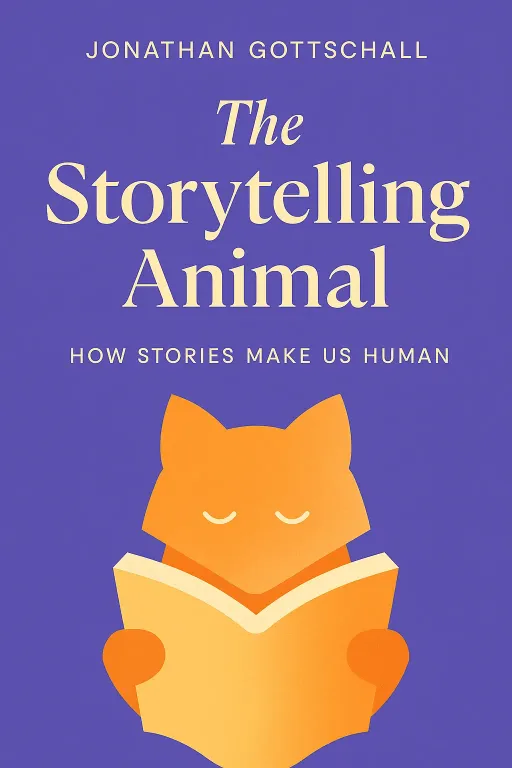
Nova: Ooh, succinct and powerful. I like it. Today, we're unpeeling the layers of something truly fundamental: how storytelling isn't just for epic sagas or bedtime tales, but for the very interfaces we interact with daily. We're drawing insights from a profound concept often overlooked in design, inspired by works like Jonathan Gottschall’s widely acclaimed book,. Gottschall, a literary scholar, blends literature, psychology, and neuroscience to make a compelling case for narrative as a core human drive, and it’s a concept that’s received significant critical praise for its interdisciplinary genius.
Atlas: So, we're not just talking about adding a 'story mode' to an app then? Because that sounds… a little forced.
Nova: Not at all! We're talking about something far deeper. It's about recognizing that humans are fundamentally story-driven creatures. We understand the world, our place in it, and even our tasks, through narratives. And when UI ignores this innate need, it often feels flat, disconnected, failing to truly engage or inspire us.
Atlas: Wow. That's a huge claim. So, our brains are basically narrative processors, even when we're just trying to check our email or order coffee?
The Human as a Storytelling Animal & Its Philosophical Roots
SECTION
Nova: Precisely. Think about it: our minds are constantly trying to make sense of cause and effect, of beginnings, middles, and ends. Even if you see three random dots, your brain instantly tries to connect them, to form a pattern, a mini-narrative. Gottschall argues this isn't just a preference; it's a fundamental drive shaping our thoughts, dreams, and even our reality.
Atlas: That makes me wonder… are you saying we’re hardwired for stories, even in our UI? Like, is it an evolutionary thing?
Nova: Absolutely. From an evolutionary perspective, stories helped us survive. They taught us about danger, about social norms, about how the world works, without us having to experience every single thing firsthand. Our ancestors passed down vital information through narrative. That impulse is still very much alive, even in our digital interactions. When a design feels intuitive, when it guides you effortlessly from one step to the next, it's often because it's tapping into that inherent narrative understanding.
Atlas: Okay, so it’s not about literal fairy tales in my banking app. It’s more about the underlying structure, the journey? As an INTP designer, I'm always looking for that logical beauty, that underlying order. How does this 'story' concept align with building order, not just superficial fluff?
Nova: That's a brilliant distinction, Atlas. It's profoundly about order. A good story, at its heart, is a structured sequence of events that leads to a resolution. In UI, it means crafting a user journey that has a clear beginning – the user's intent or problem; a compelling middle – the interaction and exploration; and a satisfying end – the goal achieved or the problem solved. It’s about building a predictable, yet engaging, path.
Atlas: So, when a user struggles with an interface, it's because the 'story' is broken? The narrative arc isn't clear, or it's missing crucial chapters?
Nova: Exactly! Or perhaps the narrative is there, but it’s a bad story – confusing, frustrating, lacking a clear protagonist, which is the user, and a clear goal. A well-designed UI makes the user the hero of their own story, guiding them through challenges to a successful outcome. It respects their agency and builds a sense of accomplishment.
Reframing UI as Narrative Journey & Practical Application
SECTION
Nova: This naturally leads us to how we can intentionally weave these narrative arcs and emotional resonance into our UI. It's about transforming functional interactions into meaningful experiences.
Atlas: I can see that. For me, design is about connection, connecting people to the world, to themselves. But how do you infuse something as abstract as a 'story' into, say, a login screen, or a preference panel? What does that even look like?
Nova: Great question. It starts with empathy, understanding the story before they even touch your interface. What are their motivations? What are their fears? What do they hope to achieve? Then, you frame each interaction as a part of that larger journey. Take an onboarding flow for example. Instead of just a series of screens, it can be framed as the 'origin story' of the user with your product.
Atlas: So, the beginning is "I need this product," the middle is "I'm learning how to use it," and the end is "I'm a master of this product"?
Nova: Precisely! And each step along the way can have its own mini-narrative. A progress bar isn't just a technical indicator; it's a visual representation of the user's journey towards a goal, building anticipation and a sense of advancement. An error message isn't just a technical fault; it can be a moment of 'conflict' in the story, where the system gently guides the user to overcome a 'challenge'.
Atlas: That’s actually really inspiring. It connects to the idea of a 'beautiful moment' – not just visually beautiful, but functionally and emotionally resonant. Like a delicate scent that evokes a memory, can UI evoke a feeling of accomplishment or ease through its narrative?
Nova: Absolutely. When Nova's Take talks about emotional resonance, it's about that. It's about how the flow, the feedback, the micro-interactions, all contribute to an overall feeling. It’s about creating an experience that feels coherent, purposeful, and even delightful. It fulfills that desire for logic’s beauty and sensory pleasure, harmoniously unified.
Atlas: So, how do we practically start? For an INTP designer like me, who loves diving deep into systems and logic, what's a small, actionable step to begin reframing our designs through this narrative lens?
Nova: Here's a tiny step you can take today: identify a key user flow in your current project. Maybe it's signing up, or completing a specific task. Then, ask yourself: how could you reframe each step as part of a mini-story? What 'beginning,' 'middle,' and 'end' would create a more engaging experience for the user?
Atlas: That's a concrete challenge. Not just thinking about the buttons and inputs, but the user's emotional arc through that sequence. The scent of a good story, you could say.
Nova: Exactly! It’s about being an architect of experience, not just an assembler of elements.
Synthesis & Takeaways
SECTION
Nova: Ultimately, understanding the art of storytelling in UI isn't about adding superficial glitter. It’s about tapping into the very core of what makes us human. It's about recognizing that our brains are wired for narrative, and by respecting that, we can build interfaces that are not just functional, but profoundly engaging, intuitive, and even delightful.
Atlas: It’s about building order, yes, but an order that resonates with our deepest human instincts. It’s about creating connections that feel earned, not forced. It's transforming the cold fact of pixels into the warm embrace of a meaningful journey.
Nova: And in doing so, designers become more than just problem-solvers; they become weavers of experiences, guiding users through compelling narratives that leave them feeling understood, accomplished, and connected.
Atlas: So, what’s the story your design is telling? Is it a compelling one that guides your user to their happy ending?
Nova: Think about it. How can you make your next design project a story worth living?
Nova: This is Aibrary. Congratulations on your growth!