Building an Unshakeable Professional Mindset
Golden Hook & Introduction
SECTION
Nova: What if your biggest professional setback this week wasn't a failure, but your most valuable lesson waiting to be unlocked? We're diving into building that unshakeable mindset, turning hurdles into your greatest allies.
Atlas: That's a provocative thought, Nova. Because let's be honest, most of us tend to see those moments as just... painful dead ends, right? A moment where the carefully constructed edifice of our career feels like it's starting to crumble.
Nova: Absolutely. It's easy to feel like you've hit a wall, a permanent roadblock. But today, we're exploring how to build a mindset so strong, so adaptable, that those walls actually become stepping stones, integral parts of your growth.
Atlas: I love that framing – turning obstacles into architects of our advancement. It speaks directly to that desire for impactful knowledge, for clarity amidst the professional chaos.
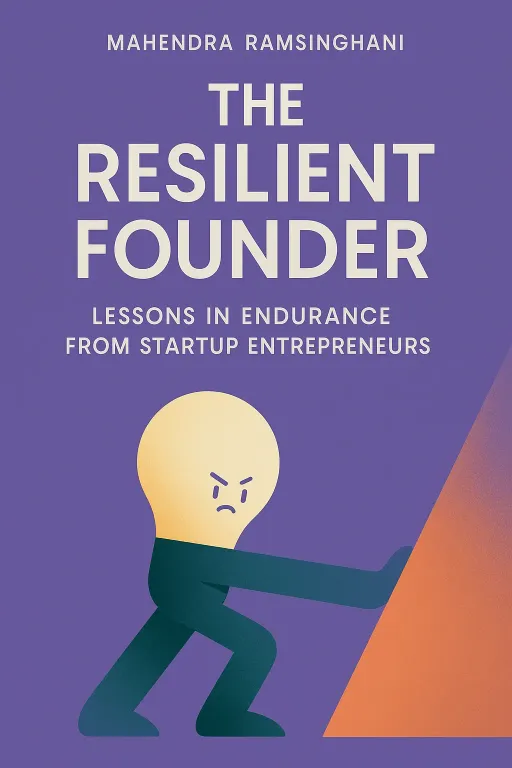
Nova: And we're drawing wisdom from two fantastic sources to guide us. First, Mahendra Ramsinghani’s ‘The Resilient Founder,’ which delves deep into the sheer psychological endurance required to navigate the inevitable highs and lows of the professional world. Think of it as fortifying your inner foundation, making sure the bedrock of your career is unshakeable.
Atlas: And then, Michael C. Hyter’s ‘The Power of Choice,’ which highlights how our conscious decision-making can transform those very professional hurdles into specific growth catalysts for our careers. It’s about being the active architect of your own development, not just a passive passenger.
Nova: Exactly. So, whether you’re a driven learner constantly seeking to absorb new insights, a curious strategist mapping out your next move, or an aspiring architect building your professional structure from the ground up, this episode is for you. We’re about to equip you with the tools to build an unshakeable professional mindset.
The Bedrock of Resilience: Psychological Endurance
SECTION
Nova: Let's start with that foundation, the psychological endurance Ramsinghani talks about. When we hear "resilience," we often think of bouncing back from adversity. But it’s more nuanced than that, isn't it? It’s about the capacity to withstand pressure, to maintain function and perspective not just when things go wrong, but also during periods of intense success or change.
Atlas: That’s a crucial distinction, Nova. The ‘highs’ can be just as challenging as the ‘lows’ in their own way. During the highs, complacency can set in, or the pressure to maintain that success can become its own form of stress. And during the lows, well, that's where most people feel their resilience tested to its absolute limit. So, how does one actually build this psychological endurance? Is it something you're born with, or can it be cultivated?
Nova: That’s the best news: it can absolutely be cultivated. Think of your psychological resilience like a muscle. You wouldn't expect to run a marathon without training, right? You build up your stamina, your strength, your ability to push through discomfort gradually. Psychological endurance is the same. It requires consistent practice, exposure to manageable challenges, and learning how to recover effectively.
Atlas: I can see that. It’s not about avoiding the gym; it’s about showing up consistently, even when you don’t feel like it. But for many listeners, especially those who feel overwhelmed by choices or the sheer pace of modern work, that concept of ‘consistent practice’ can feel like yet another demand on their already scarce time and energy. What does that training actually look like when you’re already feeling depleted?
Nova: That’s a very real challenge, and it’s where the ‘small steps build big momentum’ growth recommendation comes in. It's not about grand gestures; it's about micro-habits. For instance, during a stressful meeting, instead of letting anxiety spiral, you consciously practice a brief grounding technique, like focusing on your breath for three counts. Or when a project hits a snag, you make a deliberate choice to first acknowledge the difficulty, then immediately pivot to identifying one small, actionable step forward, rather than dwelling on the problem.
Atlas: So, it’s about internalizing small moments of control and positive response, even when external circumstances feel chaotic. It’s like being a tree in a storm. A rigid, brittle tree will snap. But a tree with deep roots and flexible branches can bend, sway, and ultimately survive, even thrive, because its structure is inherently resilient. The storm doesn’t break it; it tests it, and in testing, it proves its strength.
Nova: That's a beautiful analogy, Atlas. And it’s not just about withstanding the storm; it’s about learning to navigate it. Psychological endurance also involves developing what’s often called ‘cognitive flexibility’ – the ability to shift your perspective, to see situations from multiple angles, and to adapt your thinking when new information emerges. This is crucial when you’re feeling overwhelmed by choices; resilience helps you avoid freezing up and instead allows you to engage with the options more thoughtfully.
Atlas: I’m picturing someone facing a major career setback – a project that imploded, a significant professional disappointment. They’re not just enduring the emotional fallout; they’re actively managing their thoughts, perhaps by reminding themselves of past successes, by reframing the setback as a temporary situation rather than a permanent state of being. Is that part of it?
Nova: Absolutely. It’s about developing an internal dialogue that supports you, rather than undermines you. Instead of thinking, "I'm a failure," a resilient mindset might reframe it as, "This situation is difficult, and I'm feeling the effects, but I have the capacity to learn from this and move forward." It’s a subtle but profound shift from self-criticism to self-compassion and problem-solving. And this is precisely where the second piece of wisdom comes into play – how we to interpret and respond to these events.
The Catalyst of Choice: Reframing Setbacks into Growth
SECTION
Atlas: That transition is perfect, Nova. So we’ve established the importance of building that inner foundation of psychological endurance, that flexible, deep-rooted tree. But what happens when the storm hits, and it feels less like a challenge to endure and more like a complete derailment? This is where Michael C. Hyter’s work on ‘The Power of Choice’ and the idea of conscious decision-making really shines, especially for someone like me, or many listeners, who feels overwhelmed by the sheer volume of decisions and potential paths. When a setback hits, it often feels like overwhelming problem, an additional burden, not an opportunity for choice.
Nova: That’s a brilliant point, Atlas. And Hyter’s work suggests that the choice isn't to have a setback, but you choose to process and respond to it. The key is shifting from a passive 'this happened to me' – a victim of circumstance – to an active 'what can I learn from this?' This is where conscious decision-making truly shines; you are what you will learn and how you will grow from this experience, rather than letting the experience dictate your growth.
Atlas: The ‘specific learning objective’ part you mentioned earlier is the real game-changer here, isn't it? It’s so concrete. It’s not just ‘be more resilient,’ or ‘think positively,’ which can feel vague and unattainable when you’re in the thick of it. It’s about identifying something tangible, like ‘improve my data visualization skills by 20% for the next client presentation,’ or ‘develop better active listening techniques for navigating difficult team discussions.’ That clarity is precisely what I, and I imagine many listeners, crave when we feel overwhelmed by options or by a mistake.
Nova: Exactly! It’s the difference between standing in the wreckage of a collapsed structure and stepping into the role of the architect. For the aspiring architect in our audience, imagine your design gets rejected by a client. The immediate feeling might be despair. But instead of dwelling on the rejection, you consciously choose to reframe it. The specific learning objective isn't just ‘get better at designing’ – that’s too broad. It’s more like: ‘My objective is to improve my ability to anticipate client objections by 20% in the next design meeting,’ or ‘I need to refine my proposal’s budget justification to address potential client concerns more effectively.’
Atlas: Ah, so it’s about dissecting the setback like a professional dissects a blueprint. You’re not abandoning the project; you’re identifying the precise structural flaw – perhaps the load-bearing calculations were off, or the aesthetic didn't align with the client's stated vision – and you are learning how to fix it for the next iteration. That’s not failure; that’s essential architectural practice, isn’t it? It transforms a moment of crisis into a targeted development session.
Nova: Precisely! It shifts you from being a victim of circumstance to being the active, intentional architect of your own growth. This is where conscious decision-making truly shines – you are what you will learn and how you will grow from this experience, rather than letting the experience dictate your narrative. This active reframing is incredibly empowering because it puts you back in the driver's seat.
Atlas: And that clarity, that specific objective, cuts through the overwhelm. It gives you a tangible goal, a direction. It’s the difference between drowning in a sea of ‘what ifs’ and charting a specific course. When you feel overwhelmed by choices, having a clear learning objective from a setback provides immediate focus. It tells you to decide on next, to direct your energy. It’s about making informed decisions about your own development.
Nova: This is why Hyter’s work is so impactful. He’s not just talking about abstract concepts; he’s providing a framework for practical application. When you encounter a hurdle – a project that didn’t go as planned, a communication breakdown, a missed opportunity – your immediate impulse might be to label it a failure and move on, or worse, get stuck in rumination. But with this approach, you pause. You consciously ask: What specific skill did I need here? What knowledge was I missing? What strategic approach could have been more effective?
Atlas: It sounds like a form of deliberate practice, applied to our mistakes. Instead of just experiencing the mistake, you're actively extracting the lesson. It’s like a chef tasting a dish that didn’t quite work. They don’t just discard it; they analyze the flavor profile, the texture, the balance of ingredients, and then adjust the recipe for next time. The ‘mistake’ becomes the crucial data point for improvement.
Nova: Exactly. And this process naturally builds resilience. The more you practice reframing setbacks into learning objectives, the less daunting future challenges become. You develop confidence in your ability to navigate difficulties, not because you’re immune to them, but because you know you have a built-in mechanism for growth and recovery. It’s a virtuous cycle: resilience allows you to face challenges, and facing challenges with a reframing mindset strengthens your resilience.
Atlas: It’s fascinating how these two concepts, psychological endurance and conscious reframing, are so deeply intertwined. You need the underlying resilience to even attempt to reframe, and the act of reframing actively strengthens that resilience. It’s a feedback loop for building an unshakeable professional core.
Nova: They are indeed. One provides the stability, the other provides the dynamic adaptation. Think of it like building a house. Resilience is the unshakeable foundation – the concrete slab, the steel beams. Reframing is the active construction process, the skilled architect and builders choosing the materials, designing the layout, and adapting plans when unforeseen issues arise, ensuring the house not only stands but is functional, beautiful, and capable of withstanding future environmental changes.
Atlas: And this proactive approach is so vital for anyone who identifies as a driven learner, or an aspiring architect of their own life and career. It’s about taking ownership. It’s about recognizing that even when things go wrong, you still hold the power to choose your next step, to choose what you learn, and therefore, to choose your future trajectory. It truly transforms professional hurdles from potential career-ending events into specific, valuable growth catalysts.
Synthesis & Takeaways
SECTION
Nova: So, to wrap up, we’ve journeyed through the essential components of building an unshakeable professional mindset. We started with fortifying that inner foundation – the bedrock of psychological endurance that allows us to withstand the inevitable storms of professional life, to bend without breaking, and to maintain our equilibrium through both the exhilarating highs and the challenging lows.
Atlas: And then, we moved from enduring the storm to actively navigating and even harnessing it, by exploring Michael C. Hyter’s powerful concept of conscious choice and reframing. We learned that those moments we might instinctively label as failures are, in fact, potent opportunities. The key is to consciously choose to see them not as dead ends, but as specific learning objectives.
Nova: This is where the magic happens for the driven learner and the curious strategist. Instead of getting stuck in the narrative of 'I failed,' you pivot to 'What specific skill, knowledge, or strategic insight can I extract from this experience?' For the aspiring architect, it’s about meticulously analyzing the blueprint of a setback to understand how to build stronger, more resilient structures next time.
Atlas: And that actionable takeaway, directly from the material we explored, is incredibly powerful for anyone feeling overwhelmed by choices or seeking clarity: Identify one professional setback from this week. Just one. Take a moment, breathe, and then consciously reframe it as a specific learning objective rather than just a failure. It’s the exercise that builds that resilience muscle and sharpens your strategic edge.
Nova: It’s about embracing the journey, knowing that small, deliberate steps build immense momentum. This isn't about achieving perfection overnight, but about consistent, mindful practice in how we perceive and respond to challenges. It’s about recognizing that our mindset is not static; it’s a dynamic construct we actively build and refine.
Atlas: That’s the driven learner in all of us, seeking that impactful knowledge, even from the moments we might rather forget. It’s about finding clarity and making informed decisions about our own development, turning those perceived hurdles into our greatest teachers and allies.
Nova: Precisely. It’s a continuous process of fortifying your inner foundation and actively choosing your path forward, consciously shaping your professional journey. That's how you truly build an unshakeable professional mindset.
Atlas: This has been incredibly enlightening, Nova. It's a powerful reminder that our mindset is not just something we have, but something we actively build and choose, day by day, setback by setback.
Nova: Indeed it is. And that’s the essence of building an unshakeable professional mindset.
Atlas: This is Aibrary. Congratulations on your growth!