The Invisible Ledger: Decoding the Psychology of Wealth with Eben
Golden Hook & Introduction
SECTION
Prof. Eleanor Hart: Imagine a man who worked as a gas station mechanic for 25 years and a janitor for 17 years. He lived in a quiet, two-bedroom house he bought for twelve thousand dollars, swept floors, fixed cars, and lived a completely unassuming life. When he died in 2014 at the age of 92, his name made international headlines. Ronald Read had a net worth of over eight million dollars. He left two million to his stepkids and over six million to his local hospital and library. Now, contrast him with Richard Fuscone. Harvard-educated, Merrill Lynch executive, a man with an MBA who was so wildly successful in high finance that he retired in his 40s to become a philanthropist. Yet, in the very same era, Fuscone declared bankruptcy, admitting he had no income and his Greenwich mansion was sold in a foreclosure auction for seventy-five percent less than its value. How does a janitor with no formal financial education completely obliterate a financial titan? Welcome to the podcast. I am Professor Eleanor Hart, and joining me today is Eben, a brilliant analytical thinker who loves connecting the dots across history, psychology, and systems. Eben, when you look at these two lives, what is the immediate systemic connection you make?
Eben: It is great to be here, Eleanor. When I hear those two stories, my mind immediately goes to a fundamental concept in systems theory: the difference between a system's state and its behavioral dynamics. In almost every other field, whether we are talking about astrophysics or medicine, inputs are tightly coupled with outputs. A brilliant surgeon performs a better operation; a top-tier rocket scientist designs a more stable orbit. But in personal finance, Ronald Read and Richard Fuscone prove that the inputs of raw intelligence and formal credentials can be completely decoupled from the output of financial security. It tells us that doing well with money is not about what you know. It is about how you behave. And behavior is incredibly difficult to teach, even to the smartest people. It is a soft skill, a psychological puzzle rather than a mathematical formula.
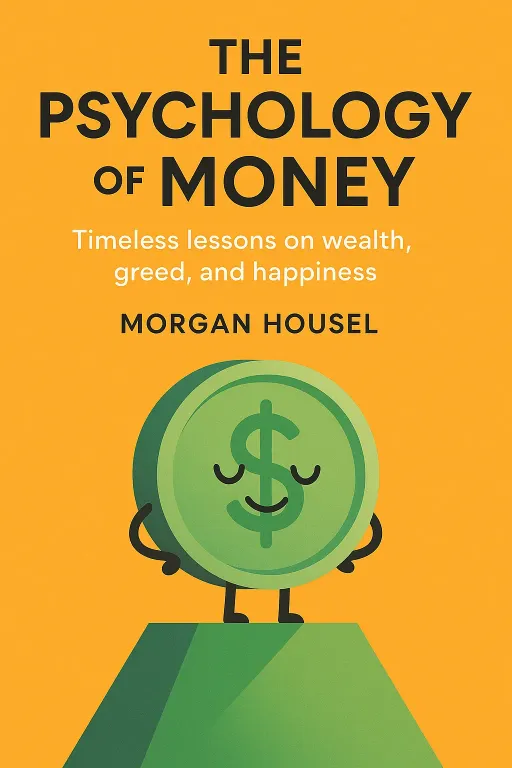
Prof. Eleanor Hart: That is a beautiful way to frame it. Housel argues that the financial industry treats investing like a hard science, akin to physics, when it is actually much closer to psychology and history. Today, we are going to tackle this book from two different angles. First, we will explore this behavior gap and why consistency beats intelligence through the counterintuitive science of compounding. Then, we will unmask the invisible nature of true wealth and discover why our brains are evolutionarily wired to fall for the seductive trap of financial pessimism.
The Behavior Gap and the Magic of Compounding
SECTION
Prof. Eleanor Hart: Let us start with Ronald Read. His secret was not a complex trading algorithm or insider information. He simply saved what little he could and invested it in blue-chip stocks. Then, he did something incredibly difficult for the modern human: he waited. For decades. He let those tiny, quiet savings compound over half a century.
Eben: Exactly, Eleanor. And that brings us to the core of why compounding is so difficult for us to grasp. Our brains are wired for linear thinking, not exponential growth. If I ask you to calculate eight plus eight plus eight, your brain does it instantly. But if I ask you to calculate eight times eight times eight, and keep going, the numbers quickly escape our cognitive horizon. Housel uses a fascinating scientific parallel to explain this: the ice age cycles. For a long time, scientists like Milutin Milanković believed that earth's ice ages were caused by brutally cold winters. It makes intuitive sense, right? You need extreme cold to build massive glaciers. But a Russian meteorologist named Wladimir Köppen refined this theory and discovered something mind-blowing. Ice ages are actually caused by moderately cool summers.
Prof. Eleanor Hart: Yes, it is so counterintuitive. If a summer is just cool enough that it fails to melt the previous winter's snow, a tiny layer of ice is left behind. The next winter, more snow falls on top of that base. The following summer, because of the existing ice sheet, even more snow is preserved. This leftover snow reflects more sunlight, which cools the local climate further, leading to even more snowfall. It is a classic positive feedback loop. The snow does not need to be torrential; it just needs to last. Over geological time, a tiny, cool summer compounds into a continental ice sheet.
Eben: That is a perfect systems feedback loop. And the financial equivalent of that persistent summer snow is Warren Buffett. When people analyze Buffett's success, they focus on his investment style, his value investing philosophy, his eye for companies. But they miss the most critical variable in his wealth equation: time. Buffett started investing when he was ten years old. By the time he was thirty, he had a net worth of one million dollars, which is about nine million adjusted for inflation. But here is the kicker: as of the writing of this book, his net worth was eighty-four point five billion dollars. Of that massive fortune, eighty-four point two billion was accumulated after his fiftieth birthday. His skill is investing, but his secret is time.
Prof. Eleanor Hart: It really puts things into perspective. Housel does this great thought experiment. What if Buffett had been a normal person who started investing at age thirty with, say, twenty-five thousand dollars, and retired at sixty? Even if he had maintained his extraordinary annual return of twenty-two percent, which is practically legendary, what would his net worth be? Just eleven point nine million dollars. Ninety-nine point nine percent of his actual wealth would be gone, simply because he cut his compounding window in half.
Eben: That is a staggering calculation, Eleanor. It shows that a moderate return sustained over an uninterrupted period of time will always beat a spectacular return that can only be held for a short burst. Look at Jim Simons, the head of the hedge fund Renaissance Technologies. He is arguably the greatest investor of all time, compounding money at an astonishing sixty-six percent annually since 1988. Yet his net worth is a fraction of Buffett's, around twenty-one billion dollars. Why? Because Simons did not start compounding until he was fifty. He did not have the runway. If Simons had achieved his sixty-six percent returns for the same seventy-year span as Buffett, his net worth would be sixty-three quintillion dollars. That is an astronomical, impossible number. It proves that in the game of compounding, longevity is the ultimate leverage.
Prof. Eleanor Hart: But staying in the game is incredibly hard because it requires a completely different skillset than getting into the game. Housel devotes an entire chapter to this: getting wealthy versus staying wealthy. Getting wealthy requires taking risks, optimism, and putting yourself out there. Staying wealthy, however, requires the exact opposite. It requires humility, frugality, and a healthy dose of paranoia. You have to accept that some portion of your success was due to luck, which means you cannot rely on it to save you from risk.
Eben: I love that distinction. In engineering, we talk about building redundant systems to prevent a single point of failure. If you are designing an airplane, you do not just have one hydraulic system; you have backups, because you know that even if the odds of failure are low, the consequences are catastrophic. In finance, people often confuse a margin of safety with being conservative or fearful. But a margin of safety is actually a strategic advantage. It is what allows you to survive the inevitable downturns so that compounding can keep working. If you use leverage, like Rick Guerin did—who was the third partner alongside Warren Buffett and Charlie Munger in the 1970s—you risk being wiped out. Guerin was in a hurry to get rich, used margin loans, and when the market fell seventy percent in the 1973 downturn, he faced margin calls and was forced to sell his Berkshire stock to Buffett for a pittance. He did not survive the cycle.
Prof. Eleanor Hart: It is a tragic story. Guerin was just as smart as Buffett and Munger, but he lacked the survival mentality. Buffett once said that more than big returns, he wanted to be financially unbreakable. Because if you are unbreakable, you can stick around long enough for compounding to work its wonders. It is the ultimate lesson of the behavior gap: survival is the only metric that truly matters in the long run.
The Invisible Ledger: Wealth vs. Rich and the Allure of Pessimism
SECTION
Prof. Eleanor Hart: This idea of survival and behavior leads us directly to our second core topic: the invisible ledger of wealth versus richness, and why we are so easily seduced by financial pessimism. Let us start with a definition. Housel writes that richness is current income. It is the visible display of money. It is the person driving a one-hundred-thousand-dollar Porsche, or living in a massive Greenwich mansion. But wealth? Wealth is what you do not see. It is the cars not purchased, the diamonds not bought, the assets that have not yet been converted into material possessions.
Eben: This is a profound psychological distinction, Eleanor. It connects to the concept of potential energy in physics. A boulder sitting at the top of a cliff has immense potential energy, but it is quiet, invisible. Once it falls, that energy becomes kinetic—visible, loud, and ultimately spent. Richness is kinetic energy; wealth is potential energy. The tragedy of modern consumerism is that we are trained to judge financial success by what we can see. We see the Porsche and think, "Wow, that guy is successful." But as Housel points out from his days working as a valet in Los Angeles, many of those drivers were actually financial disasters. He tells the story of Roger, a customer who drove a brand-new Porsche. One day, Roger showed up in an old Honda. The author asked him what happened, and Roger nonchalantly replied that the Porsche had been repossessed because he defaulted on the loan. Roger looked rich, but he had zero wealth.
Prof. Eleanor Hart: It is the "Man in the Car Paradox." When you see someone driving a beautiful luxury car, you rarely think, "Wow, the guy driving that car is cool." Instead, you think, "Wow, if I had that car, people would think I am cool." The paradox is that you are completely ignoring the driver, focusing only on the object and projecting your own desires onto it. We buy expensive things to signal to others that we should be liked and admired, but those other people bypass admiring us entirely and only focus on the object.
Eben: It is a complete cognitive mismatch. And it is why building wealth is so difficult. To build wealth, you have to exercise restraint. You have to create a gap between your ego and your income. Housel defines savings as the difference between your ego and your income. If your income rises but your ego rises just as fast, your savings rate remains flat. This is why high-income earners, like Rihanna, can nearly go bankrupt. She sued her financial advisor after losing a fortune, and the advisor's response was legendary: "Was it really necessary to tell her that if you spend money on things, you will end up with the things and not the money?" It sounds like a joke, but it is a fundamental truth that our brains struggle to accept because we live in a hyper-visible culture.
Prof. Eleanor Hart: It is so true. We can see people's spending, but we cannot see their bank accounts or brokerage statements. So we try to emulate the spending, thinking that is how you become wealthy, when in reality, spending is the exact opposite of building wealth. But if wealth is invisible, how do we learn to value it? It is incredibly hard to find role models for something you cannot see. Ronald Read was a hidden millionaire. No one knew he was wealthy until he died.
Eben: And that invisibility makes us highly vulnerable to narratives. When we cannot see the objective reality, we rely on stories. This brings us to one of the most fascinating chapters in the book: the seduction of pessimism. Why is it that when someone tells us the world is going to hell, we treat them as a prophet, but when someone tells us things will get better, we dismiss them as a naive salesman?
Prof. Eleanor Hart: Oh, pessimism is absolutely seductive. It sounds smarter. It feels more intellectually rigorous. If an analyst gets on television and says, "The market is going to crash by fifty percent because of systemic debt," we lean in. We take notes. But if they say, "The market will grow by eight percent annually over the next decade because of gradual technological improvements," we yawn and turn the channel. Housel uses the historical example of Igor Panarin, a Russian professor who, during the depths of the 2008 financial crisis, predicted that the United States would collapse and break into six pieces by 2010. The Wall Street Journal put him on the front page. People took him seriously because fear makes us hyper-vigilant.
Eben: It is an evolutionary survival mechanism, Eleanor. In the wild, a creature that ignores a potential threat—a pessimist's warning—gets eaten. A creature that ignores a potential opportunity—an optimist's promise—simply misses a meal. Our brains are hardwired to prioritize bad news because the downside of ignoring bad news is death, whereas the downside of ignoring good news is just status quo. But when you apply that evolutionary wiring to modern financial markets, it becomes highly destructive. Pessimists often extrapolate present trends without accounting for how markets adapt. They look at a resource shortage, like the 1970s oil crisis, and predict we will run out of oil by 2030. But they fail to see that high prices incentivize innovation. High prices led to the development of fracking and horizontal drilling, which completely reversed the supply dynamic.
Prof. Eleanor Hart: Yes, progress is a slow, quiet, compounding process, while setbacks are sudden and dramatic. Growth takes years of quiet accumulation, but destruction happens in a single afternoon. Think of the Wright brothers. They invented the airplane in 1903, but for years, the public barely noticed. The Detroit Free Press had argued just years before that human flight was physically impossible. When the Wright brothers actually flew, people dismissed it as a trick because progress happens too slowly to notice. But a plane crash? That makes the front page instantly. Setbacks are fast, which makes them highly visible and dramatic, while progress is slow, which makes it easy to overlook.
Eben: That asymmetry is so dangerous. It reminds me of the Fukushima nuclear disaster in 2011. The plant was designed to withstand the worst historical earthquake and tsunami levels. But the designers made a classic cognitive error: they assumed that the worst event in the past was the worst event that could ever happen in the future. They failed to build a margin of safety for the unprecedented. In finance, if you rely solely on history as a guide to the future, you are committing the "historians as prophets" fallacy. Things that have never happened before happen all the time. The most important economic events of the future will be outliers that no historical data could have predicted.
Prof. Eleanor Hart: It is a powerful warning. If we do not build room for error into our plans, we are setting ourselves up for catastrophic failure when the next black swan event arrives.
Synthesis & Takeaways
SECTION
Prof. Eleanor Hart: As we wrap up this conversation, let us bring these threads together. We have talked about the behavior gap, the quiet power of compounding, the invisible nature of wealth, and the seductive trap of pessimism. How do we apply these insights to our daily lives? Housel offers some incredibly practical advice in the final chapters. One of the most striking is the story of Rajat Gupta. He was a man who had everything—born an orphan in Kolkata, rose to become the CEO of McKinsey, worth one hundred million dollars. Yet, he was surrounded by billionaires, and his ego could not handle the comparison. He wanted to be a billionaire. So, he leaked confidential information about Warren Buffett's investment in Goldman Sachs to a hedge fund manager, Raj Rajaratnam, just sixteen seconds after the board meeting ended. He was caught, convicted, and sent to prison. He risked his reputation, his freedom, and his legacy for money he did not need and did not have.
Eben: It is the ultimate tragedy of not knowing what "enough" is. If you do not have a sense of enough, the goalposts will keep moving, and you will eventually take a risk that wipes you out. Housel's advice is simple: stop moving the goalposts. Compare yourself to your own needs, not to the wealthiest person in your social circle. True success is exiting the rat race to achieve peace of mind.
Prof. Eleanor Hart: And that peace of mind is achieved through room for error. I love the historical story of the Battle of Stalingrad in World War II. A German tank unit sat in reserve on the grasslands outside the city. When they were desperately needed on the front lines, they discovered that out of one hundred and four tanks, fewer than twenty were operable. Why? Because during their weeks of inactivity, field mice had nested inside the vehicles and eaten away the insulation covering the electrical systems. The German army had the best technology, the best training, and the best strategy, but they were defeated by field mice. It is a vivid reminder that the biggest risk is always what is left over when you think you have thought of everything.
Eben: That is an incredible story, Eleanor. It shows that you must build a margin of safety not just for the risks you can see, but for the "field mice"—the completely unpredictable, bizarre events that life throws at you. For me, the single most actionable takeaway from this book is to save money without a specific goal. We are trained to save for a car, a house, or retirement. But saving for the unknown—saving simply to buy yourself options, flexibility, and control over your time—has an infinite return on investment. Having the flexibility to wait for a better job, to take a break when you are burned out, or to handle a medical emergency without panic is the ultimate form of wealth.
Prof. Eleanor Hart: I couldn't agree more, Eben. The highest form of wealth is the ability to wake up every morning and say, "I can do whatever I want today." It is not about the horsepower of your car or the square footage of your home. It is about autonomy. It is about owning your time.
Eben: Well said, Eleanor. If our listeners take only one thing from this episode, let it be this: be a little less flashy, a little more humble, and focus on surviving the game. Let compounding do the heavy lifting while you focus on keeping your ego in check.
Prof. Eleanor Hart: Thank you, Eben, for these profound insights. And thank you to our listeners for joining us on this journey through. Until next time, keep an eye on your invisible ledger, respect the mess of human behavior, and make sure you are playing your own game, not someone else's.