Personalized Podcast
Golden Hook & Introduction
SECTION
Nova: Imagine a man who worked as a gas station mechanic for twenty-five years and a janitor for seventeen. He lived in a simple two-bedroom house he bought for twelve thousand dollars, swept floors, and wore a denim jacket held together with safety pins. When he died in 2014 at age ninety-two, this humble janitor, Ronald Read, left behind over eight million dollars to his local hospital and library. Now, contrast him with Richard Fuscone. He was a Harvard-educated Merrill Lynch executive with an MBA, a man so successful he retired in his forties to become a philanthropist. Yet, by borrowing heavily to expand an eighteen-thousand-square-foot mansion with a sand trap and two swimming pools, he went completely bankrupt during the 2008 financial crisis. How on earth does a janitor with no formal financial education completely outperform a Wall Street titan?
Ammar Abdullah: It is a mind-bending paradox, Nova, but it highlights the core truth of our conversation today. In almost every other field, whether it is medicine, engineering, or physics, the expert with advanced training always outperforms the amateur. A janitor cannot perform open-heart surgery better than a Harvard surgeon. But in personal finance, behavior overrides credentials. Ronald Read succeeded because he possessed the soft skills of patience and frugality, while Richard Fuscone failed because he lacked emotional control. Doing well with money is not about how smart you are; it is about how you behave.
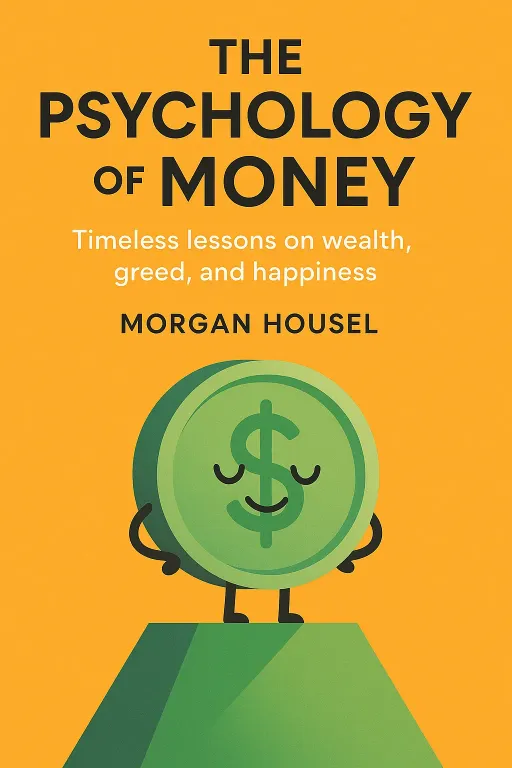
Nova: Exactly. And we are so excited to have you here, Ammar, to help us unpack these fascinating behavioral dynamics. Today, we are going to tackle Morgan Housel's brilliant book,, from three distinct angles. First, we will explore the behavioral paradox of compounding and why being reasonable is vastly superior to being coldly rational. Second, we will unmask the invisible nature of true wealth and why our brains are so easily seduced by financial doom-and-gloom. And finally, we will focus on the ultimate dividend money pays: the absolute freedom to control your own time, and how to build a margin of safety against the unexpected.
Ammar Abdullah: I love that roadmap, Nova. As an analytical thinker, I am always looking for those hidden, systemic connections across different domains. Housel's book is a goldmine for that because it shows that money is not just about spreadsheets and interest rates. It is deeply intertwined with evolutionary biology, history, and human psychology. Let us dive right into that first segment.
The Behavioral Paradox
SECTION
Nova: Let us do it. To understand why behavior beats math, we have to look at the most powerful force in finance: compounding. But compounding is incredibly counterintuitive to our linear brains. To illustrate this, Housel tells this beautiful scientific story about the ice ages. For a long time, scientists believed that massive ice ages were caused by brutally cold winters. But in the early twentieth century, a Serbian scientist named Milutin Milanković and later a Russian meteorologist named Wladimir Köppen realized something fascinating. Ice ages do not happen because of freezing winters. They happen because of moderately cool summers.
Ammar Abdullah: That is a brilliant cross-domain connection. Explain how that works, Nova.
Nova: Well, if a summer is just cool enough that it fails to melt the previous winter's snow, a thin layer of leftover ice remains. When the next winter comes, it is easier for more snow to accumulate on top of that existing base. The following summer is also cool, so even more snow stays. This leftover snowpack reflects more sunlight, which cools the earth even further, leading to more snowfall. It is a self-reinforcing feedback loop. A tiny amount of leftover snow, if it lasts, can compound over a few thousand years into a continental ice sheet.
Ammar Abdullah: That is a classic systemic feedback loop. The key variable there is not the intensity of the cold, but the fact that the snow. It is about endurance. And when you translate that geological principle to finance, you get the secret of Warren Buffett's wealth. People look at Buffett and try to copy his stock-picking formulas, but they miss the most critical factor: time. Buffett started investing when he was ten years old. By the time he was thirty, he had a net worth of one million dollars. But out of his eighty-four billion dollar fortune, over eighty-one billion was accumulated after his fiftieth birthday. His skill is investing, but his secret is time.
Nova: It really is. It is mind-blowing when you think about it. If Buffett had started investing at age thirty with twenty-five thousand dollars and retired at sixty, like a normal person, even if he still got his incredible twenty-two percent annual returns, his net worth today would be around eleven point nine million dollars instead of eighty-four billion. Ninety-nine point nine percent of his wealth is literally just the result of compounding over three-quarters of a century.
Ammar Abdullah: It shows that consistency and longevity are far more important than chasing the highest possible returns. If you chase extreme returns, you often take on extreme risks that can wipe you out, interrupting the compounding process. This brings us to a major philosophical point in the book: when making financial decisions, we should aim to be rather than.
Nova: Oh, I love this distinction. Tell us more about what that means in the real world.
Nova: To explain this, Housel uses a fascinating medical story. In the late nineteenth century, neurosyphilis was a fatal diagnosis with absolutely no cure. But an Austrian psychiatrist named Julius Wagner-Jauregg noticed a strange pattern. Syphilis patients occasionally recovered if they contracted other illnesses that caused prolonged, high fevers. So, he did something that sounds completely insane: he started injecting syphilis patients with mild strains of malaria to induce a massive fever. And it worked. The fever killed the syphilis bacteria, and then the malaria was cured with quinine. He actually won the Nobel Prize for this in 1927.
Ammar Abdullah: That is wild. Injecting someone with malaria sounds completely irrational on paper. But in that specific context, it was highly reasonable because the alternative was certain death. The fever was the body's natural defense mechanism, and Wagner-Jauregg leaned into it. In finance, academic models tell us to be coldly rational—to maximize every penny, use leverage, and optimize our portfolios mathematically. But humans are not spreadsheets. We have emotions, fears, and families.
Nova: Exactly. We need to sleep at night.
Ammar Abdullah: Precisely. Take Harry Markowitz, the pioneer of Modern Portfolio Theory who won a Nobel Prize for mathematically optimizing asset allocation. When asked how he invested his own money, he admitted he did not use his complex mathematical models. Instead, he split his contributions fifty-fifty between bonds and equities because he wanted to minimize his future regret. If the market went up, he was glad he was in; if it went down, he was glad he had bonds. Mathematically, it was sub-optimal. But behaviorally, it was highly reasonable because it kept him emotionally stable and prevented him from panicking.
Nova: That is so comforting to hear, even for a Nobel laureate. It is like Josh Brown, the financial commentator who advocates for diversified funds but still owns a few individual stocks just because he loves them. It is not about finding the mathematically perfect strategy; it is about finding the strategy that maximizes how well you sleep at night, because that is the one you will actually stick with during a market crash.
The Invisible Side of Wealth & The Seduction of Pessimism
SECTION
Ammar Abdullah: Absolutely. And that transition from visible behavior to invisible psychology brings us to our second core topic: the difference between being rich and being wealthy. Nova, you worked as a valet in Los Angeles during your college years, right? You must have seen some incredible examples of this.
Nova: Oh, you have no idea. I remember this guy, Roger, who used to come to the hotel driving a gorgeous, brand-new Porsche. He carried himself like a king, and everyone assumed he was a multi-millionaire. But then, one day, he showed up in an old, beat-up Honda. I asked him what happened to the Porsche, and he casually told me it had been repossessed because he defaulted on the loan. He had spent his entire income to rich, without actually wealthy.
Ammar Abdullah: That is a classic case of mistaking richness for wealth. Richness is current income. It is the kinetic energy of money—the visible spending on luxury cars, big houses, and fancy watches. But wealth is the potential energy. Wealth is what you do not see. It is the financial assets that have not yet been converted into material possessions. It is the unspent options, the flexibility, and the freedom to buy something later.
Nova: It is like that famous story about the singer Rihanna. She nearly went bankrupt after overspending and sued her financial advisor. The advisor's response was legendary. He said, was it really necessary to tell her that if you spend money on things, you will end up with the things and not the money?
Ammar Abdullah: It sounds so obvious, but it is a fundamental blind spot in our consumer culture. We are trained to judge financial success by what we can see. We see the Porsche, we see the mansion, and we think, wow, that person is wealthy. But we do not see their bank account or their debt. True wealth requires restraint. It is the gap between your ego and your income. But because wealth is invisible, it is incredibly hard to learn from. We can easily copy people's spending habits, but we cannot copy their saving habits because we cannot see them.
Nova: That is such a profound point, Ammar. It is like trying to learn how to exercise by only watching people eat. We see the consumption, but not the discipline behind closed doors. And this difficulty in seeing long-term, quiet progress is actually closely related to why we are so easily seduced by pessimism. Why is it that doomsday predictions always sound so much smarter than optimistic ones?
Ammar Abdullah: It is a fascinating cognitive bias. In December 2008, right in the depths of the financial crisis, a Russian professor named Igor Panarin predicted that the United States would collapse and break into six pieces by 2010. The Wall Street Journal actually published this on its front page. Of course, it did not happen. But during a crisis, people will believe almost any pessimistic narrative. Pessimism is intellectually captivating. It sounds urgent, smart, and protective. Optimism, on the other hand, is often dismissed as naive or like a sales pitch.
Nova: Yes, if you tell someone the market is going to crash by thirty percent, they will write down your name and call you a prophet. But if you tell them the market will grow by eight percent a year over the next decade, they will yawn and think you are trying to sell them a mutual fund.
Ammar Abdullah: Exactly. And there is an evolutionary reason for this. Our brains are wired to treat threats as more urgent than opportunities. As Daniel Kahneman famously showed, losses loom larger than gains. But there is also a structural asymmetry in how progress and setbacks happen. Progress happens incredibly slowly, so slowly that it is almost invisible. But setbacks happen overnight.
Nova: Right, like the Wright brothers. When they invented the airplane in 1903, almost nobody noticed. The public was so convinced that human flight was impossible that they dismissed the reports as tricks. It took years for people to realize the world had changed. Meanwhile, a plane crash or a natural disaster is reported instantly and dominates the news for weeks.
Ammar Abdullah: Yes, or look at medicine. The age-adjusted death rate per capita from heart disease has declined by more than seventy percent since 1965. That is an extraordinary, world-changing achievement that has saved millions of lives. But it happened millimeter by millimeter, through gradual improvements in diet, smoking cessation, and medical technology. There was no single Tuesday where the front-page headline read, heart disease cured. But if a new virus emerges or a hospital system collapses, it happens in days and dominates our collective consciousness. Pessimists often extrapolate current negative trends without accounting for how markets and human ingenuity adapt.
The Ultimate Dividend & Room for Error
SECTION
Nova: That is so true. We adapt, we innovate, and we solve problems. But to survive long enough to see those solutions, we have to build resilience. And that brings us to our final core topic: the ultimate dividend of money, which is control over your time, and why we must worship room for error. Ammar, Housel argues that the highest form of wealth is simply the ability to wake up every morning and say, I can do whatever I want today.
Ammar Abdullah: I completely agree, Nova. There is a mountain of psychological research showing that having a strong sense of control over your life is a far more dependable predictor of positive well-being than any objective condition of life, including your income level. Money's greatest intrinsic value is its ability to give you options. It is not about buying fancy toys; it is about buying time. If you have a financial buffer, you can wait for a better job opportunity instead of taking the first one out of desperation. You can take time off to care for a sick family member. You can retire on your own terms. That is the true return on investment.
Nova: It really is. I learned this the hard way during my college years when I got a summer internship at an investment bank. I thought I had won the career lottery because the salary was astronomical. But on my first day, I realized the cost: my boss controlled every single second of my life. I was working ninety-hour weeks, sleeping under my desk, and working weekends. I lasted exactly one month. I realized that doing something you love on a schedule you cannot control feels exactly the same as doing something you hate.
Ammar Abdullah: That is a classic psychological reaction. When we lose autonomy, we lose happiness. It is like Derek Sivers' story about his friend who worked a minimum-wage job in Manhattan but saved twelve thousand dollars by living incredibly frugally. At age twenty-two, that twelve thousand dollars gave him the freedom to quit his job, become a full-time musician, and never work a traditional job again. He was wealthier than people making six figures who were trapped in golden handcuffs. But to maintain that freedom, you have to protect yourself against the unexpected. You have to build a margin of safety.
Nova: Oh, and Housel has this incredibly vivid, almost bizarre historical example of what happens when you do not plan for the unexpected. It is from the Battle of Stalingrad in World War II. A German tank unit was kept in reserve in the grasslands outside the city. They had over a hundred tanks, all perfectly maintained and ready for battle. But when the Soviet army launched a counteroffensive, the German commanders ordered the tanks to the front lines. To their absolute horror, out of one hundred and four tanks, fewer than twenty actually worked.
Ammar Abdullah: That is a wild story. What happened to them?
Nova: Field mice. While the tanks were sitting in reserve, field mice had nested inside the vehicles and eaten away the paper insulation covering the electrical systems. The most sophisticated military machinery in the world was completely disabled by tiny rodents. The Germans had planned for fuel shortages, ammunition limits, and weather conditions, but they had not planned for mice.
Ammar Abdullah: That is a perfect illustration of a systemic failure. In engineering, they call it a single point of failure. If you only plan for the risks you can anticipate, you are leaving yourself completely vulnerable to the risks you cannot see. Risk is what is left over when you think you have thought of everything. This is why Bill Gates, in the early days of Microsoft, insisted on always keeping enough cash in the bank to pay a full year's worth of payroll, even if they received zero revenue. It was mathematically inefficient, but it made the company unbreakable.
Nova: It is about survival. If you are unbreakable, you can stick around long enough for compounding to work its magic. And that means saving money not just for a specific goal, like a house or a car, but saving simply for the sake of saving. Saving for the unknown.
Ammar Abdullah: Yes, saving for the "mice" in your life. Because the world is unpredictable, and having a cash buffer is the only way to safely navigate a world governed by odds, not certainties.
Synthesis & Takeaways
SECTION
Nova: This has been such an incredibly rich conversation, Ammar. We have covered so much ground, from the physics of ice ages to the battlefields of Stalingrad, all to understand how our behavior shapes our financial lives. If you had to synthesize the most important takeaway for our listeners today, what would it be?
Ammar Abdullah: I would say it comes down to humility and self-awareness. We need to stop treating personal finance as a math problem to be solved and start treating it as a psychological game to be managed. True financial success is not about outsmarting the market; it is about outsmarting your own ego. It is about defining what "enough" means to you, so you do not risk the things you need for things you do not even want. And it is about using your money to buy the most valuable currency in the world: control over your own time.
Nova: That is beautiful. And for everyone listening, we want to leave you with a simple challenge today. Take a look at your own life and ask yourself: what is the "Porsche" in my life that I am spending money on just to impress people who are not even looking at me? And how can I redirect that energy to build a margin of safety that helps me sleep better at night?
Ammar Abdullah: That is the ultimate question, Nova. Respect the mess of human psychology, be a little more patient, and remember that wealth is the quiet freedom of options not yet taken.
Nova: Thank you so much for joining us, Ammar, and thank you to all our listeners. Until next time, keep saving, keep compounding, and keep focusing on what truly matters.