Personalized Podcast
Golden Hook & Introduction
SECTION
Nova: Imagine a man who worked as a gas station mechanic for twenty-five years and a janitor for seventeen years. He lived in a tiny, two-bedroom house he bought for twelve thousand dollars, wore a denim jacket, and chopped his own firewood. When he died at age ninety-two, he left behind over eight million dollars, shocking his family and making international headlines. Now, contrast him with a Harvard-educated Merrill Lynch executive, a man so incredibly successful he retired in his forties to become a philanthropist. He borrowed millions to build an eighteen-thousand-square-foot mansion with two swimming pools and a seven-car garage. When the 2008 financial crisis hit, his high debt and illiquid assets crushed him, forcing him into a devastating bankruptcy. How does a humble janitor with no formal financial education completely outperform a Wall Street titan?
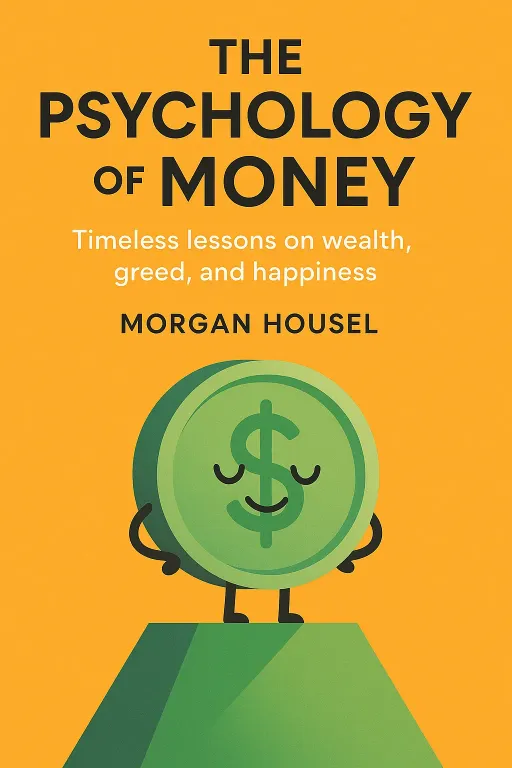
Dr.Tsadiku Getachew: It is a fascinating paradox, Nova. As someone who spent years in the highly structured, evidence-based world of healthcare, my instinct is always to look for technical mastery as the driver of success. We are trained to believe that superior intellect and advanced degrees yield superior outcomes. But Morgan Housel’s book,, completely shatters that assumption. It suggests that doing well with money is not about what you know. It is about how you behave. And behavior, as we know, is incredibly difficult to teach, even to the smartest people in the room.
Nova: Exactly. We love to think of finance as a hard science, like physics or chemistry, where if you follow the formula, you get the exact same result every time. But in reality, it is a soft skill. It is about human emotions, greed, fear, and ego. And today, we are so excited to have you here, Dr. Tsadiku. You are navigating the thrilling, high-stakes world of early-stage healthcare entrepreneurship, aiming to build a multimillion-dollar business. Today, we are going to tackle Housel's insights from three distinct angles. First, we will look at the startup survival paradox—the difference between getting wealthy and staying wealthy. Second, we will dive into the law of "long tails" and why most of your business experiments will fail, and why that is actually perfectly okay. And finally, we will focus on how to build an unbreakable margin of safety to protect your venture from the unexpected. Ready to dive in?
Dr.Tsadiku Getachew: Absolutely, Nova. Let us dissect these systems. As an ISTJ, I appreciate breaking down complex behavioral patterns into logical, actionable frameworks. Let us start with the survival paradox.
The Startup Survival Paradox
SECTION
Nova: Let us do it. Housel writes that getting money and keeping money are two entirely different skills. Getting money requires taking risks, being optimistic, and putting yourself out there. But keeping money? That requires the exact opposite. It requires humility, a little bit of paranoia, and accepting that at least some of your success was due to luck, which means you cannot rely on the same risks to keep you afloat. To illustrate this, Housel tells the tragic story of Jesse Livermore. Back in 1929, he was one of the most successful stock traders in the world. When the market crashed on Black Tuesday, wiping out almost everyone, Livermore had actually shorted the market. He made a hundred million dollars in a single day. He went home to his family, who thought they were ruined, and told them they were wealthier than ever. But then, overconfidence crept in. He felt invincible. He took bigger and bigger risks, ignored his own rules, and within four years, he lost every single penny and ended up taking his own life.
Dr.Tsadiku Getachew: That is a sobering story, Nova. It highlights a critical vulnerability for entrepreneurs, especially in the healthcare sector. When we launch a startup, we have to be intensely optimistic. We are trying to solve complex clinical problems, navigate regulatory hurdles, and convince investors to back our vision. That requires a high tolerance for risk. But once you secure that initial funding or start generating revenue, the game changes. You have to transition from an offensive mindset to a defensive one. In healthcare, your burn rate can destroy you overnight. If you assume that your early success guarantees future cash flow, you will over-hire, over-expand, and ignore the quiet, creeping risks of compliance changes or insurance reimbursement delays.
Nova: Oh, that is such a great point. It is like having a "barbelled" personality, right? You have to be optimistic about the long-term future of your healthcare business, but deeply paranoid about what will get you through to tomorrow. Housel actually talks about another investor named Rick Guerin. He was part of a famous trio in the 1970s alongside Warren Buffett and Charlie Munger. All three were brilliant at finding undervalued companies. But during the 1973-1974 recession, Guerin used margin loans—basically borrowed money—to leverage his investments. When the market plummeted seventy percent, he faced massive margin calls. He was forced to sell his Berkshire Hathaway stock to Buffett for a measly forty dollars a share just to pay back his loans. Buffett and Munger survived because they did not use leverage. They stayed in the game. Guerin was just as smart, but he did not have that survival mindset.
Dr.Tsadiku Getachew: Yes, and that is the key distinction. Survival is the ultimate metric. In medicine, we talk about patient survival as the baseline before we can talk about thriving or long-term wellness. The same applies to business. If you do not survive the lean years, the compounding effect of your business growth never has time to work its magic. Guerin's mistake was a lack of financial resilience. He optimized for maximum returns in the short term, which left him fragile. For an early-stage entrepreneur, being "unbreakable" is far more valuable than hitting a home run in year one. If you are unbreakable, you can stick around long enough for your market fit to mature.
Nova: We love that term, "unbreakable." It is not about being timid; it is about being strategically durable. If you do not have to sell your assets or shut down during a downturn, you win by default just by remaining standing when everyone else has collapsed.
The Tail-Driven Venture
SECTION
Nova: This brings us to our second core topic: the law of "long tails." This is one of the most mind-blowing concepts in the book. Housel argues that in business, investing, and life, a tiny number of events drive the vast majority of outcomes. We tend to think that successful people make great decisions all the time, but the math says otherwise. Take venture capital, for example. Correlation Ventures analyzed over twenty-one thousand startup investments. They found that sixty-five percent of them lost money. Only two and a half percent made a ten-to-twenty-times return, and a mere half a percent—about one hundred companies—earned fifty times or more. That tiny half a percent is what drives the entire industry's returns.
Dr.Tsadiku Getachew: This is incredibly liberating for an analytical thinker, Nova. In clinical medicine, we strive for a zero-percent error rate. A single mistake can have catastrophic consequences for a patient. So, when clinicians transition into entrepreneurship, they often carry this perfectionist baggage. They expect every marketing campaign, every product feature, and every new hire to be a perfect success. But Housel is showing us that business is not a clinical trial with a controlled environment. It is a tail-driven system.
Nova: It really is. Even Walt Disney experienced this. By the mid-1930s, Disney had produced over four hundred cartoons. Most of them were short, beloved by audiences, but financially disastrous. The studio was drowning in debt. Then, Disney risked everything on a single, full-length animated film:. It was eighty-three minutes of film that changed everything. It made eight million dollars in 1938, paid off all the studio's debts, and funded a state-of-the-art studio in Burbank. Hundreds of hours of previous work were practically irrelevant compared to that one massive tail event.
Dr.Tsadiku Getachew: Exactly. And as an entrepreneur, you have to design your business to survive the ninety-nine failures so you can benefit from the one. In healthcare, this might mean testing multiple digital health pilots, or exploring different patient acquisition channels. You have to accept that most of them will underperform. If you expect a hundred percent success rate, you will pull the plug too early, or worse, you will be too terrified to experiment at all. The key is to make sure that your failures are small and survivable, while your successes have unlimited upside.
Nova: Yes, "fail small, win big." Even Warren Buffett admitted that he has owned four hundred to five hundred stocks in his lifetime, but he made the vast majority of his money on just ten of them. Charlie Munger added that if you remove just a few of Berkshire’s top investments, their long-term track record is actually pretty average. If the greatest investor of all time is only right a fraction of the time, we should definitely cut ourselves some slack when our early business ideas do not pan out.
Dr.Tsadiku Getachew: It is a shift from deterministic thinking to probabilistic thinking. As an ISTJ, I like to map out processes. But I have to accept that the process map must include a high failure rate for individual nodes. The goal is not to avoid failure; it is to ensure that no single failure can cause a systemic collapse.
The Entrepreneur's Margin of Safety
SECTION
Nova: That is the perfect bridge to our third topic: the margin of safety, or what Housel calls "room for error." He argues that the only way to navigate a world governed by odds, not certainties, is to build a gap between what you expect to happen and what happen. And this is not just a conservative hedge; it is a strategic advantage. To show how unexpected things can be, Housel tells this wild story from World War II. During the Battle of Stalingrad, a German tank unit sat in reserve in the grasslands outside the city. When they were finally ordered to the front lines, they discovered that out of one hundred and four tanks, fewer than twenty were actually operable. Why? Because during their weeks of inactivity, field mice had nested inside the vehicles and eaten away the insulation covering the electrical systems. The most sophisticated military technology of its time was completely neutralized by mice.
Dr.Tsadiku Getachew: I love that story because it perfectly illustrates that the biggest risks are always the ones you do not see coming. In business planning, we often create financial models based on historical data. We assume our revenue will grow by ten percent, or our customer acquisition cost will remain stable. But those models do not account for the "mice"—the global pandemic, the sudden regulatory shift, or a key employee leaving. If your business plan requires perfect execution to survive, it is fragile.
Nova: It is so fragile. Housel points out that when people estimate their budgets, like in home renovations, they are incredibly biased. A study by Harvard psychologist Max Bazerman showed that when looking at other people's projects, we easily predict they will run twenty-five to fifty percent over budget. But when it comes to our own projects, we confidently assume we will finish on time and under budget. We underestimate our own vulnerability to the unexpected.
Dr.Tsadiku Getachew: We do. And in early-stage healthcare, those unexpected delays are almost guaranteed. Credentialing with insurance companies can take six months instead of two. FDA approvals can get delayed. If you do not have a margin of safety—specifically in your cash reserves—you will run out of oxygen right before you reach the summit. This is where Bill Gates’ early philosophy at Microsoft is so instructive. He insisted on always keeping enough cash in the bank to pay a full year's worth of payroll, even if they received zero revenue. That is an extraordinary margin of safety for a young, fast-growing tech company.
Nova: It really is. Most modern venture capitalists would look at that cash sitting idle and scream, "That is inefficient! You should be investing that to grow faster!" But Gates knew that survival was more important than efficiency. That cash buffer allowed Microsoft to make bold moves without the fear of bankruptcy hanging over their heads. It gave them peace of mind.
Dr.Tsadiku Getachew: And peace of mind has an infinite return on investment, Nova. For an entrepreneur, cash is not just an asset that earns low interest in a bank account. Cash is options. Cash is time. If a crisis hits, the founder with no cash is forced to make desperate, short-term decisions—like taking high-interest debt or selling equity at a massive discount. The founder with a cash buffer can remain calm, think strategically, and wait for the market to recover. It turns a potential catastrophe into a minor inconvenience.
Nova: Yes. Volatility is not a fine for doing something wrong; it is just the fee you have to pay to get those long-term, multimillion-dollar returns. And having that cash buffer is what allows you to pay that fee without going broke.
Synthesis & Takeaways
SECTION
Nova: This has been such an incredibly rich conversation, Dr. Tsadiku. We have covered so much ground. We talked about how staying wealthy requires a completely different skillset than getting wealthy—one rooted in humility and paranoia. We explored the law of long tails, realizing that a few big wins will carry us through a sea of small, survivable failures. And we unpacked the absolute necessity of a margin of safety, treating cash not as idle efficiency, but as strategic oxygen.
Dr.Tsadiku Getachew: It really comes down to a fundamental shift in how we define wealth, Nova. True wealth is not about showing off expensive cars or massive houses—which Housel calls the "Man in the Car Paradox," where we admire the car but ignore the driver. True wealth is the ability to wake up every morning and say, "I can do whatever I want today." It is control over your time. For any entrepreneur listening, especially those in healthcare, my advice is to build your business systematically. Protect your downside, worship room for error, and let the power of compounding do the heavy lifting.
Nova: That is a beautiful note to end on. Thank you so much for sharing your analytical brilliance and your heart with us today, Dr. Tsadiku. And to our listeners: what is one area in your business or personal finance where you are running too close to the edge? How can you build a margin of safety today to protect your tomorrow? Think about it, take action, and we will see you next time.