The Structural and Psychological Pillars of Wealth
Golden Hook & Introduction
SECTION
Nova: Most people treat personal finance like a complex math equation where if you just find the right variable, you’ll solve for wealth. If that were actually true, accountants would be the wealthiest people on the planet.
Atlas: Right, and yet, here we are. It’s a bit of a harsh reality check, isn't it? If the math was the only thing that mattered, the classroom would be the training ground for billionaires. But we know that’s not how the world works.
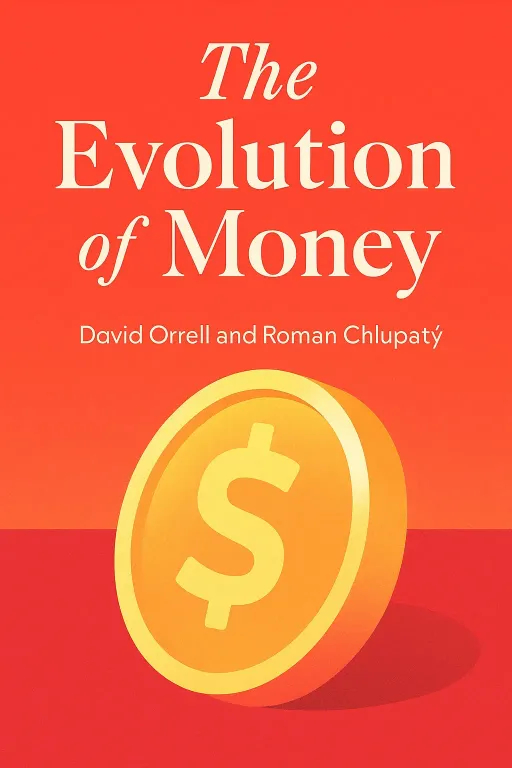
Nova: Exactly. It’s not about finding the perfect spreadsheet. Today, we’re looking at why that is by combining two heavy hitters in the financial literature space. We’re diving into The Evolution of Money by David Orrell and Roman Chlupatý, and The Psychology of Money by Morgan Housel.
Atlas: I love this pairing. It feels like we’re getting the macro and the micro in one go.
Nova: That’s the goal. Orrell and Chlupatý take us on this wild ride through history, showing us that money isn't some fixed physical law—it’s a social network agreement that’s been evolving since the days of Mesopotamian credit systems. Meanwhile, Housel brings it all the way home, proving that doing well with money has almost nothing to do with how smart you are and everything to do with how you behave.
Atlas: So, one book tells us the rules of the game, and the other tells us how to stop tripping over our own feet while playing it. Let’s start with that big picture. If money is just a network agreement, how does that change the way we should look at our own portfolios?
Systemic Evolution and the Network Agreement
SECTION
Nova: Think about where money comes from. We tend to think of it as a tangible thing, like gold or government-printed paper. But Orrell and Chlupatý point out that money is actually a form of social trust. In ancient Mesopotamia, they didn't just trade sheep for grain. They used clay tablets to track credit. It was a ledger system.
Atlas: So, it was basically the world’s first blockchain, just etched in mud.
Nova: Precisely. And that’s the key realization. Whether it’s a clay tablet, a gold coin, or a decentralized digital asset, money is only as valuable as the network of people who agree to honor it. It’s a system of collective belief. When you zoom out, wealth isn't just about accumulating stuff. It’s about understanding the current iteration of that agreement.
Atlas: That’s a fascinating way to frame it. For anyone listening who feels overwhelmed by the complexity of modern finance, that perspective is actually kind of liberating. It means the system isn't some immutable force of nature. It’s a living, breathing, evolving structure.
Nova: It is. And the danger for most people is trying to fight the system or beat it, rather than understanding its mechanics. If you treat money as an objective truth that you can outsmart, you’ll lose. But if you see it as a network that you can participate in, you start to see opportunities for efficiency.
Atlas: But isn't that where it gets risky? If the system is just an agreement, it feels fragile. How do we build something sustainable when the very foundation—the network—is constantly shifting?
Nova: That’s the million-dollar question. And that’s where the shift from the macro to the micro happens. You can't control the evolution of global currency, but you can control how you position yourself within that network. The systemic view tells you that wealth is a network agreement, but the behavioral view tells you that you are the only variable you can actually optimize.
The Behavioral Reality and the Human Variable
SECTION
Atlas: Okay, let’s pivot there, because that’s where things get really messy. We’ve established that money is a system, but humans are predictably irrational. Morgan Housel’s work is legendary for highlighting this. What is the biggest trap most high-performers fall into when they try to apply logic to their finances?
Nova: The biggest trap is the illusion of control. Housel tells this incredible story about the man in the car. You see someone driving a fancy, expensive sports car, and your immediate instinct is to think, that person is rich, or that person is successful. You assume their financial life is in perfect order.
Atlas: And that’s a total assumption.
Nova: Completely. You have no idea what their debt looks like, what their stress levels are, or if they’re one bad month away from total collapse. Housel’s point is that we judge wealth by what we see, but true wealth is often what we don’t see. It’s the money that wasn’t spent. It’s the savings that aren't visible.
Atlas: That resonates deeply. It’s the difference between looking rich and being wealthy. For people who spend their careers building technical expertise or systems, it’s frustrating. We want a direct input-output relationship. Put in hard work, get out financial security. But Housel suggests that the input is actually discipline and patience, not just effort.
Nova: Exactly. And that’s the hardest part for the analytical mind to accept. We want to optimize everything. We want to find the perfect asset allocation, the perfect time to enter the market, the perfect tax strategy. But Housel shows us that doing well with money is more about avoiding ruin than it is about maximizing gains.
Atlas: That’s a major shift. Instead of playing to win, you’re playing to not lose.
Nova: Precisely. It’s about survival. Think about the concept of room for error. If you’re an architect building a bridge, you don't build it to handle exactly the weight of the cars you expect. You build it to handle three times that weight. You leave room for the unexpected. Housel argues we need to do the same with our personal finances.
Atlas: That makes perfect sense. But how do we bridge that? How do we take this systemic understanding from Orrell and Chlupatý—the idea that money is a network agreement—and marry it with Housel’s behavioral discipline?
Synthesis and Building Wealth Architecture
SECTION
Nova: The synthesis is what I like to call Wealth Architecture. You look at the system—the macro—and you build a framework that doesn't rely on your daily willpower. You automate the network participation.
Atlas: So, you’re saying we should take the human element out of the equation as much as possible?
Nova: In a way, yes. You use your analytical mind to design a system that works while you sleep. You don't try to beat the market; you participate in the network. You set up automated investments, you build in that room for error, and then you step back. You stop checking the price of your assets every day, because that’s where the behavioral, emotional mistakes happen.
Atlas: I love that. It’s like, use your intelligence to design the system, but then use your discipline to stay out of the system’s way.
Nova: That’s it. Most people spend their energy trying to micromanage their money, which is just a recipe for anxiety. If you understand that money is a social agreement, you realize you don't need to be a genius to benefit from it. You just need to be consistent.
Atlas: It’s funny, because the more we talk about this, the more it sounds like building a career or a business. You set up a foundation, you build processes, and then you let them compound.
Nova: It’s identical. Compound interest isn't just a financial concept; it’s a life principle. The same way your technical skills compound over time if you keep learning, your wealth compounds if you keep the system running and don't panic.
Atlas: So, for the listener who’s sitting there thinking, okay, I get the theory, but what do I do tomorrow morning? What’s the first step in this architecture?
Nova: Start with an audit of your habits, not your assets. Look at where you’re trying to be clever. Are you trying to time the market? Are you trying to pick the next big thing? If so, stop. Replace that effort with a simple, boring, automated framework. Move that mental energy toward something that actually compounds—your health, your skills, or your network.
Atlas: That’s a great challenge. It’s basically telling people to stop trying to be the smartest person in the room and start being the most disciplined person in the room.
Nova: And there’s a massive difference. The smartest person might find a shortcut that works for a year. The disciplined person finds a path that works for a decade.
Atlas: I think that’s the takeaway that’s going to stick with me. We’re often so obsessed with the "how" of making money that we forget the "why" of keeping it.
Synthesis & Takeaways
SECTION
Nova: It really comes down to this: Wealth is a game of endurance, not a sprint for intelligence. If you can understand the systemic nature of money—that it’s a shared belief—you’ll stop fearing its volatility. And if you can master your own behavioral responses, you’ll stop sabotaging your own growth.
Atlas: It’s the perfect combination. The macro-perspective gives you the confidence to participate, and the micro-perspective gives you the discipline to stay the course.
Nova: Exactly. And just remember, the goal isn't to be the richest person in the room. The goal is to be the one who owns their time. Because ultimately, the only real currency we have is the time we get to spend on our own terms.
Atlas: That’s a powerful thought to end on. If you’re listening, take those ten minutes today. Look at your financial system—is it designed for you, or are you just reacting to it? Simplify it, automate it, and then get back to the work that actually matters.
Nova: We’re so glad you joined us for this deep dive. If this sparked a new way of looking at your own wealth architecture, we’d love for you to pass this episode along to someone else who might be overcomplicating their financial life.
Atlas: Until next time, keep building those systems and staying the course.
Nova: This is Aibrary. Congratulations on your growth!