Beyond the Balance Sheet: Understanding the Psychology of Money.
Golden Hook & Introduction
SECTION
Nova: What if I told you that your financial success isn't primarily about how smart you are, or even how much you earn, but actually about something far more unpredictable and deeply human?
Atlas: Whoa, that's a bold claim, Nova. I think most people, especially those of us trying to plan our futures, believe it's all about the spreadsheets and the savvy market moves. Are you saying my carefully constructed budget is just... a suggestion?
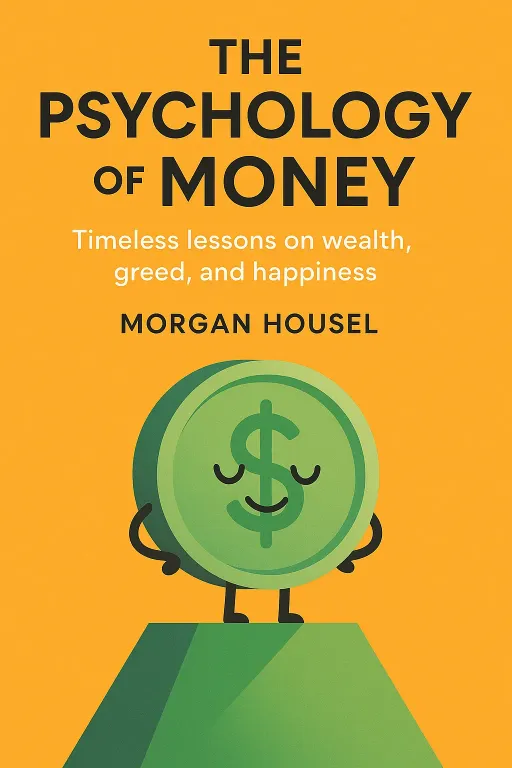
Nova: Not a suggestion, Atlas, but perhaps a map with some unexpected detours you didn't account for on the planning phase. Today, we're cracking open two groundbreaking books that fundamentally shift how we view wealth: "The Psychology of Money" by Morgan Housel, and "Thinking, Fast and Slow" by Nobel laureate Daniel Kahneman.
Atlas: So, we're not just talking about numbers on a spreadsheet, are we? This is about the squishy stuff between our ears.
Nova: Exactly. Housel's powerful insight is that managing money is far more about behavior than intelligence, and Kahneman, with his Nobel Prize-winning work, gives us the scientific framework for our behavior is often so irrational. It's a fascinating look at the internal forces driving our external financial realities.
Atlas: Okay, I'm intrigued. So, where do we even begin to untangle this web of human behavior and cold hard cash?
The Blind Spot: Why Financial Decisions Aren't Purely Logical
SECTION
Nova: We begin with what I like to call 'The Blind Spot.' It's the pervasive belief that financial decisions are, or at least be, purely logical, driven by data and facts. We gather information, we analyze, we calculate, and then we make the optimal choice, right?
Atlas: That's the ideal, isn't it? The goal of any smart investor or planner is to remove emotion from the equation, to be a rational actor.
Nova: Absolutely. But the reality is, money is rarely just about math. It's deeply tied to our emotions, our past experiences, and a whole host of unconscious biases. Think about it: imagine someone who lived through a really tough economic downturn in their childhood, maybe their family lost everything.
Atlas: Oh, I know that feeling. I imagine a lot of our listeners have felt the ripple effects of economic instability, whether personal or global.
Nova: Exactly. Now, fast forward decades later. The market takes a small dip, nothing catastrophic, but suddenly, that person feels an overwhelming urge to sell. They panic. Their rational brain knows it's a minor correction, but their gut, that deeply ingrained fear from childhood, screams 'Get out now before you lose it all again!'
Atlas: That gut-wrenching panic. I can definitely relate to that kind of primal reaction. But why do we keep falling for it? Isn't it obvious when we're doing it?
Nova: It's rarely obvious in the moment, Atlas. That's the blind spot. We rationalize it the fact. We tell ourselves, 'Oh, I saw the signs,' or 'It was a logical move to protect my assets,' when really, an old fear was pulling the strings. This ignoring of the human element, this belief that we're always calculating machines, can lead to incredibly costly mistakes and missed opportunities. It’s like trying to navigate a dense fog with only a compass, ignoring the fact that you can’t see five feet in front of you.
Atlas: So it's less about the numbers on the page and more about the narrative we're telling ourselves, often subconsciously, about those numbers.
Nova: Precisely. And that narrative is shaped by everything from our upbringing to our personality to sheer luck. Our personal history and unique perspectives shape our financial choices, often in truly irrational ways. And that leads us to the 'why' behind this blind spot.
Unpacking the 'Why': Behavioral Economics and Cognitive Biases
SECTION
Atlas: So, we know we have this blind spot. But how do we actually understand what's happening inside our heads when we make these calls? What's the mechanism behind the panic selling, or the irrational exuberance?
Nova: This is where Housel and Kahneman really shine. Housel reveals that managing money is more about behavior than intelligence. He shows how our personal histories and unique perspectives shape our financial choices. Kahneman, on the other hand, gives us the scientific framework for these behaviors manifest, explaining the two systems that drive our thinking.
Atlas: Two systems? Like, a good cop and a bad cop in our brains?
Nova: Kind of! Kahneman describes them as System 1 and System 2. Think of System 1 as the fast, intuitive, emotional, almost automatic part of your brain. It’s what allows you to recognize a friend’s face instantly or slam on the brakes without thinking. It's efficient, but prone to biases.
Atlas: Like when you see a 'Limited Time Offer!' and your hand reaches for your wallet before you've even processed if you need it.
Nova: Exactly! That's System 1 in action. It's fantastic for quick decisions, but not always for complex financial planning. System 2, on the other hand, is slow, deliberate, logical, and requires effort. It's what you use to solve a complex math problem, or to carefully weigh the pros and cons of buying a house.
Atlas: So, System 1 is like driving a familiar route on autopilot, and System 2 is like navigating a completely new city with a detailed map, having to concentrate on every turn.
Nova: That’s a perfect analogy! Now, imagine a financial situation where System 1 really takes the wheel, and System 2 is just along for the ride. Let's say you bought a stock based on a friend's hot tip. It immediately drops 10%. Your System 1, driven by 'loss aversion'—the psychological pain of losing something being greater than the pleasure of gaining an equivalent amount—screams "Sell it now!" You don't want to admit you made a mistake, or you don't want to see the loss get bigger.
Atlas: Oh, I've been there. The rational part of you knows you should probably hold, or at least re-evaluate, but that feeling in your stomach just wants to make the pain stop.
Nova: And that's the powerful influence of System 1. It hijacks the logical part of your brain. Or consider 'confirmation bias'—we tend to seek out information that confirms our existing beliefs. If you believe a certain company is going to boom, you'll naturally gravitate towards news articles and opinions that support that belief, ignoring any red flags. Your System 1 is building a comfortable, but potentially dangerous, echo chamber.
Atlas: So, knowing all this, how do we, the 'Pragmatic Planners' and 'Curious Investors' out there, actually use this to our advantage? How do we stop our brains from sabotaging our bank accounts?
Synthesis & Takeaways
SECTION
Nova: It’s not about eliminating System 1; that’s impossible and often beneficial. It’s about recognizing when it’s at play, and consciously engaging System 2 for critical financial decisions. True financial wisdom isn't just about understanding market trends or economic indicators; it's about understanding. It's about knowing your own biases, your emotional triggers, and your default reactions.
Atlas: So it's less about having a perfect financial model and more about having a really good model of? That's actually really inspiring, because it puts the power back in our hands.
Nova: Absolutely. It empowers you to build more resilient and rational money habits. It’s about pausing before that impulse buy, questioning that gut feeling to sell, and consciously seeking out diverse information, even if it challenges your initial assumptions. It's about proactively designing your financial life to mitigate the inevitable irrationality of being human.
Atlas: That gives me chills. It transforms financial planning from a cold, hard numbers game into a journey of self-discovery.
Nova: It truly does. And it leaves us with a powerful question, one that holds more financial wisdom than any stock chart: How have your past experiences or emotions shaped a significant financial decision you've made, for better or worse? Reflect on that. Understanding your own mind is the most valuable investment you can make.
Atlas: That's a perfect example of focusing on what we can control. For anyone out there looking to master their daily money flow or start growing their wealth, understanding these underlying psychological currents is step one.
Nova: It's the foundation of everything. This is Aibrary. Congratulations on your growth!